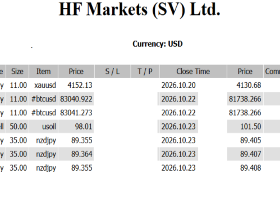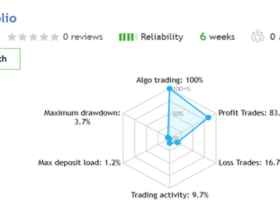

Prop firm marketing shows you the success stories. The Discord screenshots. The $50,000 funded account. The grinning trader holding a payout certificate.
What they never show you is the formula.
Because once you actually multiply the variables — pass rate × payout probability × time spent — the picture stops looking like opportunity and starts looking like one of those casino machines that pay out just often enough to keep the chairs full.
Most traders buying challenges in 2026 have never done this math. They calculate the upside ("if I pass, I get $50k buying power") and ignore the three variables that determine whether they'll actually pocket a dollar.
So let's do the math nobody's done for you. Then I'll show you what the same calculation looks like when the business model doesn't depend on your failure.
The Three Variables Nobody Mentions
Every prop firm sales page leans on the same hook: "trade up to $200,000 in funded capital." The hook works because most prospective buyers stop calculating at "if I pass." Here's what they leave out.
Variable 1: Pass Rate
Industry pass rates across major prop firms publicly cluster in the 8-15% range across two-phase evaluations. FTMO has historically reported figures in this band on their own statistics page. Most competitors don't publish at all, which is its own data point.
Translation: for every 100 evaluation purchases, 85-92 end without a funded account. The buyer doesn't lose money on a trading mistake — they lose the evaluation fee, full stop. The firm's revenue model assumes this. It's not a bug.
Variable 2: Payout Probability After Passing
Here's the part that breaks the spreadsheet for most buyers.
Passing isn't the end of the gauntlet. Funded accounts come with continuing rules — trailing drawdowns, consistency clauses ("no single day's profit can exceed X% of total"), profit splits, and minimum trading days. Some funded accounts get reset for breaching a rule the trader never read carefully. Some payouts get delayed or voided post-fact for "violating consistency."
How often does a funded trader actually receive multiple withdrawals over 12 months? The industry doesn't publish that number — and the silence is itself the answer. Anecdotally, the gap between "passed evaluation" and "received a second payout" is where most funded careers quietly die.
Variable 3: Time Spent
A two-phase evaluation typically takes 30-60 days minimum. If you fail and re-attempt, multiply. A trader doing four attempts a year burns four to eight months of focused effort, often on rules-driven trading that has nothing to do with their actual edge — and statistically lands with $0 to show for it.
Time isn't a sunk cost. It's the rarest resource a trader has.
A Worked Example (Conservative Assumptions)
Let's run a concrete scenario. We'll be generous to the prop firm side and see what falls out.
The trader: Attempts 4 challenges per year at $155 each (FTMO $10k Swing pricing as a reference point). Annual fee outlay: $620.
Pass rate assumed: 10% (the optimistic end of publicly available stats). Expected passes per year: 0.4. In plain English: most years, this trader passes zero challenges. Roughly every other year, one passes.
If they pass: Funded $10k account, generating an optimistic 5% monthly return ($500/month). After typical 80/20 profit split favoring the trader, that's $400/month per active funded account. Realistic active months before something triggers a reset or consistency violation: 3-6 months. Total trader-side payout per successful pass, optimistically: $1,200 to $2,400.
Expected annual payout = 0.4 passes × $1,800 average = $720.
Net before time: $720 payout − $620 fees = +$100 per year.
Now subtract the time. 4 challenges × 45 days average = 180 days of focused effort. For $100 net. That's $0.55 per day of attention.
And those numbers are generous. Real-world pass rates are often lower, real payouts often shorter, and the time cost real. Tighten any one assumption and the expected value flips negative. Loosen any one and it's still not a career.
This is the math the marketing pages skip.
What The Alternative Math Looks Like
Here's the contrast. Real Axi Select payouts — three are mine, the rest are anonymized examples Axi shares as proof points, names hidden for privacy: 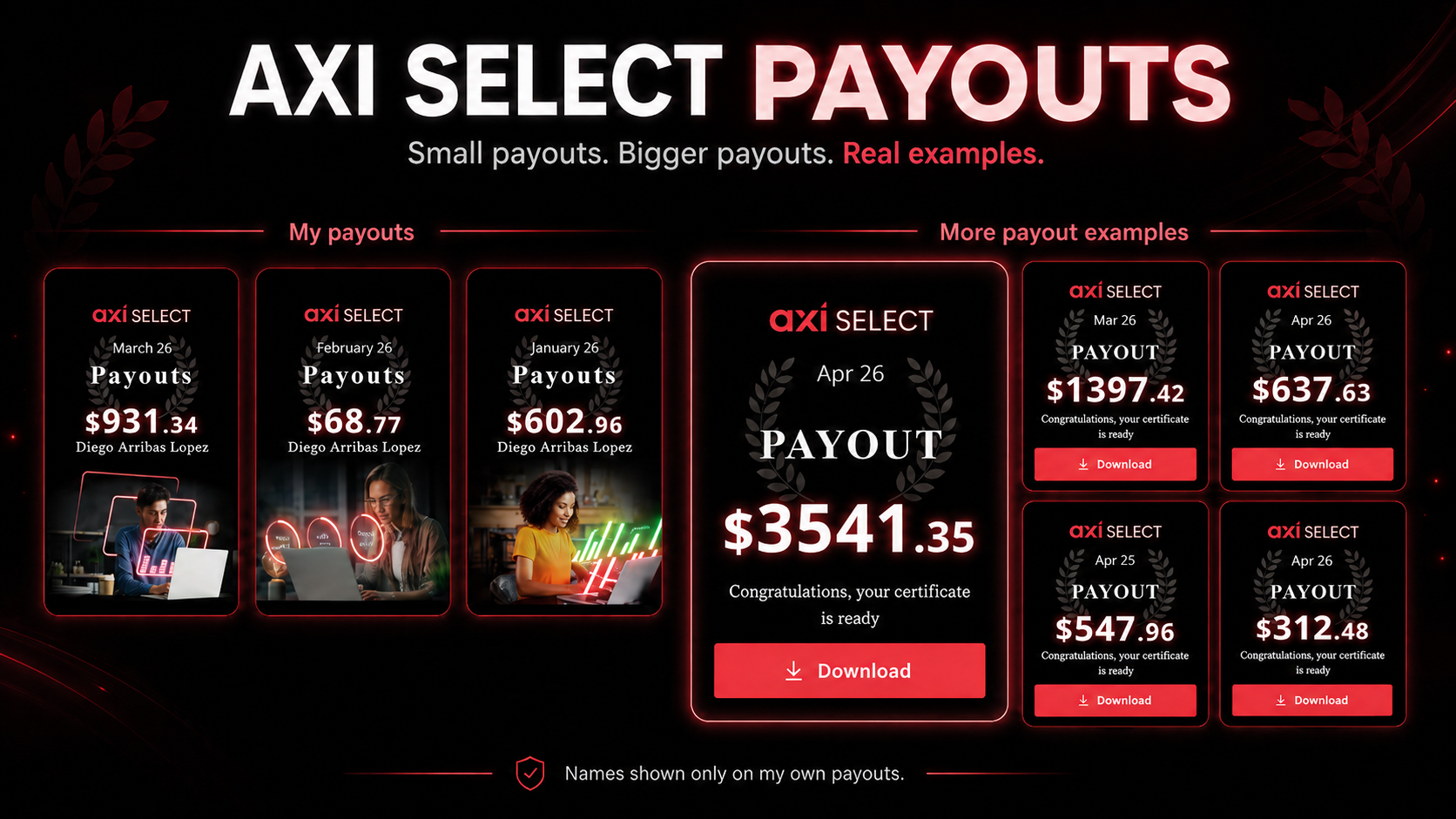
What changes in the formula:
- No evaluation fee. You deposit your own minimum ($500), keep it, and trade your normal strategy. Fee variable: zero.
- No artificial pass/fail. Your Edge Score builds based on actual trading quality (skill, consistency, risk discipline, sample size). There's no $50k account that gets nuked because you had a 4.2% drawdown day instead of a 4.0%.
- Payout probability isn't gated by gotcha rules. If you trade well, capital gets allocated to copy your trades and pays out on real performance. The spread of payouts in that image — $312 to $3,541 across different traders — reflects different allocation sizes and account stages, not lottery outcomes.
- Time cost goes toward your own equity. Every day you trade your $500+ account is a day building real history on a real Myfxbook (or equivalent) record — capital and track record you keep regardless of where the funding path goes next.
Same trader, same skill level, two different business models. One has to manufacture failure to stay solvent. The other has to keep you trading well to keep generating spread revenue. Pick the one whose math doesn't require your failure.
When Prop Firms Still Make Sense
I'm not anti-prop-firm reflexively. There are scenarios where the math works out, and being honest about them strengthens the rest of the argument.
You treat the fee as paid education. If you genuinely intend to learn risk management by having artificial rules enforced on you for 30 days, and you're treating the $155 like a course fee rather than an investment, the lesson can be worth it. Just call it what it is.
You have a verified system that consistently passes. If you've already passed two challenges and your strategy has measurable edge under the evaluation rules, prop firms become a tool — leverage on top of your own capital. The math flips when pass rate (for you) is closer to 70-80% than to industry average.
You're a short-burst swing trader. Some evaluation formats (FTMO Swing, for instance) suit traders who can produce a sharp profit run in 30 days and don't need long-term capital allocation. If that's your actual style, the model fits.
For everyone else — the 80% of buyers who match the industry pass rate, not the lucky tail — the math says stop buying challenges and start building on a model where the broker profits because you trade well, not because you fail.
Where To Start
If the formula above made you stop and recalculate, here's the off-ramp:
- Open an Axi Select account through this link: Axi Select — no challenge fees, real Edge Score, public stages
- Deposit your own $500 minimum and trade your verified strategy normally.
- Hit 20 closed trades + Edge Score 50+ to unlock Seed stage allocation up to $5,000.
- Need to escalate any issue? Message me. As an active affiliate I have direct manager contact at Axi — typical resolution is 2-5 days versus 1-3 weeks via generic support.
If you don't yet have a verified strategy, start with the Free USDJPY MT5 module — no cost, proper risk management baked in, the kind of EA you build a real Edge Score on. And if you want updates when new broker setups, AI frameworks, and payout proofs land that don't fit a blog post, join the newsletter — one email a week.
Frequently Asked Questions
What is a typical prop firm pass rate in 2026?
Publicly reported figures across major firms cluster in the 8-15% range for two-phase evaluations, with FTMO historically the most transparent source on its own statistics page. Most competitors don't publish — which is its own signal. Assuming above 15% is generous; below 8% is realistic for newer/stricter firms.
How do prop firms actually make money?
Primarily from evaluation fees paid by traders who don't pass. Secondary revenue comes from spread markups on funded accounts and from re-attempt fees. The model only scales because most participants don't complete the funded-payout cycle. If pass rates were 60-80%, the unit economics would collapse — which is why the rules are calibrated to produce the rates they produce.
Is Axi Select better than FTMO for AI traders?
For traders running EAs or AI-driven systems, Axi Select tends to fit better because there's no challenge with artificial rules to dodge (consistency clauses, prohibited news trading, etc., that an automated system can stumble into without context). You trade your normal strategy from day one, your Edge Score reflects real behavior, and capital allocation scales with proven consistency. Different model entirely.
Why don't most prop firms publish their payout-to-trader rates?
Because the number is the giveaway. If "% of funded traders who receive at least three payouts in 12 months" were healthy, every firm would publish it on the homepage. The silence is a clue about which way the variable lands. Until firms publish, assume the gap between "passed evaluation" and "received sustained payouts" is wide.
Can I trade with Axi Select while still running a prop firm account?
Yes — they're separate accounts at separate institutions with no exclusivity clause. Many traders run both initially to test which model fits their workflow, then concentrate capital and attention on whichever produces real withdrawals. Your own $500 deposit at Axi Select stays yours regardless of where the prop firm side ends up.