Why Most Gold EAs Fail After 3 Months — The Regime Mismatch Problem

In the MQL5 ecosystem, it is not uncommon to see a newly launched gold Expert Advisor deliver impressive early results—only to deteriorate within a matter of weeks or months. The equity curve begins with consistency, sometimes even acceleration, and then gradually flattens before entering a phase of drawdown or stagnation. This pattern is so widespread that it is often attributed to overfitting or poor risk management. While those factors can contribute, they are not the primary cause. The more fundamental issue is regime mismatch.
Gold, particularly XAUUSD, is not a static market. It does not behave consistently across time. Instead, it transitions between distinct structural conditions—what can be described as market regimes. These regimes define how price moves, how volatility manifests, and how liquidity is distributed. Any trading system that does not explicitly account for these shifts is effectively making a single assumption about market behavior and applying it universally. That assumption will eventually break.
A market regime, in the context of gold, refers to a persistent state of price behavior. There are periods where gold trends cleanly, often driven by macroeconomic flows, central bank expectations, or geopolitical developments. In such phases, directional momentum is sustained, pullbacks are shallow, and continuation patterns dominate. There are also compression regimes, where price oscillates within tight ranges, liquidity becomes fragmented, and directional follow-through is limited. Between these extremes lie transitional states—volatile expansions where range boundaries break but structure is not yet stable.
The problem for most Expert Advisors is that they are implicitly designed for only one of these conditions. A trend-following system, for example, performs exceptionally well during sustained directional movement. It captures continuation, scales into strength, and compounds effectively. In a trending regime, such systems can produce a near-linear equity curve. However, when the market transitions into compression, the same logic becomes fragile. Breakouts fail, follow-through disappears, and entries are repeatedly invalidated within a few candles. The system begins to accumulate small losses, not because it is incorrectly coded, but because the underlying assumption—persistent directionality—is no longer valid.
The inverse is equally problematic. Mean-reversion systems are built on the expectation that price will oscillate around a central value. They perform best when volatility is contained and extremes are temporary. In compression regimes, this logic is effective. Entries near range boundaries revert toward equilibrium, and risk can be tightly controlled. But when the market shifts into expansion, particularly during high-volatility events or macro-driven trends, mean-reversion systems are exposed. What appears to be an extreme becomes the beginning of a sustained move. Positions are entered against momentum, stops are hit in sequence, and drawdown accelerates.
What becomes evident is that neither approach is inherently flawed. Each is conditionally valid. The failure arises from applying a condition-specific strategy in a condition-agnostic manner.
This is where rigid parameter systems exacerbate the problem. Many Expert Advisors rely on fixed thresholds—static stop distances, fixed take-profit ratios, predefined indicator levels, and constant volatility assumptions. These parameters may be optimized during backtesting for a specific dataset, which often corresponds to a dominant regime within that period. The resulting configuration appears robust because it aligns with the historical conditions it was tuned for. However, once deployed in live markets, the regime inevitably changes. Volatility expands or contracts, structure evolves, and the fixed parameters lose relevance.
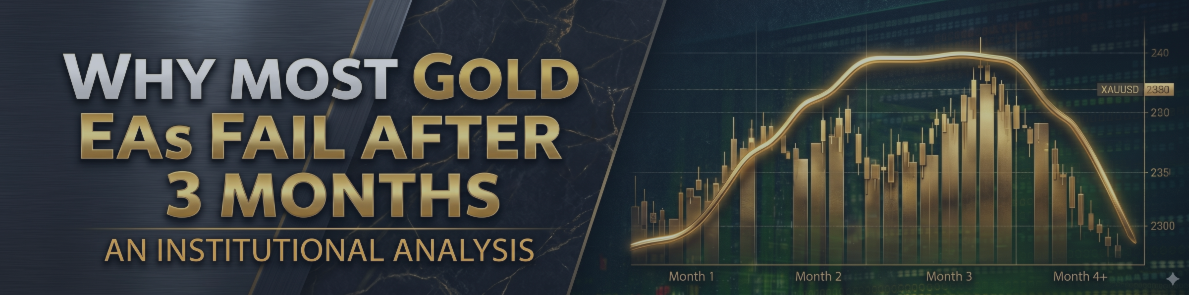
The consequence is not an immediate failure, but a gradual degradation. Trade frequency may remain stable, but edge diminishes. Win rates decline, reward-to-risk profiles distort, and the system begins to underperform. This is why many gold EAs appear viable for one to three months—the period during which the live regime resembles the backtested one—before diverging.
The solution to regime mismatch is not simply diversification in the conventional sense of adding more indicators or tweaking parameters. It requires a structural shift in how trading systems are designed. Specifically, it requires the introduction of regime-conditional strategy activation.
In a regime-aware framework, the system does not assume a single mode of operation. Instead, it continuously evaluates the current market state and selectively activates the strategies that are structurally aligned with that state. When the market exhibits characteristics of sustained momentum, trend-following logic is permitted to operate. When compression is detected, mean-reversion logic becomes active. Transitional states may invoke hybrid approaches or reduce participation altogether.
The key insight is that strategies are not universally valid; they are context-dependent. A regime-aware system treats strategies as conditional modules rather than permanent rules. This approach does not attempt to predict the market in a directional sense. Instead, it focuses on aligning execution logic with observed structural conditions.
An additional advantage of this framework is that it reduces the reliance on parameter rigidity. Instead of forcing a single set of parameters to perform across all environments, each strategy operates within the regime it was designed for. This allows for more coherent risk management and more stable performance characteristics over time.
A practical example of this concept in application is Quantura Gold Pro, an Expert Advisor built specifically for gold trading. Rather than relying on a single strategy or fixed parameter set, it incorporates a regime-aware architecture that conditionally activates different strategy paths based on prevailing market structure. While the internal implementation remains proprietary, the underlying principle is aligned with the regime-conditional model described above. For those interested in observing how such a system behaves in real conditions, the product is available on the MQL5 Marketplace at https://www.mql5.com/en/market/product/164558
It is important to note that regime awareness does not eliminate risk or guarantee performance. Markets can exhibit ambiguous or rapidly shifting conditions where classification itself becomes challenging. However, it addresses the core structural flaw that causes most Expert Advisors to fail over time—the assumption of consistency in an inherently non-stationary market.
For experienced algorithmic traders, the implication is clear. The question is no longer whether a strategy works, but under what conditions it works. Evaluating an Expert Advisor should involve not only reviewing its backtest metrics, but also understanding its implicit regime assumptions. Systems that do not explicitly account for regime shifts are, by design, exposed to eventual mismatch.
The persistence of the “three-month failure” pattern in gold EAs is not a coincidence. It is the natural outcome of deploying static logic in a dynamic environment. As long as market regimes continue to evolve—as they always have—systems that fail to adapt will continue to degrade.
Understanding and addressing regime mismatch is therefore not an enhancement. It is a prerequisite for long-term viability in gold algorithmic trading.
Quantura Gold Pro is available on the MQL5 Marketplace with a free demo. Try it and observe how a regime-aware system behaves when exposed to changing market conditions.