Forex Atlas – System Technical Architecture
This article serves as detailed documentation of the Forex Atlas system and describes the architecture of the strategies, risk management, and configuration of the Expert Advisor parameters.
While the product page provides a general overview of the system, the following text explains the logic of the individual system components in greater detail.
Forex Atlas is an automated trading system for the MetaTrader 5 platform designed as a systematic multi-strategy, multi-market portfolio.
The objective of the system is to achieve more stable performance by combining strategies that respond to different types of market environments.
The system architecture is based on the combination of two primary trading approaches:
-
trend trading
-
breakout trading
Trend strategies are designed to capture medium-term to long-term market trends, while breakout strategies react to volatility expansion and price structure breakouts after consolidation periods.
The combination of these approaches helps reduce the system’s dependency on a single market regime.
The system operates in netting mode, which means that only one resulting position exists per instrument at any time. This approach simplifies exposure management and allows natural aggregation of signals from individual strategies.
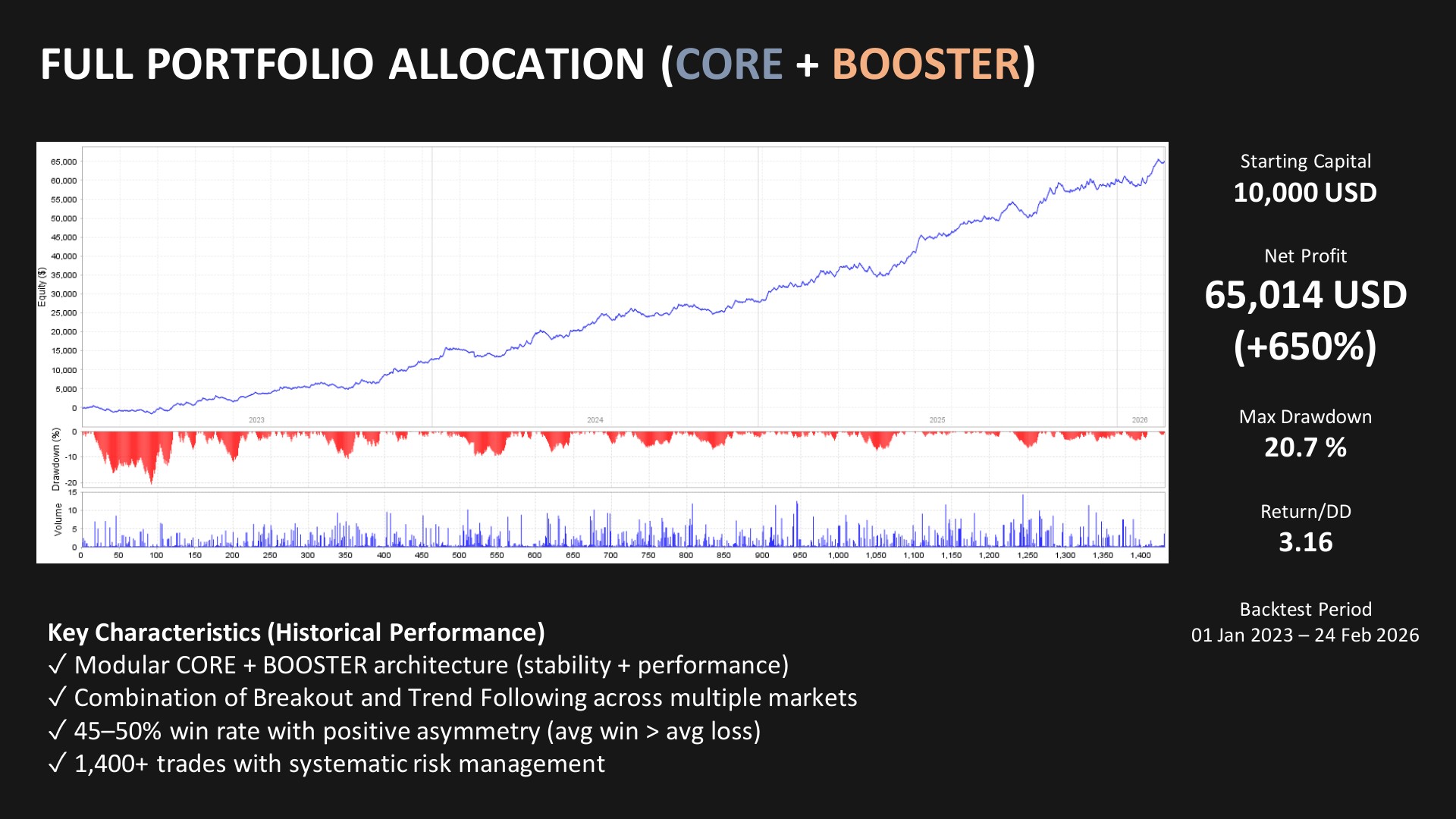
Portfolio Architecture (CORE + BOOSTER)
Forex Atlas uses a modular portfolio structure divided into two main components: CORE and BOOSTER.
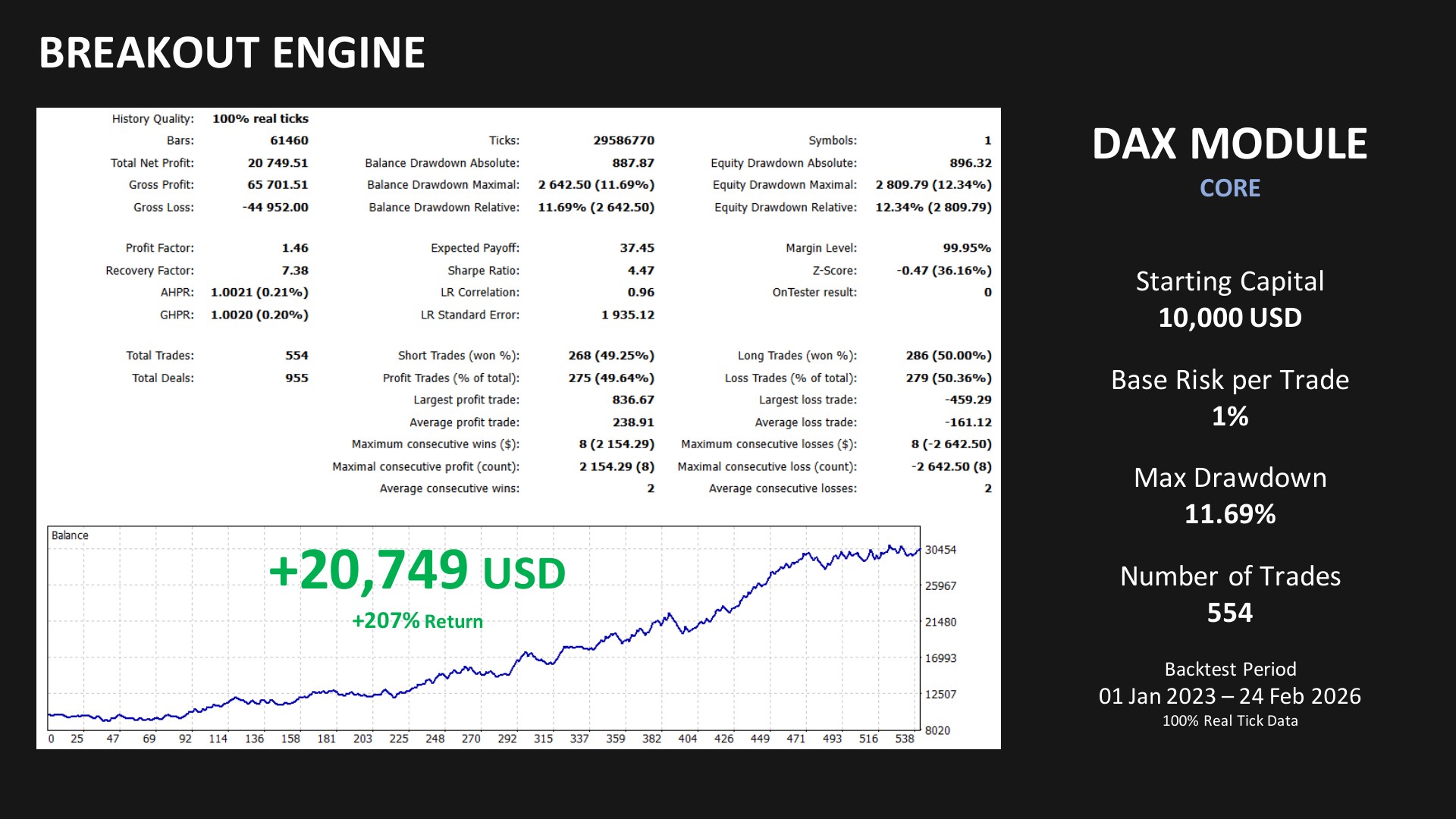
The CORE section represents the stabilizing foundation of the system. Strategies in this part of the portfolio are designed to deliver more stable performance with lower result volatility. CORE includes:
Breakout strategies
- DAX
- XAUUSD
Trend strategies
- USDJPY
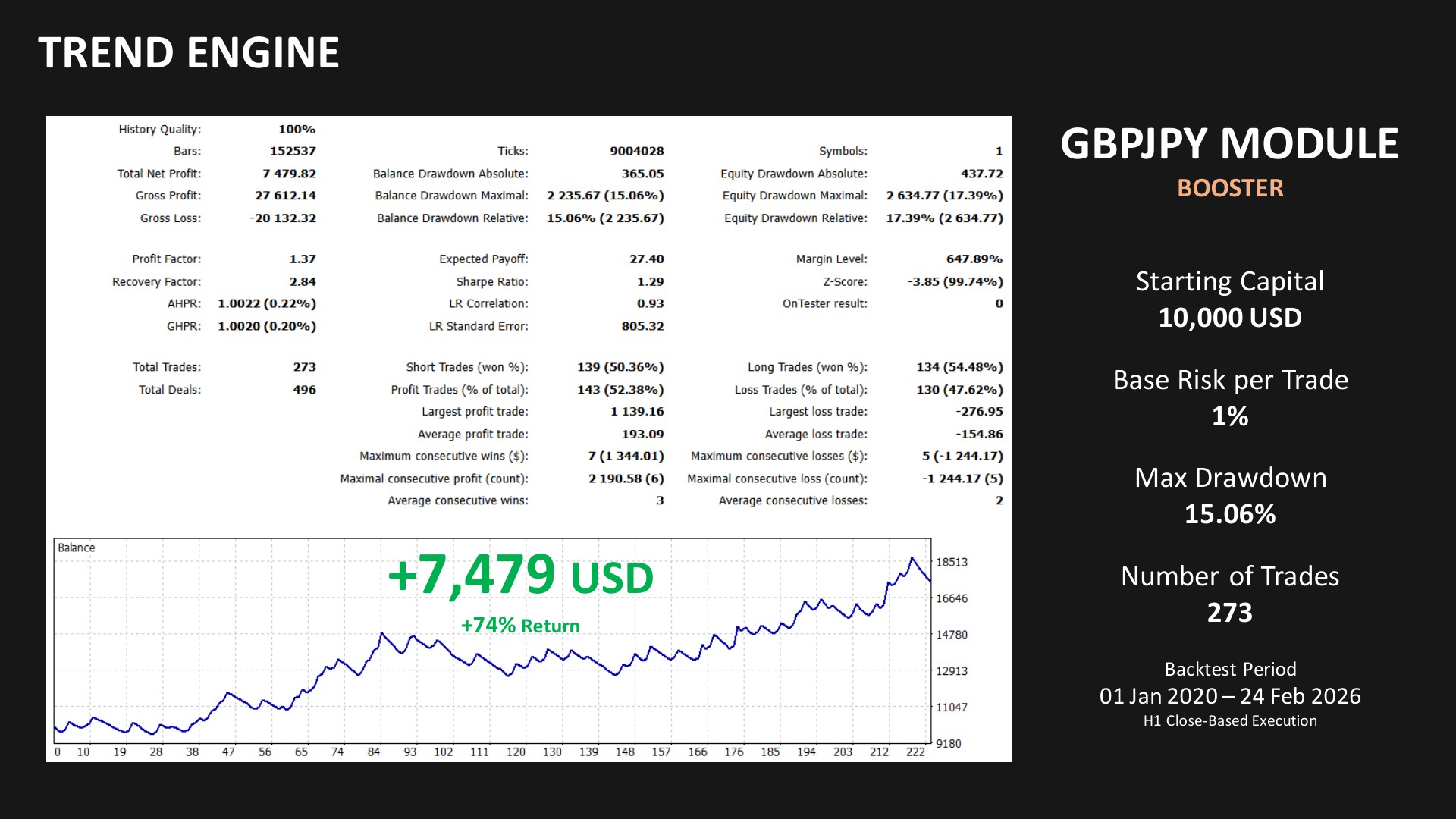
BOOSTER modules serve as a performance extension of the portfolio. Their objective is to increase the potential return of the portfolio while maintaining diversification. BOOSTER includes trend strategies:
- EURJPY
- GBPJPY
The combination of CORE and BOOSTER creates a diversified strategy portfolio with different trading frequencies, different time behavior, and different responses to market conditions.
The system can be used:
-
as a complete portfolio across all instruments
-
or individually on selected markets according to the user’s preferences
Trend Strategy
The trend strategy is designed to capture medium-term to long-term market trends.
It is used on the following instruments:
USDJPY

GBPJPY
EURJPY

The entry logic uses a combination of several analytical elements:
-
moving averages
-
candle structure
-
trend filter
The strategy can open both long and short positions depending on the current market development.
Position Management
Open position management uses a multi-stage exit model based on risk-reward levels.
The model includes:
-
automatic stop-loss shift to Break Even
-
partial position exits (partials)
-
dynamic trailing stop
This approach allows gradual profit realization while leaving part of the position open in case the trend continues.
Breakout Strategy
The breakout strategy is designed for markets with higher volatility.
It is used on the following instruments:
DAX
XAUUSD
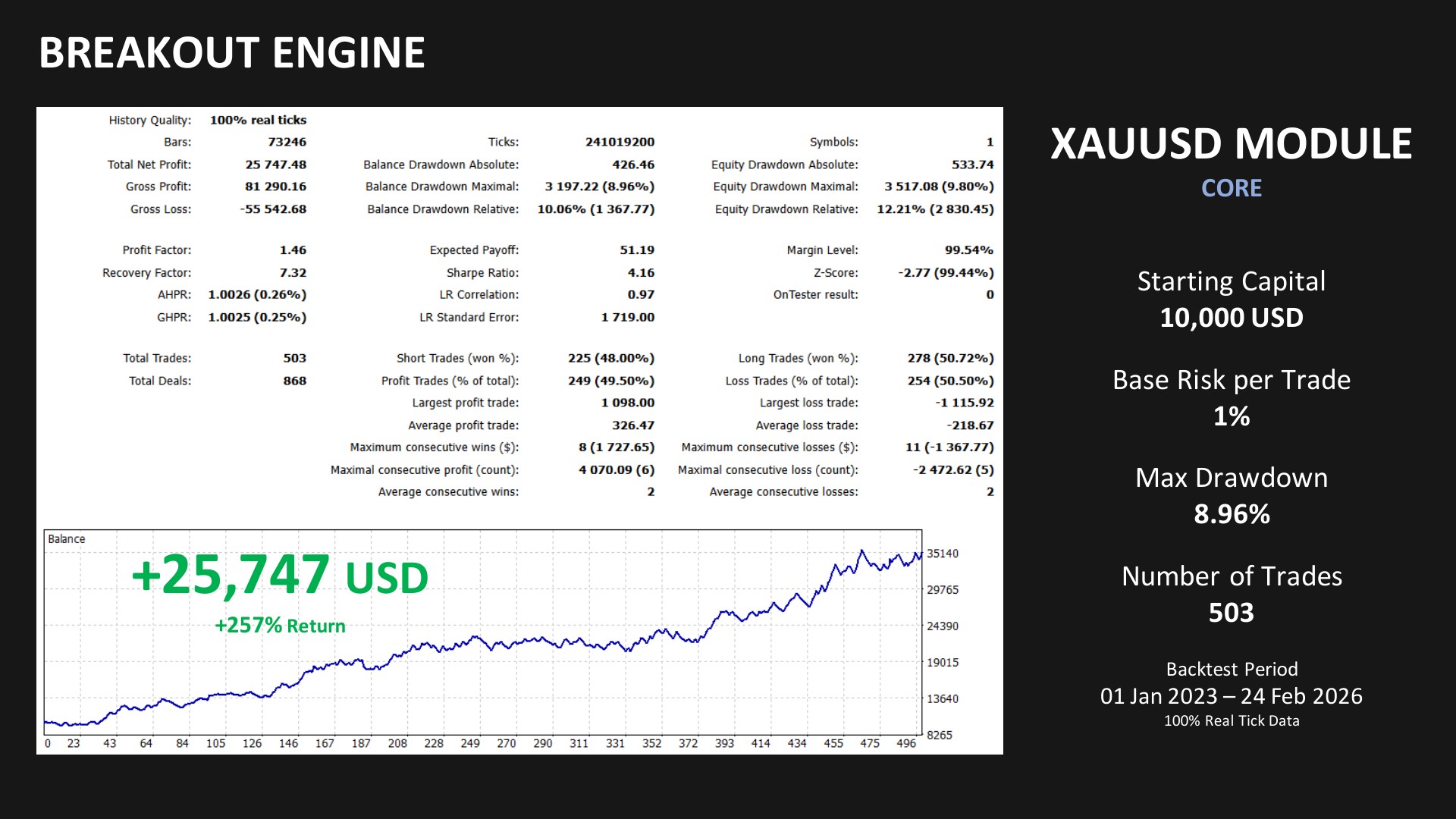
The algorithm first identifies consolidation periods where price moves within a relatively narrow range. It then monitors a breakout of this range, which may signal the beginning of a new impulsive movement.
When entering a trade, the system analyzes candle structure and the size of the price range, which helps reduce false breakouts.
Max Candles Protection
The breakout strategy includes a protective mechanism called Max Candles.
This mechanism functions as a time-based exit rule.
If the stop-loss is not moved to Break Even within a defined number of candles after the trade is opened, the position is automatically closed.
The purpose of this mechanism is to eliminate stagnating trades and free capital for new trading opportunities.
Regime-Based Risk Filter
An important component of the system is dynamic risk management using a regime-based risk filter.
The filter evaluates:
-
trend strength
-
current market volatility
-
long-term average volatility
Based on these factors, the system distinguishes three basic market regimes.
Favorable regime
The system can trade with a higher multiple of the base risk.
Normal regime
Standard risk is applied.
Adverse regime
The system automatically reduces the risk size.
The risk size is always derived from the Base Risk % parameter, while individual regimes apply different multipliers.
The goal of this mechanism is to adapt exposure to current market conditions and reduce risk during unfavorable periods.
Health Protection System
Forex Atlas includes a protection mechanism referred to as the Health System, which monitors strategy stability.
The system includes two main protection functions.
Loss Streak
Monitors the number of consecutive losses on a given instrument.
If the number of losses exceeds a defined threshold, trading on that instrument is temporarily paused.
Equity Drawdown from ATH
The system monitors equity decline from the historical maximum on a given instrument.
If the drawdown exceeds a defined limit, trading on that instrument is temporarily stopped.
Trading Sessions
Forex Atlas does not trade continuously throughout the entire day.
The strategies operate within defined time windows corresponding to major periods of market activity.
Trend strategies
03:00 – 11:30
16:00 – 21:00
Breakout strategies
08:00 – 11:00
14:30 – 18:00
Trading is primarily concentrated in morning, afternoon, and evening hours when market liquidity is typically higher.
The system intentionally avoids night hours and part of the midday period when market liquidity tends to be lower and price movements can be more chaotic.
All times are defined according to the platform’s local time.
Economic Calendar
The EA includes an integrated economic event filter.
The filter allows:
-
pausing trading before an economic event
-
pausing trading after an economic event
-
filtering events by importance (High / Medium / Low)
Use of the economic calendar is optional and can be enabled or disabled at any time.
For technical reasons, historical backtesting cannot be performed with the calendar enabled because historical economic event databases are not included in the platform's testing environment.
Risk Management
Risk management is based on the Base Risk % parameter, which defines the percentage of risk relative to the current account size.
This parameter is defined separately for the trend and breakout strategies, allowing independent risk control of both system components.
Position size is calculated automatically, and the regime risk filter can adjust the base risk depending on current market conditions.
The system also includes additional capital protection mechanisms:
Max Daily Loss – maximum daily loss
Equity Goal – stop trading after reaching a target equity level
These functions are often used particularly in prop trading environments, where strict risk management rules must be respected.
System Usage
Forex Atlas is designed as a systematic trading system for long-term portfolio trading.
It is not a scalping or high-frequency strategy.
System performance may be influenced by factors such as:
-
the broker used
-
spread type
-
instrument swap conditions
-
execution quality
The system is primarily intended for users who understand the principles of systematic trading and portfolio risk management.
Future Development
The EA is actively developed and will be gradually expanded.
Future development focuses mainly on:
-
adding additional optional features
-
expanding the portfolio of traded instruments
System Settings
Forex Atlas includes configurable parameters that allow users to adjust system behavior according to their preferences.
The default settings correspond to the configuration used in historical backtests and analytical system outputs.
Quick Start
Basic EA usage requires only a few simple steps.
1. Select the strategy for the given instrument
Default setting:
Breakout strategy = yes
Trend strategy = no
If you want to trade the trend strategy:
Trend strategy = yes
Breakout strategy = no
Only one strategy should be active per instrument.
2. Use the correct strategy for the correct instrument
Trend strategies
- USDJPY
- EURJPY
- GBPJPY
Breakout strategies
- DAX
- XAUUSD
3. Check the basic parameters
It is recommended to modify only the following variables:
Max Spread – according to broker conditions
Base Risk % – according to preferred risk management
Other parameters are optimized for the default system configuration.
Recommended Capital and Leverage
The recommended starting capital is approximately 10,000 USD with 1:30 leverage.
It is important to consider that the strategies use partial position closures (partials).
Sufficient capital is therefore important not only from a margin perspective but also for effective position management and gradual exposure reduction during trades.
With higher leverage or when trading a smaller number of instruments, the required capital may be lower.
Parameter Description
ENTRY TREND
Trend strategy = no
Enable or disable the trend strategy.
Max Spread = 10.0
Maximum allowed spread for opening a trade.
Trade direction = both
Defines the allowed trading direction:
• only long – only long positions
• only short – only short positions
• both – long and short positions
Entry TF = H1
Timeframe used for entry signals of the trend strategy.
EXIT TREND
SL ATR = 3.0
Stop-loss distance defined as a multiple of the ATR indicator.
TRADING TIME TREND
Time source = local time
Source of time used for trading sessions.
broker – broker server time
GMT – Coordinated Universal Time
local time – computer local time
1 session start = 03:00
1 session end = 11:30
2 session start = 16:00
2 session end = 21:00
Defines trading windows of the trend strategy.
RISK TREND
Base Risk % = 1.0
Base percentage risk per trade.
Favorable Regime Risk Multiplier = 1.5
Multiplier of the base risk during favorable market conditions.
Normal Regime Risk Multiplier = 1.0
Standard risk multiplier.
Adverse Regime Risk Multiplier = 0.75
Reduced risk multiplier during unfavorable market conditions.
HEALTH TREND
Loss streak = 20
Number of consecutive losing trades after which trading on the instrument is paused.
Equity DD from ATH % = 20.0
Maximum allowed drawdown from the historical equity maximum on the given instrument.
ENTRY BREAKOUT
Breakout strategy = yes
Enable or disable the breakout strategy.
Max Spread = 50.0
Maximum allowed spread for opening a trade.
Trade direction = both
Allowed trading direction.
Entry TF = M15
Timeframe used for identifying breakout signals.
Range candles = 8
Number of candles used for calculating the consolidation range.
Buffer breakout ATR = 0.2
Breakout level buffer defined as a multiple of the ATR indicator.
EXIT BREAKOUT
TP RRR = 4.0
Target profit defined by the Risk-Reward ratio.
Max candle = 96
Maximum number of candles after which the trade will be closed if the stop-loss has not been moved to Break Even.
Partials shift SL = BE+Partials
Management of stop-loss shifting:
• no – BE and partials disabled
• BE – stop-loss moves to Break Even
• BE+Partials – stop-loss shifts according to partial exits
1Partials RRR = 2.0
Risk-Reward level for the first partial exit.
1Partials close % = 50.0
Percentage of the position closed at the first partial.
2Partials RRR = 0.0
Risk-Reward level for the second partial exit.
2Partials close % = 0.0
Percentage of the position closed at the second partial.
TRADING TIME BREAKOUT
Time source = local time
1 session start = 08:00
1 session end = 11:00
2 session start = 14:30
2 session end = 18:00
RISK ALL ATLAS
Slippage = 10
Maximum allowed slippage during execution.
Max instruments = 4
Maximum number of instruments traded simultaneously.
Max currency exposure = 4
Maximum number of open positions containing the same currency.
Max daily loss % = 15.0
Maximum daily account loss. After reaching this value trading is paused.
Equity Goal = 220000.0
After reaching this equity level the EA closes all open positions and stops trading.
CALENDAR ALL ATLAS
Enable = no
Enable or disable the economic calendar.
Event filter – Disable before (min) = 15
Pause trading before the economic event.
Event filter – Enable after (min) = 15
Re-enable trading after the event.
Event High = yes
Event Medium = no
Event Low = no
Filtering of economic events according to their importance.
Time offset hours = -1
Time offset of the economic calendar.