PropDip
- 专家
- 版本: 1.0
- 激活: 10

PropDip: buys short dips in the US stock indices with a rule I measured before I built it.
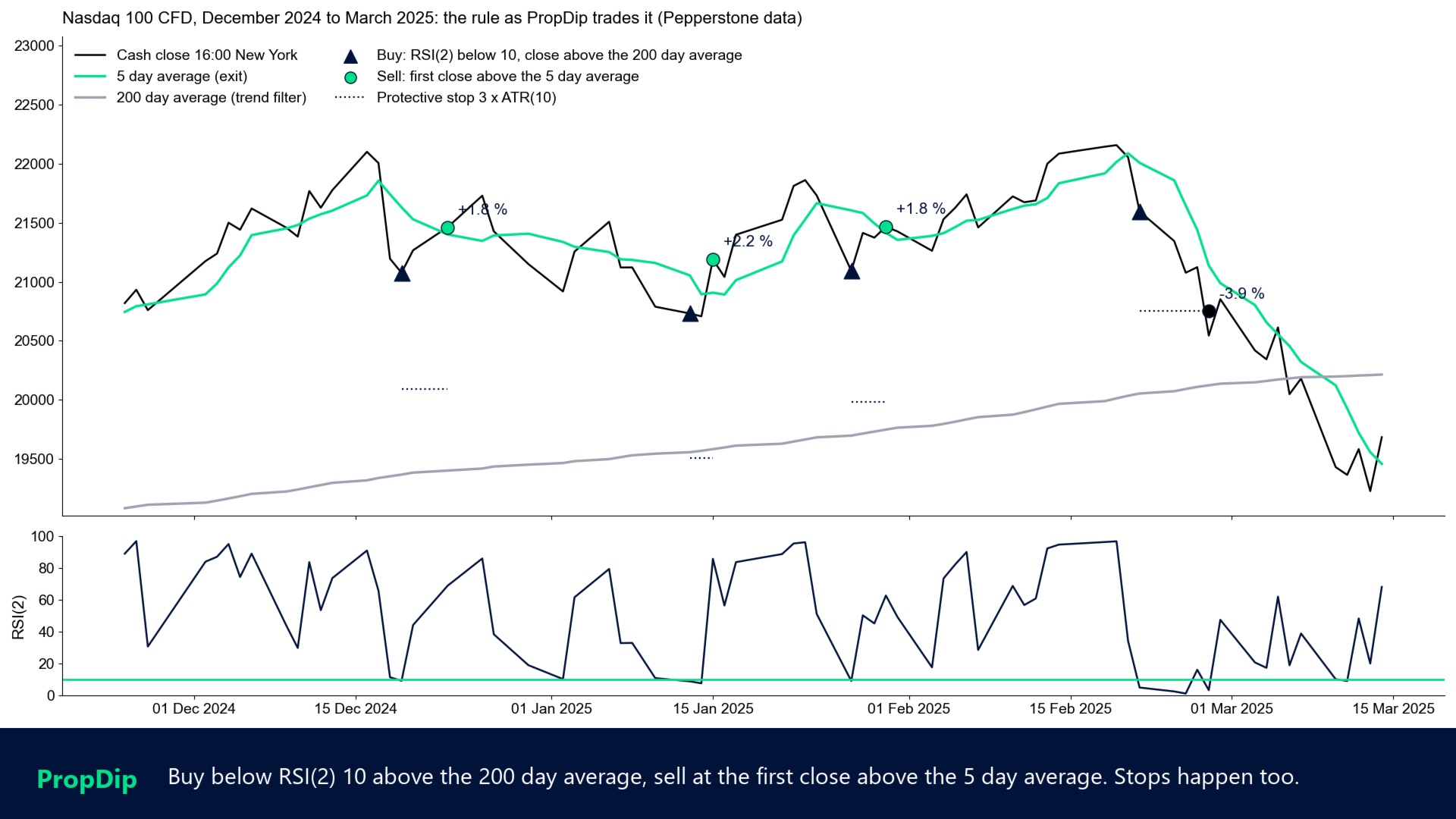
PropDip trades one well known rule on the S&P 500, Nasdaq 100 and Dow CFDs: it buys at the US cash close when RSI(2) drops below 10 while the index is above its 200 day average, and sells at the first close above the 5 day average. I tested the rule with CFD costs on 2000 to 2018 and then once on a separate holdout from 2019 to 2026. Of 65 rules I tested on separate data, it is one of two that passed the correction for multiple testing.
Setup: attach PropDip to one US index chart, choose the risk per trade, keep the terminal running at 16:00 New York. Nothing else to set.
Try it first: run it in the strategy tester on your broker's US500, NAS100 or US30 symbol (1 minute OHLC or real ticks). Start the test about a year before the period you want to see, because the 200 day average needs the history. On other symbols the tester runs a demo schedule (one trade every weekday) so you can watch the order handling.
What it does
- The tested rule, nothing tuned. RSI(2) below 10, close above the 200 day average, exit at the first close above the 5 day average or after 20 closes at the latest. These values are fixed in the code. There are no thresholds to optimise into a nice backtest.
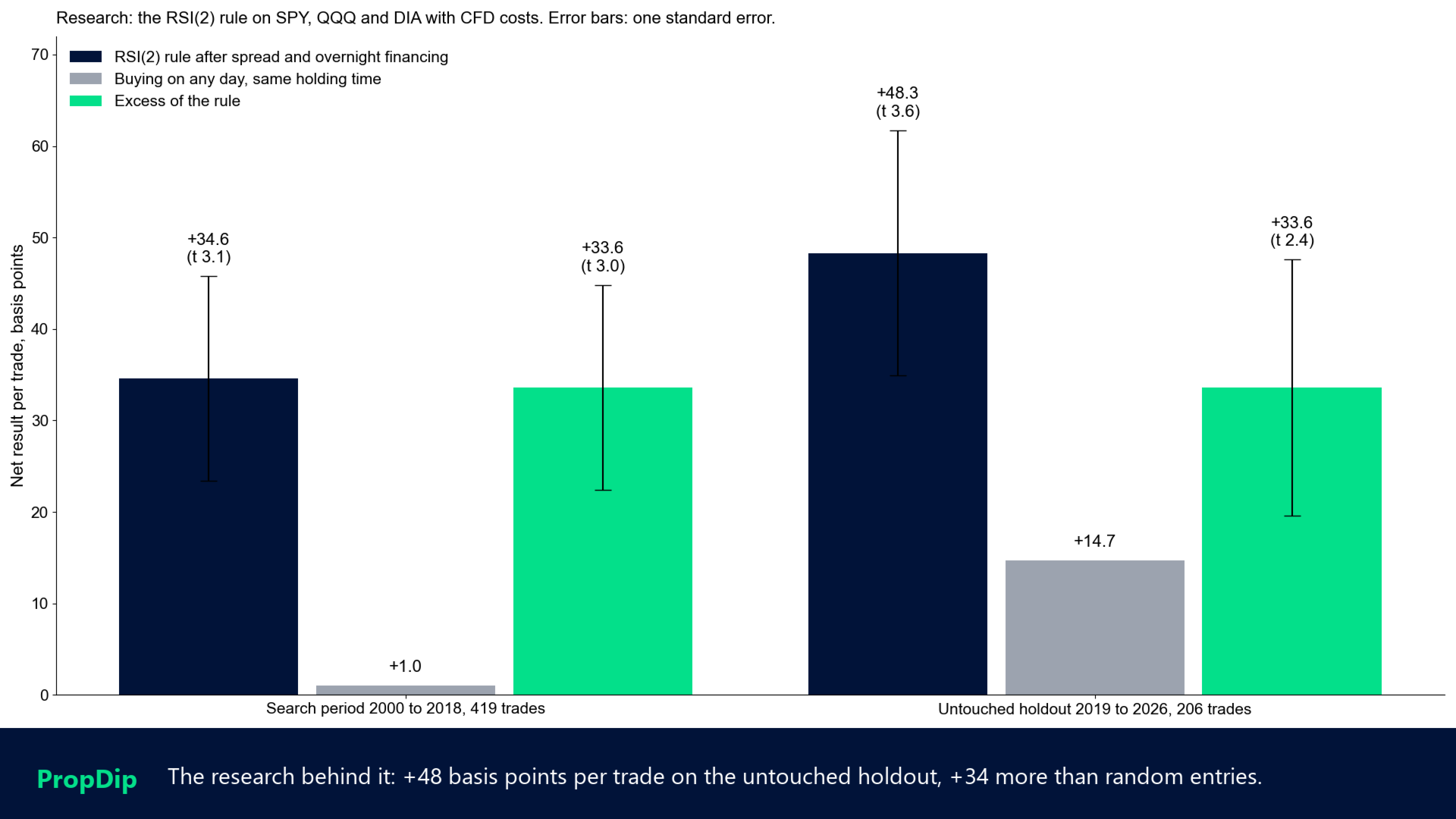
- The numbers, after costs. On 2000 to 2018 (SPY, QQQ and DIA as proxies) the rule made +34.6 basis points per trade after spread and overnight financing (419 trades, t 3.1). On the untouched holdout from 2019 to October 2026 it made +48.3 basis points per trade (206 trades, t 3.6), which is +33.6 basis points more than buying on random days with the same holding time (t 2.4).
- Built on the US cash close. Index CFDs trade almost around the clock. PropDip builds its daily series from the prices at 16:00 New York, the close the rule was tested on, and trades between 16:00 and 16:15 New York. Daylight saving in New York and on your broker's server is handled, in live trading the server clock is checked against your computer's clock.
- Protective stop on every trade at 3 x ATR(10) below the entry, sent with the order. With this stop the holdout made +55 (S&P 500), +59 (Nasdaq 100) and +25 (Dow) basis points per trade; 7 to 11 % of the trades ended at the stop.
- Sizing that fits a prop account. Risk in % of equity at the stop, position value in % of equity, or fixed lots. Margin, volume and spread are checked before every order.
- Restart safe. The state comes from the open position and the deal history: no second entry after a restart, no exit on the entry day.
What to expect
- About 8 to 9 trades per year and index, held 3 to 4 sessions on average, about 70 % winners, and rare large losses in sell offs (2020, 2022).
- Small returns at prop account risk. With 0.5 % risk per trade on all three indices the rule made about +1.0 % per year on 2000 to 2018 and +1.7 % per year on 2019 to 2026, largest drawdown 3.6 % and 2.0 %. More return needs more risk: with a position value of 100 % of equity the Nasdaq 100 made +5.4 % per year on 2019 to 2026, but had a 23 % drawdown on 2000 to 2018.
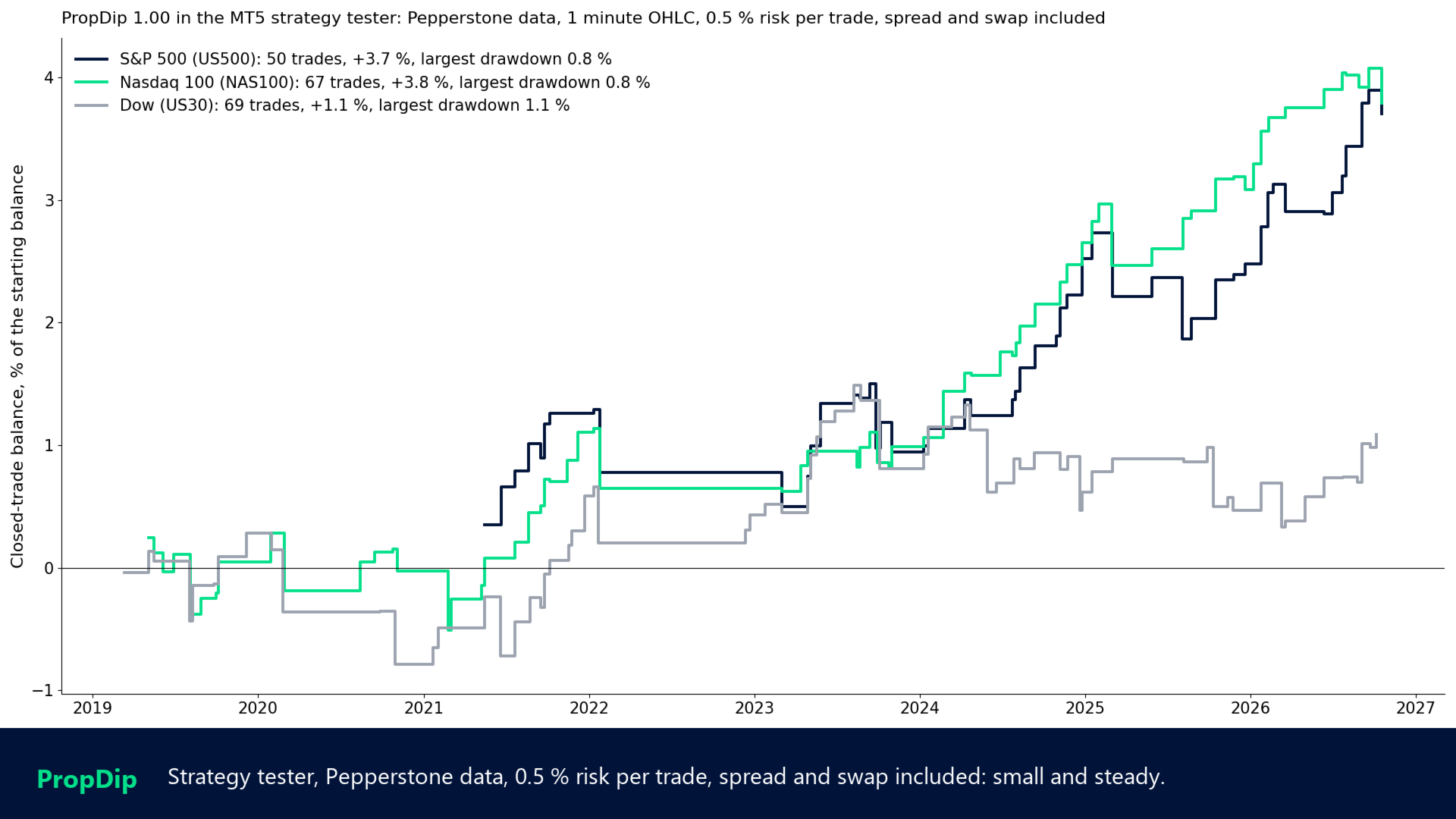
- In the MT5 strategy tester on Pepperstone data with 0.5 % risk per trade, spread and swap included, starting balance 100,000 EUR: S&P 500 50 trades since May 2021, +3.7 % (+0.68 % a year), largest drawdown 0.8 %; Nasdaq 100 67 trades since May 2019, +3.8 % (+0.51 % a year), largest drawdown 0.8 %; Dow 69 trades since March 2019, +1.1 % (+0.14 % a year), largest drawdown 1.1 %. The broker's S&P 500 history before 2020 has no cash session, so that test starts later.
- It needs weekend holding. About two thirds of the trades run over a weekend, and that is where the result comes from: closing every Friday cut the 2000 to 2018 result on the S&P 500 from +36 to +2 basis points per trade. If your account does not allow weekend holding, PropDip is not for it.
- The three indices usually signal on the same day. Three charts means three positions in one bet, so set the risk per chart with that in mind.
Where it fits
Any MT5 broker with US500, NAS100 or US30 cash index CFDs, hedging or netting. Forward and futures CFDs jump at every roll and distort RSI(2), so use the cash CFD. A VPS is recommended so the 16:00 decision happens every day. The rule has been public since 2008 (Connors and Alvarez) and has held up since; crowding and decay are possible. Past results do not guarantee future results.
Activations: 10, one per computer or VPS where you run PropDip.
Features
- Index detected from the symbol name (US500, SPX500, NAS100, USTEC, US30, DJ30 and similar), override for other names
- Daily series from the 16:00 New York cash close, built from M30 history
- RSI(2) with Wilder smoothing, SMA200, SMA5, ATR(10) of the cash session
- Exit at the first close above SMA5, time limit 20 closes
- Protective stop at the broker on every order (1 to 10 x ATR, default 3)
- Risk % of equity, position value % of equity, or fixed lots
- Spread filter, margin check, volume normalisation
- Server clock models with automatic check in live trading
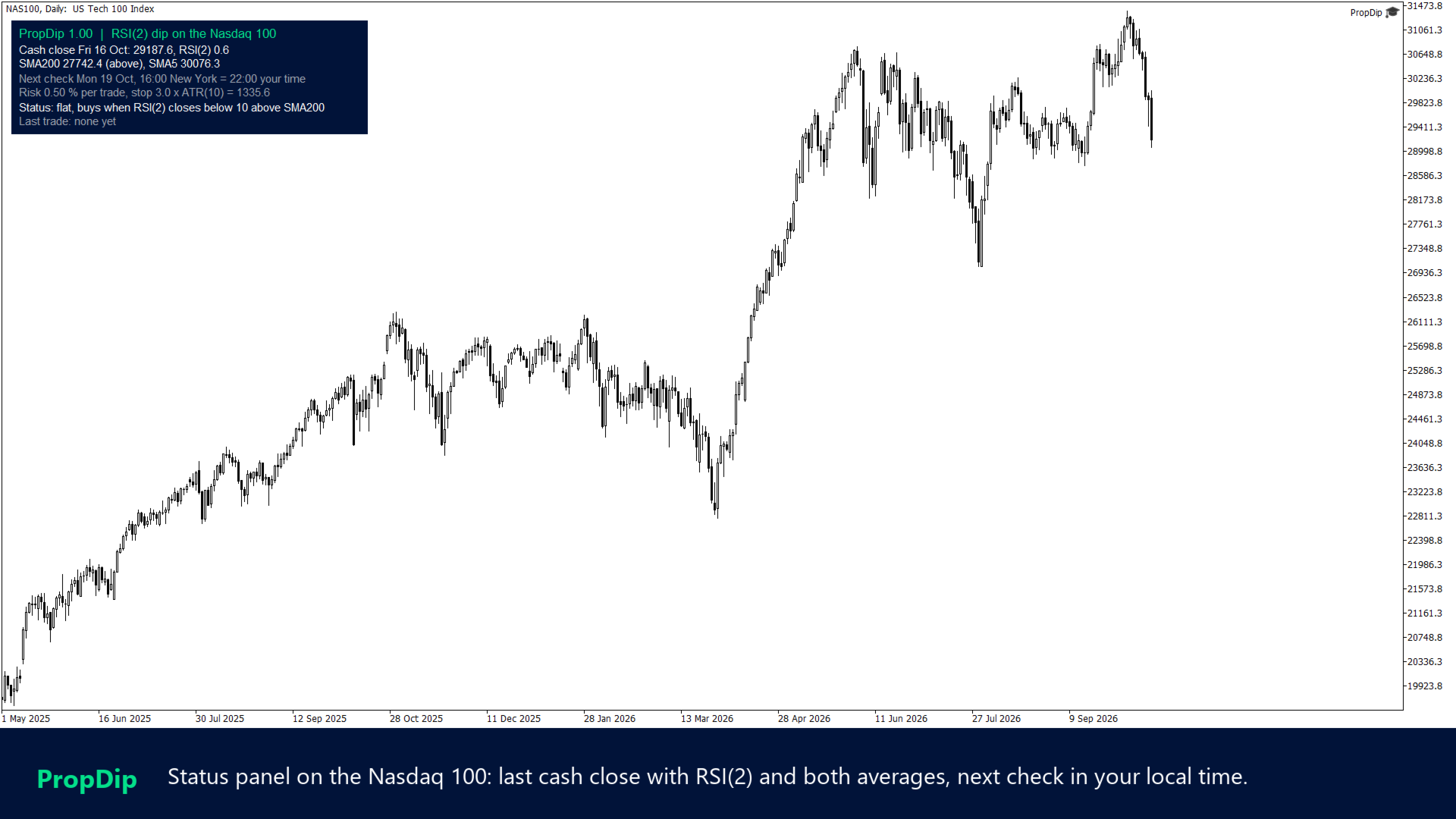
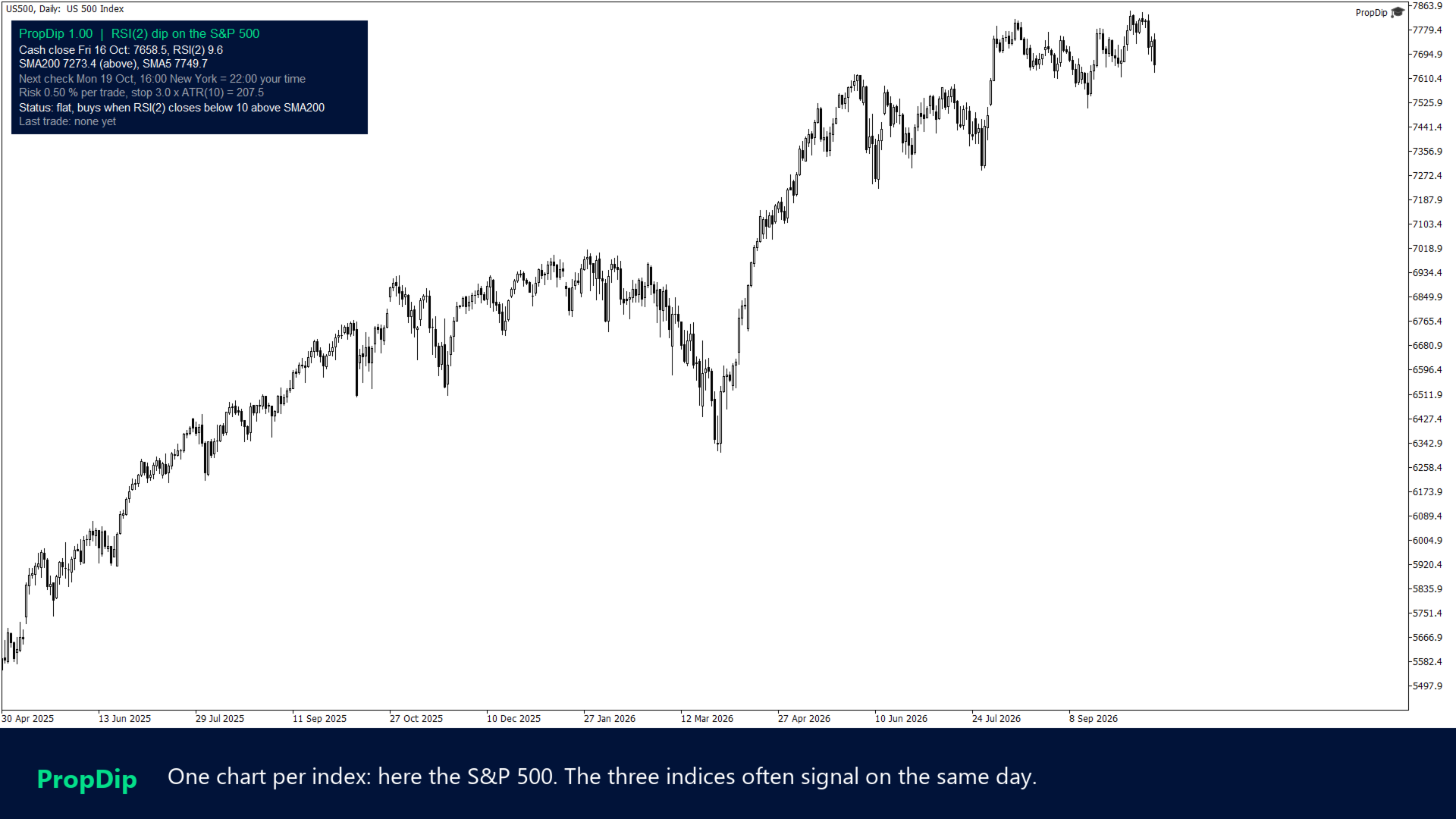
- Status panel: last close with RSI(2) and both averages, next check in your local time, risk, status, last trade
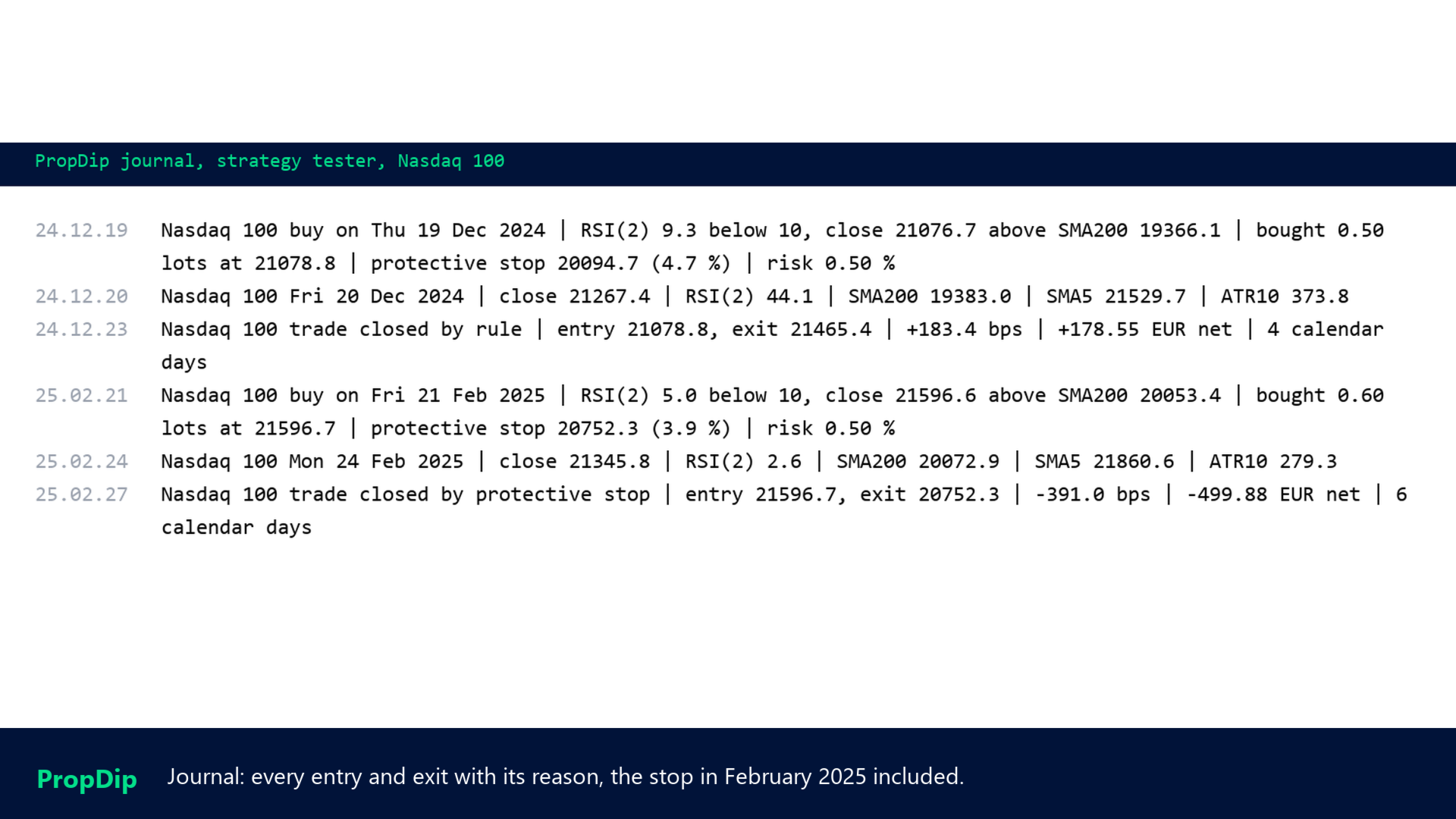
- Journal line for every entry and exit with the reason, optional daily values and push notification
- One magic number per index, so three charts never touch each other's positions
- Hedging and netting accounts
Quick start
- Open your broker's S&P 500, Nasdaq 100 or Dow cash CFD chart (any timeframe) and attach PropDip.
- Set the risk per trade (default 0.5 % at the stop).
- Enable AutoTrading and keep the terminal running at 16:00 New York, ideally on a VPS.
- Check the panel: it shows the last cash close, RSI(2), both averages and the next check in your local time.
Questions: write in the Comments section or send me a message, I answer every question. If PropDip does something you do not expect, please contact me before you rate it. All my products are on my seller page.