• Bilgiler
2 yıl
deneyim
5
ürünler
85
demo sürümleri
0
işler
1
sinyaller
0
aboneler
Finansal Yönetim alanında uzmanlaşmış Finans ve Uluslararası İş profesyoneli. Algoritmik ticaret, çoklu varlık portföy oluşturma ve kantitatif risk yönetimi odaklı, kendi kendini yetiştirmiş MQL5 ve Python geliştiricisi.

Çalışmalarım, izole stratejiler yerine koordineli bir portföy olarak çalışan Expert Advisor'ların tasarımı, optimizasyonu ve doğrulanması üzerine yoğunlaşmaktadır. Tek bir enstrümana veya tek bir yaklaşıma bağımlı olmayan sistemler inşa etmek için korelasyon analizi, zaman kapsama haritalaması ve varlık sınıfı çeşitlendirmesi uyguluyorum.

Şu anda forex, endeksler, değerli metaller, enerji ve ABD hisse senetlerini kapsayan algoritmik portföyleri yönetmekte olup, birden fazla seansta ve zaman diliminde eş zamanlı olarak işlem yapmaktayım.

Deneyimlerimi bu toplulukta teknik makaleler ve açık kaynak araçlar aracılığıyla paylaşıyorum. "Bireysel EA'lar inşa etmek"ten "portföy mühendisliği"ne geçişin, bireysel yatırımcı düşüncesini kurumsal düşünceden ayıran sınır olduğuna inanıyorum ve burada yayınladığım her şeyi bu ilke yönlendirmektedir.
Cristian David Castillo Arrieta
Edge Drift Detector kodunu yayınladı
Tests whether live closing deals still match the backtest of an Expert Advisor. A bootstrap-calibrated CUSUM detector raises an alarm and estimates when the drift began, a two-window check separates a short dip from a lasting decline, and an expectancy decomposition shows whether the win rate or the trade sizes changed. The script generates demonstration data on the first run and is written in pure MQL5.
Cristian David Castillo Arrieta
"Building a Neural Loss-Pattern Auditor in MQL5" makalesini yayınladı
Building a Neural Loss-Pattern Auditor in MQL5

Aggregate metrics like win rate or profit factor miss sequence-dependent behavior, such as sizing up right after a loss. This MQL5 script trains a small native neural network on closed-deal history to estimate loss probability from behavioral and market-context features. It reports accuracy uplift over a baseline, probability calibration, and permutation feature importance, then combines them into a configurable A-F grade with concise, plain-language recommendations.

Cristian David Castillo Arrieta
"Did Your Scale Outs Actually Help? A Scale Out Value Analyzer in MQL5" makalesini yayınladı
Did Your Scale Outs Actually Help? A Scale Out Value Analyzer in MQL5

The article presents an MQL5 tool that tests whether scaling out improved results rather than only appearing disciplined. It reconstructs positions from closing-deal history and reprices the full volume at the first, last, and best exit rates actually achieved, producing a Value-Add Ratio, a Scale-Out Win Rate, and an Efficiency measure. A single-trade dependence check and a configurable A+ to F grade turn these into clear, decision-ready feedback.

Cristian David Castillo Arrieta
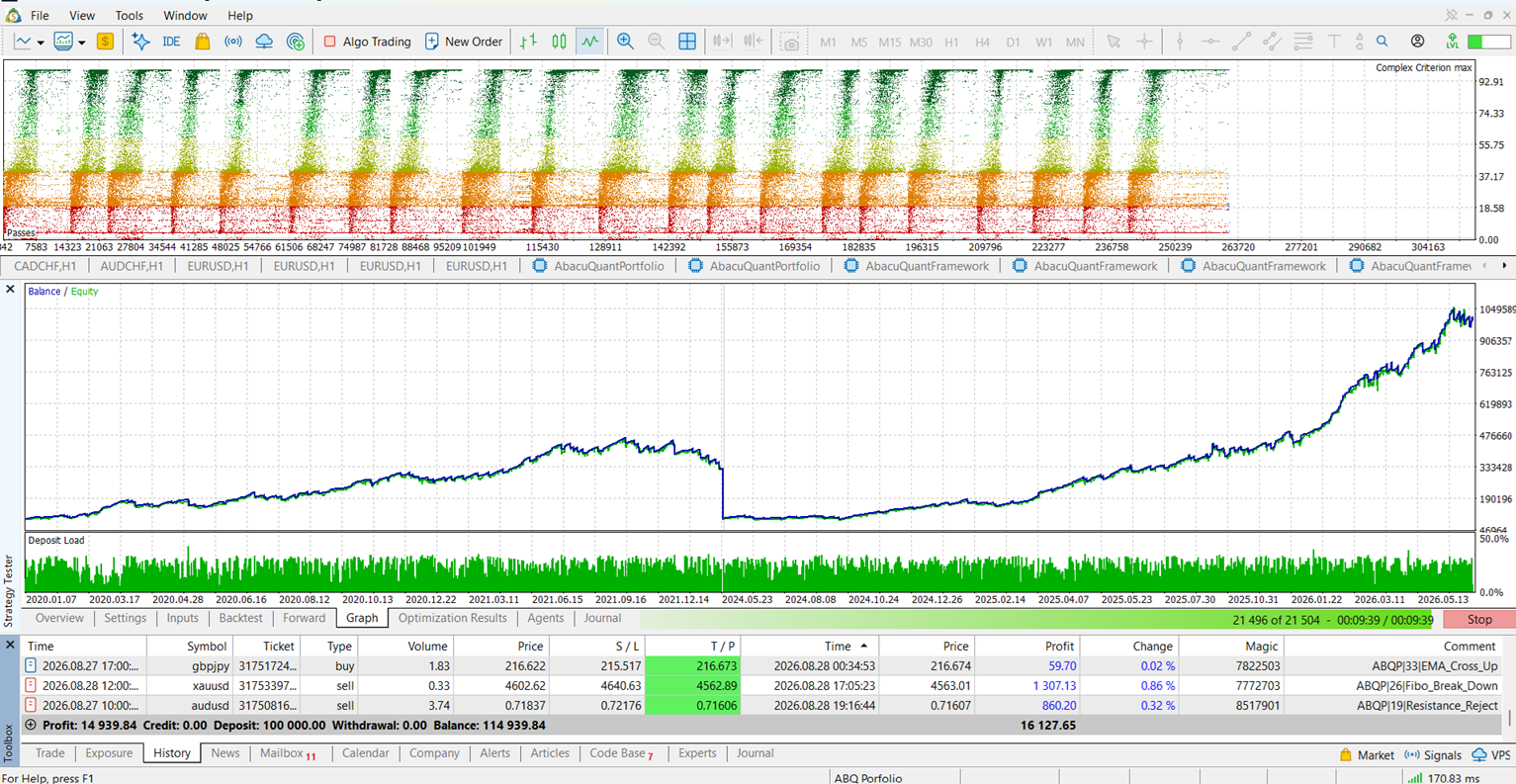
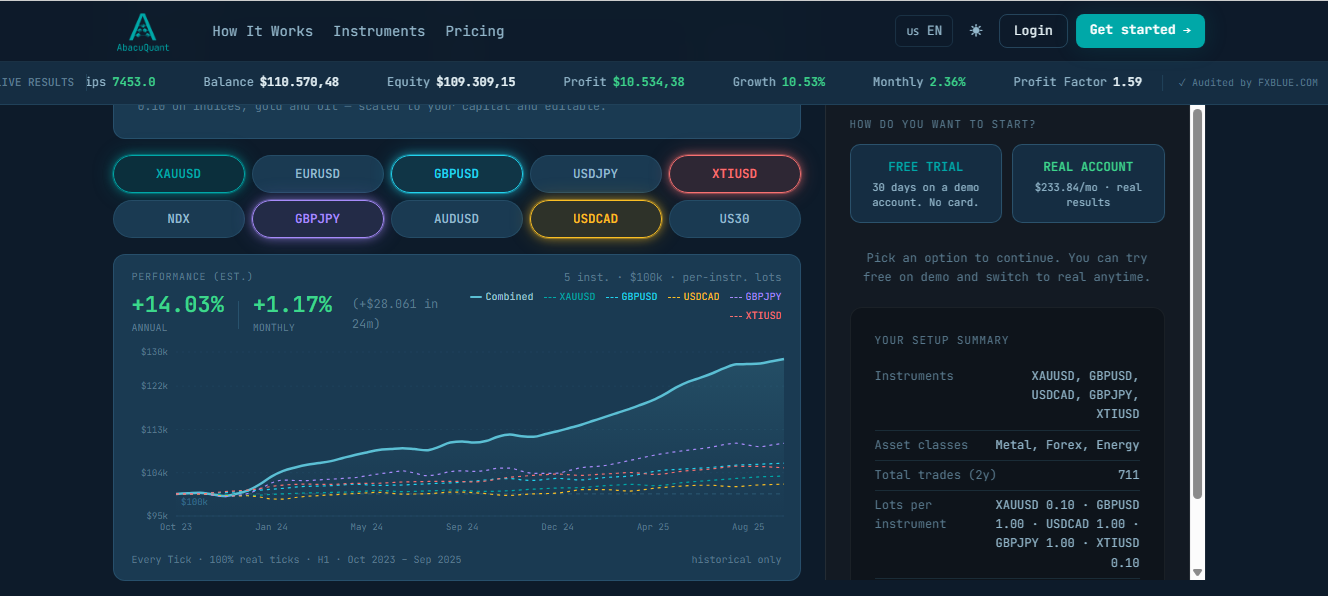
These remarkable optimization results were generated using the AbacuQuant Portfolio EA, available here:
What makes this interesting is that this is not a single strategy being optimized over and over. AbacuQuant Portfolio is designed as a portfolio engine, capable of running multiple independent configurations across different instruments and market conditions from a single MT5 chart.
The process starts by testing different combinations of strategies, trading conditions, parameters, stop/target structures and risk settings. Instead of simply looking for the configuration with the highest profit, AbacuQuant uses a custom optimization criterion designed to evaluate whether the historical win rate provides a meaningful margin above the break-even level implied by the stop and target structure.
The resulting configurations are then combined into a portfolio, allowing different strategies and instruments to operate during different market sessions while a shared risk engine controls total exposure at the account level.
The objective is not to find one “perfect” setup. It is to build a collection of independent configurations that complement each other and create a more robust portfolio.
This image shows one of those optimization and portfolio-development results. The robot used to generate it is the AbacuQuant Portfolio EA.
🔗 https://www.mql5.com/en/market/product/191885
Cristian David Castillo Arrieta
Neural Loss-Pattern Auditor kodunu yayınladı
Neural Loss-Pattern Auditor, davranışsal ve piyasa bağlamına ilişkin özelliklerin hangi işlemlerin zarar etme olasılığının daha yüksek olduğunu öngörüp öngörmediğini test etmek amacıyla, tamamen sıfırdan yerel MQL5 dilinde yazılmış küçük bir ileri beslemeli sinir ağını, kapatılmış işlem geçmişi üzerinde eğitir. Bu araç, basit bir temel referans değerine kıyasla doğruluk artışını, bir olasılık kalibrasyon tablosunu, permütasyon özellik önem sıralamasını ve öneriler içeren yapılandırılabilir bir A-F bileşik notunu raporlar. İlk çalıştırmada yerleşik bir sentetik demo kullanır, böylece herhangi bir kurulum gerektirmeden çıktı hemen görülebilir; bunun yerine gerçek hesap geçmişini analiz etmek için bir girişi InpUseDemoData=false olarak değiştirin. Saf MQL5: harici kütüphaneler, Python ve herhangi bir türde yapay zeka hizmeti içermez.
Cristian David Castillo Arrieta
Introduction AbacuQuant Portfolio is a multi-configuration Expert Advisor for MetaTrader 5. Instead of running one strategy with one set of parameters on one instrument, it runs up to 48 independent configurations at the same time, across EURUSD, GBPUSD, USDJPY and AUDUSD, from a single H1 chart...
Cristian David Castillo Arrieta
After months of research, I've published AbacuQuant Portfolio — a multi-configuration Expert Advisor for MetaTrader 5, and I wanted to share it here first.

Why it's different

Most EAs run one strategy with one set of parameters on one instrument. This one runs up to 48 independent configurations at once, across EURUSD, GBPUSD, USDJPY and AUDUSD, from a single chart. Each configuration owns its own trading hours, its own combination of ten built-in strategies, and its own ATR-based stop and target. A configuration built for the London session simply doesn't trade outside it — and risk is measured across the whole account, not per configuration, so running four instruments together doesn't quietly multiply your exposure.

And it's built the honest way: no martingale, no grid, no averaging into a losing position, no hidden loss-recovery logic. Every stop is attached the moment the trade opens. If you've been burned by an EA with a beautiful equity curve that fell apart the first time the market disagreed with it, this was built specifically against that failure mode.

How it decides a trade

Each active configuration waits for its window, reads only completed H1 bars (never the forming candle), requires several of its enabled strategies to agree, and sizes the position from the stop distance rather than a fixed lot — so a wider stop always means a smaller position, and the money at risk stays constant. Every configuration passed the same acceptance procedure on real-tick data before it shipped: statistical significance over its own break-even line, a minimum number of losing trades to actually measure it, and stops that were genuinely reached rather than just theorized.

Try it before you take my word for it

The demo runs in full inside the Strategy Tester — same presets, same logic, no time limit. Turn on the validated instruments, select "Every tick based on real ticks," and look at the trade list yourself: the stops, the position sizing, the risk ceilings holding across instruments. I'd rather you find out in the tester, for free, than after committing real money.

Link to the product page: https://www.mql5.com/en/market/product/191885
Cristian David Castillo Arrieta ürün yayınladı

AbacuQuant Portfolio , MetaTrader 5 için geliştirilmiş çok varlıklı ve çok para birimli bir kantitatif Uzman Danışmandır (Expert Advisor). Birbiriyle korelasyonu düşük 11 piyasada, tek bir H1 grafiği üzerinden ve tüm hesabı kapsayan kurumsal düzeyde bir risk motoruyla işlem yapar: martingale yok, ızgara (grid) sistemi yok, zarardayken maliyet düşürme (ortalama alma) kesinlikle yok . Her emir, piyasaya iletildiği ilk andan itibaren matematiksel olarak hesaplanmış Zararı Durdur (Stop Loss) ve Kârı

Cristian David Castillo Arrieta
"Building a Hidden Risk of Ruin Auditor in MQL5" makalesini yayınladı
Building a Hidden Risk of Ruin Auditor in MQL5

Aggregate metrics alone do not reveal how a trade sequence manages risk. This MQL5 tool analyzes closed positions to flag four structural patterns: post-loss volume escalation, overlapping same-direction entries, asymmetric payoffs, and a classical risk-of-ruin figure. The results are merged into a configurable A-F grade with concise recommendations to guide further review.

Cristian David Castillo Arrieta
Scale Out Value Analyzer kodunu yayınladı
A native MQL5 tool that reconstructs closed positions from deal-level history, flags the ones closed through more than one exit, and reprices each one at its own first, last, and best exit rates to measure whether scaling out actually added value. Reports a Value-Add Ratio, a Scale Out Win Rate, an Efficiency figure, and a single-trade dependence check, combined into an A+ to F score with recommendations. Runs out of the box against a built-in demonstration data set; a companion script exports the real input file from your own account history. Pure MQL5, no external libraries.
Cristian David Castillo Arrieta
Hidden Risk of Ruin Auditor kodunu yayınladı
Kapalı pozisyonların işlem geçmişini (bir CSV dosyası veya RuinExport.mq5 komut dosyası tarafından mevcut hesabın işlem geçmişinden otomatik olarak oluşturulan bir dosya) okur ve dört bağımsız risk göstergesini raporlar: zarar sonrası hacim artışı, ortalama fiyatı daha kötü hale getiren aynı yöndeki örtüşen pozisyonlar, kazançlar ve zararlar arasındaki getiri asimetrisi ve işlem başına belirtilen risk düzeyinde klasik iflas riski tahmini. Bu dört puan, sade bir dille yazılmış önerilerle birlikte tek bir A'dan F'ye kadar not sistemine dönüştürülür. CSV dosyası bulunmazsa, komut dosyası otomatik olarak tekrarlanabilir bir örnek işlem defteri oluşturur; böylece rapor ilk çalıştırmada görüntülenebilir.
Cristian David Castillo Arrieta
"Execution Cost and Slippage Sensitivity Analyzer" makalesini yayınladı
Execution Cost and Slippage Sensitivity Analyzer

Backtests often understate spread, commission, and slippage. This MQL5 analyzer loads closing deals and simulates rising execution costs to measure robustness. It computes the breakeven cost per deal, the cushion over an assumed cost, the net profit and profit factor at that cost, and how many winners turn into losers, then summarizes the result with an A+ to F grade and targeted guidance.

Cristian David Castillo Arrieta
"Creating a Profit Concentration Analyzer in MQL5" makalesini yayınladı
Creating a Profit Concentration Analyzer in MQL5

Net profit and win rate tell you how much a strategy made, not how the result is distributed. This article builds a native MQL5 script that reads your closed trades and measures profit concentration: the top-N trade share, the Gini coefficient of the winners, an outlier-dependence stress test that removes the best few winners, and the largest day against a prop-firm consistency limit. It combines these into one A+ to F score with recommendations, running inside MetaTrader 5.

Cristian David Castillo Arrieta
Portfolio Correlation and Margin Risk Calculator kodunu yayınladı
Herhangi bir enstrüman grubu ile hesabınızın bu enstrümanların tümünü aynı anda tutabilmesi için ihtiyaç duyacağı toplam teminat arasındaki tarihsel Pearson korelasyonunu, öz sermayenizin yüzdesi olarak hesaplar. MetaTrader 5'te harici kütüphaneler, Python veya yapay zeka (AI) kullanmadan yerel olarak çalışır — sembol listenizi ve lot büyüklüklerinizi girdi olarak belirleyin; uzmanlar sekmesinde ve grafikte tam matrisi gösterir ve zamanlayıcıya göre yenilenir.
Cristian David Castillo Arrieta
Why the same trailing stop breaks the moment Gold changes character

I was in a forum thread today about trailing stops on XAUUSD, and it made me put into words something I've been building my whole approach around for a while: almost every trailing method traders compare — EMA cross, Chandelier, ATR multiples, swing-structure trails — gets judged on a single backtest run over one continuous chunk of history. The "best" multiplier or ladder step that wins that test isn't actually the best method. It's the method that happened to fit whatever mix of trend and chop was sitting in that sample.

The fix I use is simple to describe and annoying to implement properly: split the history into volatility regimes first (I use ATR percentile over a rolling window, expansion vs. compression), then optimize and validate each piece of logic separately per regime instead of once over the whole dataset. A structural trail wins clearly in expansion. In compression it just gets chopped up by noise, and something tighter does better there. Neither method is "the winner" — the regime decides which one applies.

That's the same principle I ended up building AbacuQuant around, just scaled up from one exit rule to an entire portfolio. Instead of one strategy tuned to look good on one backtest, the logic behind each strategy is walk-forward tested and optimized (genetic optimization, not a single curve-fit) across different market regimes and asset classes, forex, metals, indices, energy, ETFs, individual stocks — and then combined into a portfolio specifically to keep cross-asset correlation low (the current version sits under 0.4 correlation across most pairs in the book). The idea isn't "find the one strategy that beats the market." It's "find enough structurally different, regime-validated pieces that the portfolio doesn't fall apart when one regime ends," which is exactly the failure mode people are describing in that XAUUSD thread, just at the position level instead of the portfolio level.

It also runs entirely inside your own MetaTrader account nothing custodial, your funds never move to a third party and the newer version adds the drawdown/consistency rules prop firms check for, since that's become how a lot of people are actually trading it live.

If any of this is useful for how you're thinking about your own trailing logic or portfolio construction, happy to go deeper in the comments. And if you want to see what the regime-validated approach looks like applied across a full portfolio rather than one exit rule, it's at abacuquant.com.

Cristian David Castillo Arrieta
Build your own portfolio and connect it to your demo (free) or live account.

www.abacuquant.com
Cristian David Castillo Arrieta
Execution Cost Sensitivity Analyzer kodunu yayınladı
Bir stratejinin avantajının işlem maliyetleri karşısında ne kadar sağlam olduğunu ölçen, tamamen MQL5 ile yazılmış bir komut dosyasıdır. Kapanan işlemlerin Tarih, Kâr, Hacim bilgilerini içeren bir CSV dosyasını okur ve her işlemin maliyetini sabit bir kısım artı lot başına değişen bir kısım olarak modelleştirir. İşlem başına başabaş maliyetini, tampon değeri (net kârın sıfıra ulaştığı varsayılan gerçekçi maliyetin katı), varsayılan maliyet üzerinden yeniden fiyatlandırılmış net kâr ve kâr faktörünü, maliyet nedeniyle kârlı işlemlerin zarara dönüşen oranını ve öneriler içeren A+'dan F'ye kadar bileşik maliyet dayanıklılık puanını gösterir. Dosya yoksa, tekrarlanabilir bir örnek oluşturur ve bunu analiz eder; böylece çıktı ilk çalıştırmada görülebilir. Harici kütüphane, Python veya yapay zeka gerektirmez.
Cristian David Castillo Arrieta
"Beyond Maximum Drawdown: Building a Drawdown DNA Analyzer in MQL5" makalesini yayınladı
Beyond Maximum Drawdown: Building a Drawdown DNA Analyzer in MQL5

Maximum drawdown is one number that hides what really matters: how often an equity curve declines, how long it stays below a previous peak, and how quickly it recovers. This article builds a native MQL5 tool that reconstructs the underwater curve, breaks it into individual drawdown episodes (depth, duration, recovery time), computes the Ulcer Index, Pain Index, and Recovery Factor, and combines them into a single resilience grade with practical recommendations. No external libraries, no Python, no AI.