• Informações
2 anos
experiência
4
produtos
99
versão demo
0
trabalhos
1
sinais
0
assinantes
Profissional de Finanças e Negócios Internacionais com especialização em Gestão Financeira. Desenvolvedor autodidata em MQL5 e Python com foco em trading algorítmico, construção de portfólios multi-ativos e gestão quantitativa de risco.

Meu trabalho se concentra no design, otimização e validação de Expert Advisors que operam como um portfólio coordenado, e não como estratégias isoladas. Aplico análise de correlação, mapeamento de cobertura temporal e diversificação por classe de ativos para construir sistemas que não dependam de um único instrumento nem de uma única abordagem.

Atualmente gerencio portfólios algorítmicos que abrangem forex, índices, metais, energia e ações americanas, operando simultaneamente em múltiplas sessões e timeframes.

Compartilho minha experiência através de artigos técnicos e ferramentas de código aberto nesta comunidade. Acredito que a transição de "construir EAs individuais" para "engenharia de portfólios" é o que separa o pensamento do trader de varejo do institucional, e esse princípio guia tudo o que publico aqui.
Cristian David Castillo Arrieta
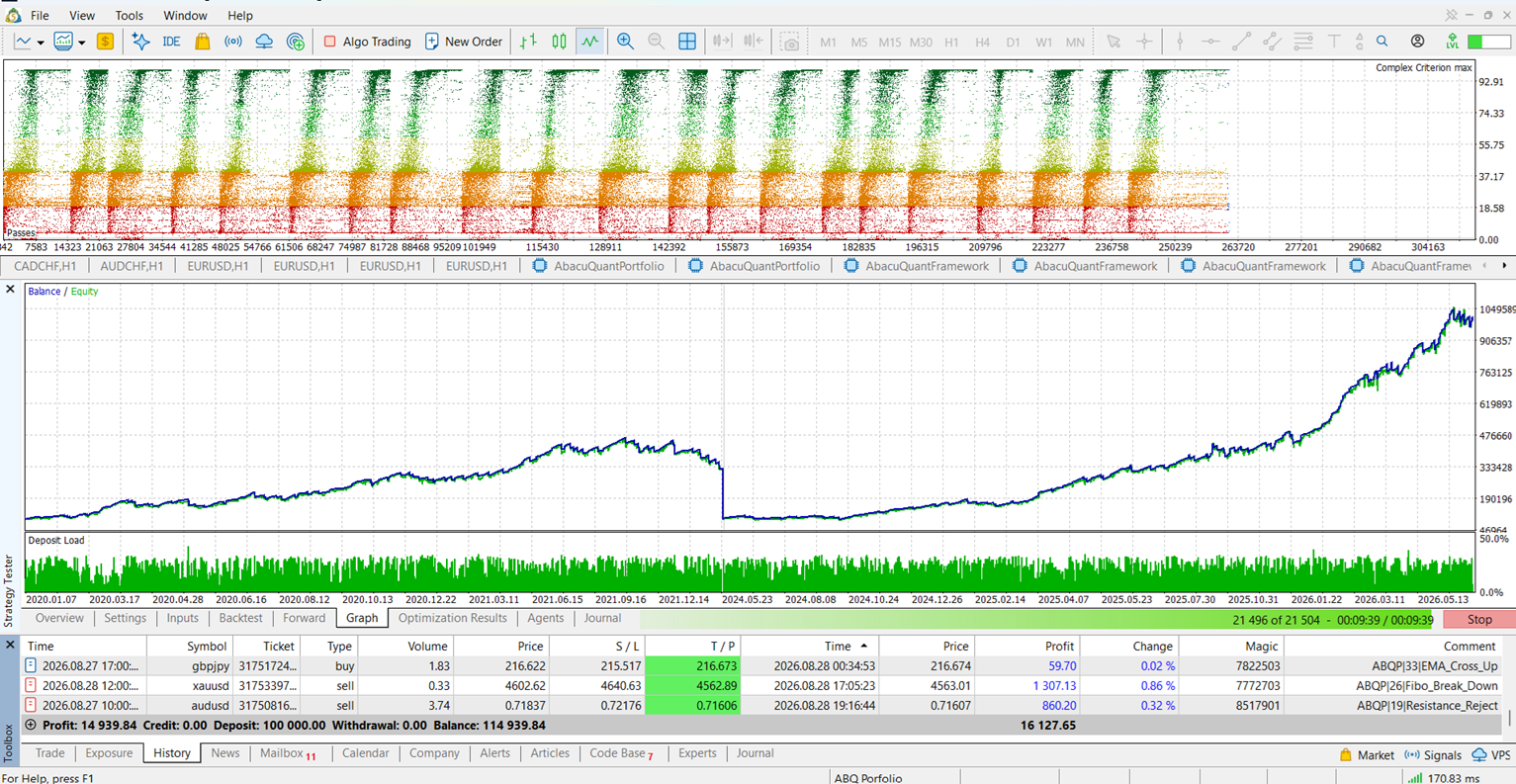
These remarkable optimization results were generated using the AbacuQuant Portfolio EA, available here:
What makes this interesting is that this is not a single strategy being optimized over and over. AbacuQuant Portfolio is designed as a portfolio engine, capable of running multiple independent configurations across different instruments and market conditions from a single MT5 chart.
The process starts by testing different combinations of strategies, trading conditions, parameters, stop/target structures and risk settings. Instead of simply looking for the configuration with the highest profit, AbacuQuant uses a custom optimization criterion designed to evaluate whether the historical win rate provides a meaningful margin above the break-even level implied by the stop and target structure.
The resulting configurations are then combined into a portfolio, allowing different strategies and instruments to operate during different market sessions while a shared risk engine controls total exposure at the account level.
The objective is not to find one “perfect” setup. It is to build a collection of independent configurations that complement each other and create a more robust portfolio.
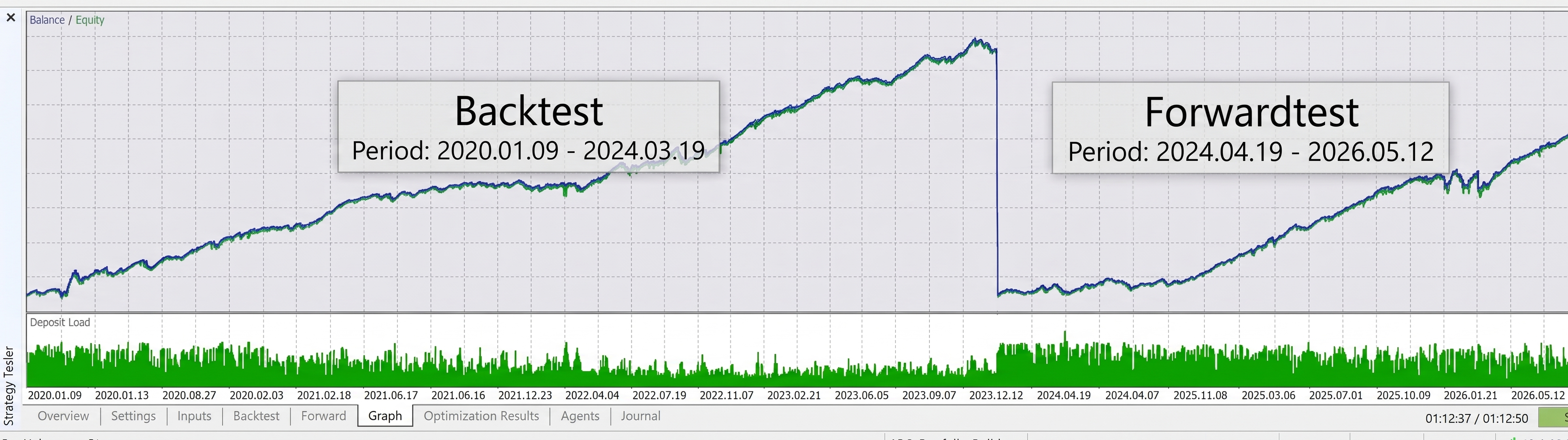
This image shows one of those optimization and portfolio-development results. The robot used to generate it is the AbacuQuant Portfolio EA.
🔗 https://www.mql5.com/en/market/product/191885
Cristian David Castillo Arrieta
Publicado o código Neural Loss-Pattern Auditor
Neural Loss-Pattern Auditor trains a small feed-forward neural network, written from scratch in native MQL5, on closed-deal history to test whether behavioral and market-context features predict which trades are more likely to lose. It reports an accuracy uplift over a naive baseline, a probability-calibration table, a permutation feature-importance ranking, and a configurable A-F composite grade with recommendations. On first run it uses a built-in synthetic demo, so the output is visible immediately with no setup; switch one input to InpUseDemoData=false to analyze real account history instead. Pure MQL5: no external libraries, no Python, and no AI service of any kind.
89
Cristian David Castillo Arrieta
Introduction AbacuQuant Portfolio is a multi-configuration Expert Advisor for MetaTrader 5. Instead of running one strategy with one set of parameters on one instrument, it runs up to 48 independent configurations at the same time, across EURUSD, GBPUSD, USDJPY and AUDUSD, from a single H1 chart...
Cristian David Castillo Arrieta
After months of research, I've published AbacuQuant Portfolio — a multi-configuration Expert Advisor for MetaTrader 5, and I wanted to share it here first.

Why it's different

Most EAs run one strategy with one set of parameters on one instrument. This one runs up to 48 independent configurations at once, across EURUSD, GBPUSD, USDJPY and AUDUSD, from a single chart. Each configuration owns its own trading hours, its own combination of ten built-in strategies, and its own ATR-based stop and target. A configuration built for the London session simply doesn't trade outside it — and risk is measured across the whole account, not per configuration, so running four instruments together doesn't quietly multiply your exposure.

And it's built the honest way: no martingale, no grid, no averaging into a losing position, no hidden loss-recovery logic. Every stop is attached the moment the trade opens. If you've been burned by an EA with a beautiful equity curve that fell apart the first time the market disagreed with it, this was built specifically against that failure mode.

How it decides a trade

Each active configuration waits for its window, reads only completed H1 bars (never the forming candle), requires several of its enabled strategies to agree, and sizes the position from the stop distance rather than a fixed lot — so a wider stop always means a smaller position, and the money at risk stays constant. Every configuration passed the same acceptance procedure on real-tick data before it shipped: statistical significance over its own break-even line, a minimum number of losing trades to actually measure it, and stops that were genuinely reached rather than just theorized.

Try it before you take my word for it

The demo runs in full inside the Strategy Tester — same presets, same logic, no time limit. Turn on the validated instruments, select "Every tick based on real ticks," and look at the trade list yourself: the stops, the position sizing, the risk ceilings holding across instruments. I'd rather you find out in the tester, for free, than after committing real money.

Link to the product page: https://www.mql5.com/en/market/product/191885
Cristian David Castillo Arrieta Produto publicado

AbacuQuant Portfolio: Expert Advisor de múltiplas configurações Até 48 configurações independentes. Múltiplos instrumentos. Um único gráfico. Gestão de risco em nível de conta. Expert Advisor para MetaTrader 5 capaz de operar EURUSD, GBPUSD, USDJPY e AUDUSD a partir de um único gráfico H1. Inclui presets validados e um modo manual completo. Não utiliza Martingale, Grid, averaging down nem sistemas de recuperação de perdas. Cada configuração possui sua própria janela de negociação, combinação de

Cristian David Castillo Arrieta
Publicado o artigo Building a Hidden Risk of Ruin Auditor in MQL5
Building a Hidden Risk of Ruin Auditor in MQL5

Aggregate metrics alone do not reveal how a trade sequence manages risk. This MQL5 tool analyzes closed positions to flag four structural patterns: post-loss volume escalation, overlapping same-direction entries, asymmetric payoffs, and a classical risk-of-ruin figure. The results are merged into a configurable A-F grade with concise recommendations to guide further review.

Cristian David Castillo Arrieta
Publicado o código Scale Out Value Analyzer
A native MQL5 tool that reconstructs closed positions from deal-level history, flags the ones closed through more than one exit, and reprices each one at its own first, last, and best exit rates to measure whether scaling out actually added value. Reports a Value-Add Ratio, a Scale Out Win Rate, an Efficiency figure, and a single-trade dependence check, combined into an A+ to F score with recommendations. Runs out of the box against a built-in demonstration data set; a companion script exports the real input file from your own account history. Pure MQL5, no external libraries.
101
Cristian David Castillo Arrieta
Publicado o código Hidden Risk of Ruin Auditor
Lê um histórico de operações com posições encerradas (um arquivo CSV ou um arquivo gerado automaticamente a partir do histórico de operações da conta atual pelo script complementar RuinExport.mq5) e apresenta quatro indicadores de risco independentes: aumento do volume após uma perda, sobreposição de exposições na mesma direção que resultam, em média, em um preço pior, assimetria de retorno entre ganhos e perdas e uma estimativa clássica do risco de ruína para um risco definido por operação. As quatro pontuações são combinadas em uma única nota de A a F, acompanhada de recomendações em linguagem simples. Se nenhum arquivo CSV for encontrado, o script gera automaticamente um livro de demonstração reproduzível, de modo que o relatório fique visível já na primeira execução.
Cristian David Castillo Arrieta
Publicado o artigo Execution Cost and Slippage Sensitivity Analyzer
Execution Cost and Slippage Sensitivity Analyzer

Backtests often understate spread, commission, and slippage. This MQL5 analyzer loads closing deals and simulates rising execution costs to measure robustness. It computes the breakeven cost per deal, the cushion over an assumed cost, the net profit and profit factor at that cost, and how many winners turn into losers, then summarizes the result with an A+ to F grade and targeted guidance.

Cristian David Castillo Arrieta
Publicado o artigo Creating a Profit Concentration Analyzer in MQL5
Creating a Profit Concentration Analyzer in MQL5

Net profit and win rate tell you how much a strategy made, not how the result is distributed. This article builds a native MQL5 script that reads your closed trades and measures profit concentration: the top-N trade share, the Gini coefficient of the winners, an outlier-dependence stress test that removes the best few winners, and the largest day against a prop-firm consistency limit. It combines these into one A+ to F score with recommendations, running inside MetaTrader 5.

Cristian David Castillo Arrieta
Publicado o código Portfolio Correlation and Margin Risk Calculator
Calcula a correlação histórica de Pearson entre qualquer conjunto de instrumentos e a margem combinada que sua conta precisaria para mantê-los todos ao mesmo tempo, expressa como porcentagem do seu patrimônio líquido. Funciona nativamente no MetaTrader 5, sem bibliotecas externas, sem Python e sem IA — basta definir sua lista de símbolos e os tamanhos dos lots como parâmetros de entrada, e ele exibe a matriz completa na aba “Especialistas” e no gráfico, atualizando-se periodicamente.
Cristian David Castillo Arrieta
Why the same trailing stop breaks the moment Gold changes character

I was in a forum thread today about trailing stops on XAUUSD, and it made me put into words something I've been building my whole approach around for a while: almost every trailing method traders compare — EMA cross, Chandelier, ATR multiples, swing-structure trails — gets judged on a single backtest run over one continuous chunk of history. The "best" multiplier or ladder step that wins that test isn't actually the best method. It's the method that happened to fit whatever mix of trend and chop was sitting in that sample.

The fix I use is simple to describe and annoying to implement properly: split the history into volatility regimes first (I use ATR percentile over a rolling window, expansion vs. compression), then optimize and validate each piece of logic separately per regime instead of once over the whole dataset. A structural trail wins clearly in expansion. In compression it just gets chopped up by noise, and something tighter does better there. Neither method is "the winner" — the regime decides which one applies.

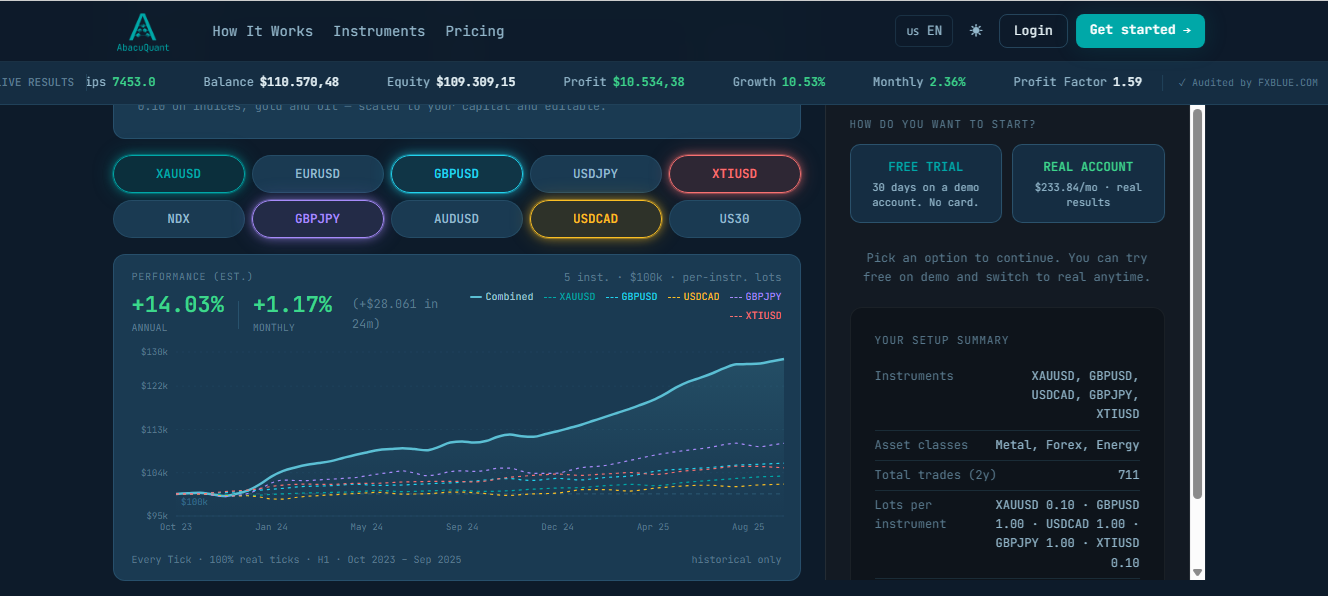
That's the same principle I ended up building AbacuQuant around, just scaled up from one exit rule to an entire portfolio. Instead of one strategy tuned to look good on one backtest, the logic behind each strategy is walk-forward tested and optimized (genetic optimization, not a single curve-fit) across different market regimes and asset classes, forex, metals, indices, energy, ETFs, individual stocks — and then combined into a portfolio specifically to keep cross-asset correlation low (the current version sits under 0.4 correlation across most pairs in the book). The idea isn't "find the one strategy that beats the market." It's "find enough structurally different, regime-validated pieces that the portfolio doesn't fall apart when one regime ends," which is exactly the failure mode people are describing in that XAUUSD thread, just at the position level instead of the portfolio level.

It also runs entirely inside your own MetaTrader account nothing custodial, your funds never move to a third party and the newer version adds the drawdown/consistency rules prop firms check for, since that's become how a lot of people are actually trading it live.

If any of this is useful for how you're thinking about your own trailing logic or portfolio construction, happy to go deeper in the comments. And if you want to see what the regime-validated approach looks like applied across a full portfolio rather than one exit rule, it's at abacuquant.com.

Cristian David Castillo Arrieta
Build your own portfolio and connect it to your demo (free) or live account.

www.abacuquant.com
Cristian David Castillo Arrieta
Publicado o código Execution Cost Sensitivity Analyzer
Um script totalmente em MQL5 que avalia a robustez da vantagem de uma estratégia em relação aos custos de execução. Ele lê um arquivo CSV com os campos Data, Lucro e Volume das operações encerradas e modela o custo de cada operação como uma parte fixa mais uma parte por lote. Ele exibe o custo de equilíbrio por operação, a margem de segurança (o múltiplo de um custo realista presumido no qual o lucro líquido chega a zero), o lucro líquido e o fator de lucro reajustados ao custo presumido, a proporção de operações lucrativas que o custo transforma em operações com prejuízo e uma nota composta de A+ a F para a robustez em relação aos custos, acompanhada de recomendações. Se não houver nenhum arquivo, ele gera uma amostra reproduzível e a analisa, de modo que o resultado seja visível já na primeira execução. Sem bibliotecas externas, sem Python, sem IA.
Cristian David Castillo Arrieta
Publicado o artigo Beyond Maximum Drawdown: Building a Drawdown DNA Analyzer in MQL5
Beyond Maximum Drawdown: Building a Drawdown DNA Analyzer in MQL5

Maximum drawdown is one number that hides what really matters: how often an equity curve declines, how long it stays below a previous peak, and how quickly it recovers. This article builds a native MQL5 tool that reconstructs the underwater curve, breaks it into individual drawdown episodes (depth, duration, recovery time), computes the Ulcer Index, Pain Index, and Recovery Factor, and combines them into a single resilience grade with practical recommendations. No external libraries, no Python, no AI.

Cristian David Castillo Arrieta Produto publicado

Funded Trade Manager MT5 Most funded accounts are not lost to a bad strategy. They are lost to a single day that went too far: one oversized position, one revenge trade, one violated daily loss limit. Prop Firm Guard is a chart panel that applies the same limits your funding company applies, before the company does. What it does Tracks your daily loss limit and maximum drawdown in real time, using the same day-reset logic prop firms use (configurable server reset hour). Blocks any new trade

Cristian David Castillo Arrieta
Publicado o código Profit Concentration Analyzer
Um script nativo em MQL5 que mede o grau de concentração do lucro de uma estratégia — se a vantagem é ampla ou se depende de poucas operações de sorte. Ele lê um arquivo CSV com dados por operação (Data, Lucro) e apresenta a parcela do lucro líquido proveniente das maiores operações, o coeficiente de Gini das operações lucrativas, um perfil de concentração, um teste de sobrevivência que remove as melhores operações e recalcula o lucro líquido e o fator de lucro, e o maior ganho em um único dia em comparação com um limite de consistência configurável, combinados em uma pontuação de concentração e consistência (A+ a F) com recomendações. Se nenhum arquivo for encontrado, ele gera um conjunto de amostras, de modo que funciona imediatamente, sem necessidade de configuração. Sem bibliotecas externas, sem Python, sem IA. O auxiliar ExportTrades.mq5 grava o arquivo a partir do seu histórico de negociações.
Cristian David Castillo Arrieta
Publicado o código Drawdown DNA Analyzer
Um script nativo em MQL5 que analisa a estrutura das quedas de valor de uma conta, e não apenas o valor isolado da “queda máxima”. Ele lê uma curva de patrimônio diária (arquivo CSV com Date e DailyPnL), reconstrói a curva de patrimônio negativo e a divide em episódios individuais de queda, com sua profundidade, duração e tempo de recuperação. Em seguida, ele apresenta o Índice de Úlcera, o Índice de Dor, o Fator de Recuperação e o tempo passado em território negativo, combinando-os em uma única pontuação de resiliência (de A+ a F) com recomendações, exibidas na aba “Experts”. Não utiliza bibliotecas externas; caso nenhum arquivo seja encontrado, ele gera uma curva de amostra para que possa ser executado imediatamente.
123