Axiom Engine
- Experts
-
Shi Chao Ma
 Never trust anything that can think for itself,
If you can't see where it keeps its brain. - Versione: 1.1
- Aggiornato: 12 giugno 2026
- Attivazioni: 20
Product Positioning
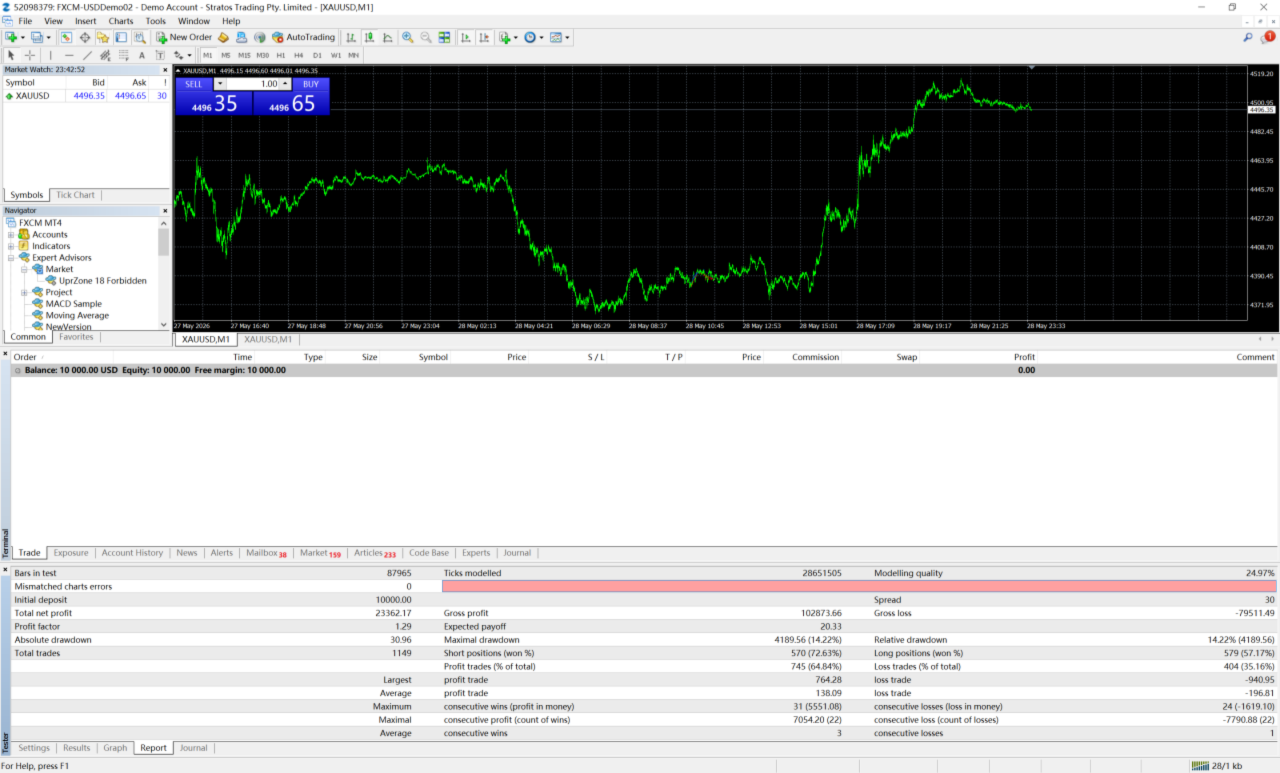
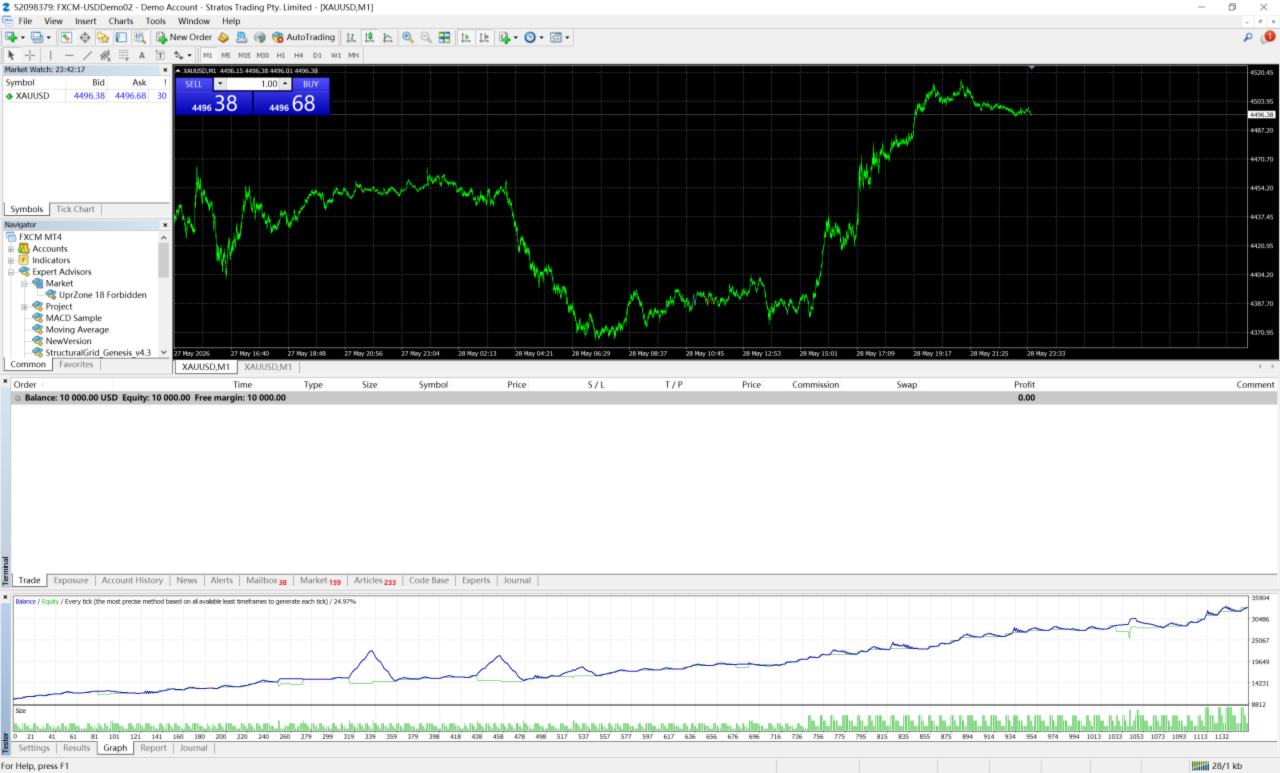
AdaptiveTrendGrid Pro is a fully automated Expert Advisor (EA) that combines trend following with a grid execution strategy, designed for professional traders. At its core, the system anchors itself to an intraday trend reference point and dynamically deploys a multi-layered grid of pending orders along the direction of price movement. It integrates an eight-tier progressive risk-defense architecture and a quantitative market-monitoring module, enabling it to pursue trend profits while maintaining closed-loop drawdown control. The system has been deeply optimized for volatility-sensitive instruments, particularly gold (XAUUSD), and supports both standard and cent accounts. Recommended capital: $10,000 and above.
Design Philosophy
Traditional grid strategies are often crippled by relentless one-way moves or violent volatility spikes. The design objective of AdaptiveTrendGrid Pro is to give a grid strategy both “trend awareness” and “environmental adaptability.” Not only does it engage promptly when a trend begins, but it also activates successive defense mechanisms when the market reverses into a compression phase, when drawdown exceeds thresholds, or when abnormal volatility appears—starting with pausing new orders, partial liquidation, counter-hedging, adapting to volatility compression, and, in extreme cases, full closure of all positions. The entire logic acts like a series of safety airbags layered around the grid, engineered to push the probability of a catastrophic daily loss to the absolute minimum.
Core Features at a Glance
1. Trend Grid Engine
-
At the start of each trading day, within a set initial time window, the system identifies an extreme price point to serve as the anchor.
-
Around this anchor price, it automatically generates multiple levels of pending orders (Buy Stop / Sell Stop) with scaled lot-size multipliers both above and below, forming a two-way breakout grid.
-
A built-in dynamic take-profit logic continuously adjusts the aggregate profit target based on current open positions, the buy-sell imbalance, and the account equity bracket, rather than clinging to a fixed percentage.
2. Eight-Layer Risk Defense System
The system categorizes risk-control actions into multiple layers, ranging from “normal take-profit” to “full circuit breaker,” triggered progressively from low to high:
-
Normal Take-Profit – The dynamic profit target is reached; all positions are closed.
-
Pause Opening + Adjust SL/TP – When floating loss hits a warning line or order volume is excessive, new orders are stopped, and existing stop-loss and take-profit levels are modified.
-
Rescue Hedge – Under specific conditions, counter-direction pending orders are deployed to reduce net exposure and capture short-term retracements.
-
Risk Release Engine – In deep drawdown, the system intelligently closes some losing or winning positions based on portfolio structure, then waits for favorable price expansion.
-
Warm-Water Frog Escape – When the system detects a slow but relentless adverse drift and drift-confidence reaches a threshold, it automatically switches to a “high-ATR escape mode,” first closing losing positions while keeping winners, then exiting fully after a large counter-move.
-
Volatility Compression Adaptation – Upon detecting a sustained contraction in market volatility, the strategy pauses, cancels take-profits, and waits for volatility to resume and trend clarity to return before re-evaluating entry direction.
-
Half-Close Protection – When drawdown exceeds a predefined threshold, the system automatically closes half of the highest-risk positions; if conditions worsen, it halves again, buying time with reduced exposure.
-
Full Circuit Breaker – If intraday drawdown hits the hard stop-loss line or quantitative models signal extreme risk, all positions are liquidated, and trading is locked for the rest of the day.
3. Quantitative Monitoring & Pre-emption
-
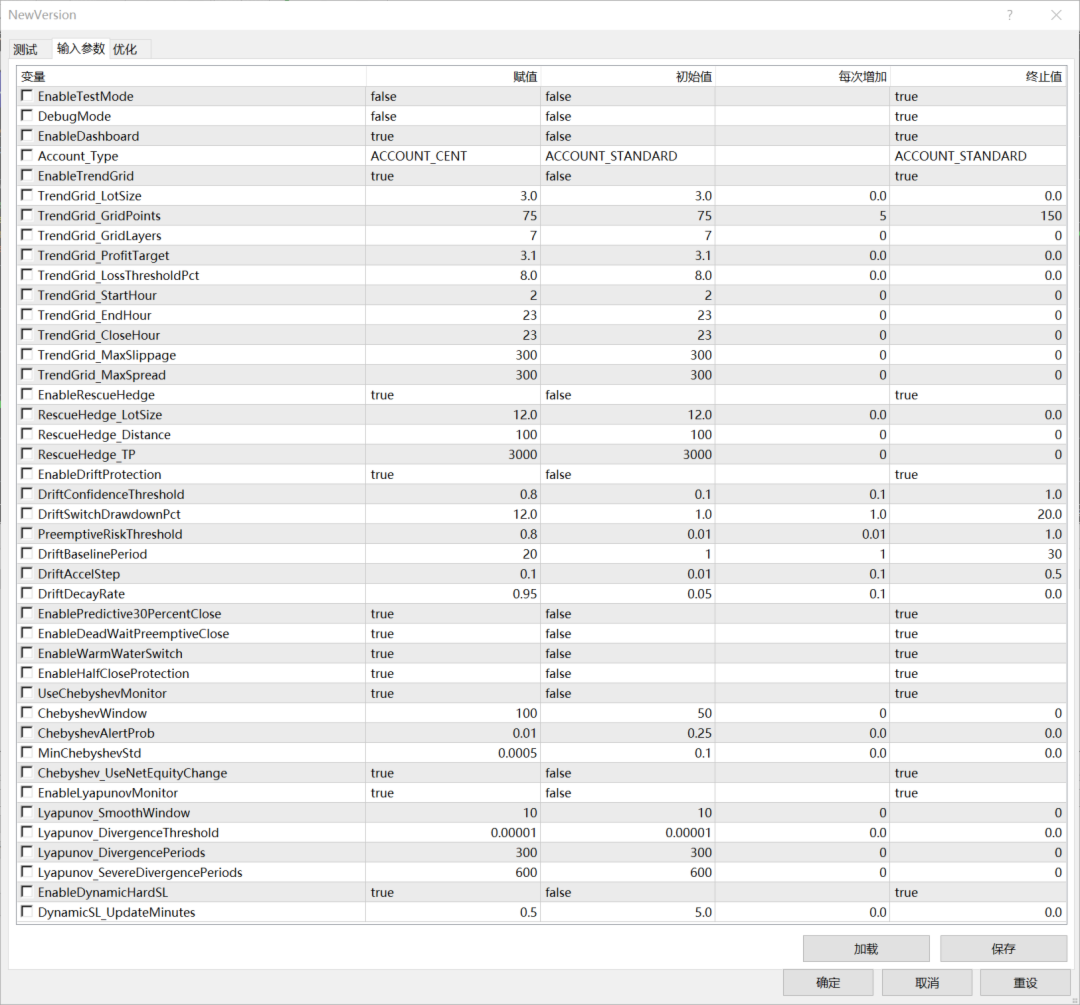
Chebyshev Inequality Monitor – Tracks the distribution of net-equity changes and identifies statistically ultra-low-probability abnormal fluctuations, triggering preemptive protection.
-
Lyapunov Stability Analysis – Constructs an “energy function” from account drawdown and continuously monitors whether it tends to diverge. Once instability is confirmed, new order placement is blocked.
-
30% Risk Probability Prediction – By combining net position lots, adverse drift distance, remaining trading time, current ATR, and the degree of volatility compression, the system estimates the probability of hitting the daily hard stop. If the probability is too high, it executes a preemptive full close without waiting for an actual loss to materialize.
4. Intelligent Position Management
-
During low volatility or “dead-waiting” markets, a gradual profit-taking routine is activated: it harvests one profitable lot at a time at regular intervals, while a price-movement monitor further trims positions when favorable price travel accumulates to a certain distance—slowly reducing exposure instead of liquidating all at once.
-
The dynamic hard stop-loss system recalculates a unified stop-loss level every few minutes based on the day’s opening balance, ensuring that a basic floor remains in place even if the network or platform temporarily fails.
-
After a rescue hedge order is hit at take-profit, the take-profit levels of the corresponding trend-grid positions are automatically adjusted, creating a synergistic effect.
Trading Environment & Compatibility
-
Instruments: Optimized for XAUUSD (gold); also supports major forex pairs.
-
Timeframe: Internal indicators operate on H1; execution and decisions are tick-based.
-
Account Types: Automatically distinguishes between cent and standard accounts and adjusts lot-size bases accordingly.
-
Operation: Designed for 24-hour runtime, with built-in daily cleanup and state-reset mechanisms requiring no manual intervention.
Visual Dashboard
The EA draws a real-time status panel on the top-left of the chart, allowing the trader to see at a glance:
-
The currently active strategy module and defense layer
-
Market microstructure (tick density, spread pressure, candle body-to-wick ratio)
-
Day’s maximum drawdown, live equity, opening equity
-
Probability bars for events like take-profit, rescue, risk release, and hard stop
It turns a black-box strategy into an explainable and monitorable transparent system.
Two Worldviews: Solving Outward vs. Solving Inward
The design of a trading system ultimately answers a fundamental question: where does the sense of security come from?
This question divides people into two paths.
Solving Outward: Trusting the Law of Large Numbers to Deliver Probability Edge
Most trading strategies share an underlying belief: the world contains discoverable statistical regularities, and I can possess a probability edge.
This path, taken to its extreme, leads to a holy grail called the Law of Large Numbers.
A probability edge is not about a single outcome. It requires a time series long enough to cover random noise so that the true edge gradually surfaces. Flip a slightly biased coin once and it means nothing; flip it a hundred thousand times, and that tiny bias becomes certainty. This is the promise of the Law of Large Numbers—given enough trials, probability turns into destiny.
But the problem lies in the premise: “given enough trials.”
Who can afford “enough”? Who can survive on the way to “enough”?
Large institutions can. They have a massive volume of trading opportunities across instruments, markets, and time horizons. They can absorb ten, twenty, or even more consecutive stops without wavering. Their equity curve will not hit a survival floor during a sequence of losses. More importantly, they possess a transgenerational time perspective—they don’t need to get rich next year; they only need to maintain an edge over a decade, letting the Law of Large Numbers silently, inexorably complete its work.
Their outward solution is rational and self-consistent, because they satisfy the Law’s implicit condition: the infinite game.
But what about the individual trader?
When a person runs a strategy with a 55% win rate on a $20,000 account, he is also solving outward, also believing in a probability edge. Yet he overlooks one thing: the Law of Large Numbers requires a time scale to materialize, and he simply does not have infinite time—or rather, his capital cannot survive on that scale.
Ten consecutive stops are noise for an institutional account; for him, they could be catastrophic. It is not that the strategy is bad; it is that he does not meet the precondition of the Law.
Push the outward solution to its depth, and it becomes a philosophical impasse: the probability edge is real, but it requires an infinite game to be realized. And most people are destined to play only a finite game.
Institutions are qualified to solve outward, because they can afford to bet on the slow arrival of the Law of Large Numbers.
Solving Inward: Not Relying on Frequency, Only Ensuring Stability Now
AdaptiveTrendGrid Pro chose a fundamentally different path.
It does not pursue the accumulation of probability advantage over a large number of repeated trades. It does not assume the protection of the Law of Large Numbers. It does not even care whether the next trade will win or lose.
It asks only one question: “Right now, is my account structurally stable?”
This shift is fundamental. It moves the source of security from “can the probability edge be realized in the future” to “can the system structure be maintained right now.”
Chebyshev’s inequality is a perfect embodiment of this philosophy. It does not need vast amounts of data to approximate the true distribution, nor does it assume any particular shape for the data. Whether the distribution is normal, fat-tailed, or anything else—it accepts all. It uses a universal mathematical truth to give an absolute upper bound: regardless of how the data is shaped, the probability of deviating from the mean by more than k standard deviations never exceeds 1/k².
The outward solution needs countless trades to approach that “true probability”; the inward solution needs only a current sequence fragment to produce a logically incontestable safety boundary.
The former relies on frequency; the latter does not.
Lyapunov stability pushes this philosophy into an even deeper dimension.
In physics, to judge whether a system is stable, one does not look at how far it is from equilibrium, but rather whether, after a disturbance, it returns toward equilibrium or moves further away. Lyapunov’s method is this: define an energy function for the system—a mathematical abstraction of its degree of disorder—and then continuously track its derivative.
If the derivative points toward zero, the system is self-repairing; energy is dissipating. If the derivative remains consistently positive, the system is accelerating away from equilibrium, even if it does not yet look like it is in big trouble.
The key here is: you don’t need to know what caused the disturbance. Why the market gapped, what the central bank said, why liquidity dried up—all of this can remain unknown. The only thing you need to know is: right now, is my energy dissipating or accumulating?
This is the essence of solving inward. It does not care about the rules by which the world operates; it only cares about the response of its own structure.
The Fork in the Road: Finite Game vs. Infinite Game
The divergence between the two paths ultimately points to a deeper question: are you playing an infinite game, or a finite one?
Institutions play an infinite game. They have an endless stream of trading opportunities, infinite instrument coverage, and infinite time horizons. Therefore, the outward solution works for them—the Law of Large Numbers will deliver. They can place their sense of security in a probability edge that will only be proven far in the future.
Individual traders play a finite game. Capital is limited, drawdown tolerance is limited, and time is limited. When you are playing a finite game, putting your safety in a promise that requires a large sample to materialize is simply betting that you won’t happen to die before the Law of Large Numbers arrives.
The inward-solving philosophy is designed for the finite game.
It does not ask, “do I have a probability edge in the long run?” because the long run is a luxury for the finite-game player. It only asks, “am I safe right now?” If every moment is safe, then strung together, that becomes the only possible way to survive into the long term.
Final Summary
Solving outward believes: as long as regularities are stable and the sample is sufficient, the probability edge will eventually be realized.
This is the projection of rationalism onto financial markets—elegant, rigorous, but its premise—the infinite game—is a luxury reserved for institutions.
Solving inward believes: I do not know whether regularities are stable; I don’t even require that tomorrow be like today. But I can solve for the structural state of my own system and act before it destabilizes.
This is a philosophy prepared for the finite-game player. It shifts certainty from a statistical promise in the future to a logical necessity in the present.
One relies on the Law of Large Numbers; the other on mathematical proof.
One bets on the future; the other proves the present.
That is the fundamental distinction between the two paths.