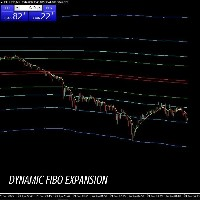
Dynamic Fibo Expansion
- Indicatori
- Versione: 1.0
- Attivazioni: 5

Core Components and How It Works
This indicator essentially combines three main elements to provide a comprehensive view of price action:
-
The EMA14 Line (Yellow Line)
- This is a Simple Exponential Moving Average calculated from the closing prices of the last 14 candlesticks.
- Function: Its primary role is to show short-term price trends. If the line is sloping upwards, it suggests an uptrend; if it's sloping downwards, it indicates a downtrend.
-
The Longer EMA Lines (Two Red Lines)
- The indicator calculates two longer-period EMAs (defaulting to 1440 periods, which could represent a 1-day EMA if the chart timeframe is M1).
- One line is calculated from the highest price (High) of each candlestick.
- The other line is calculated from the lowest price (Low) of each candlestick.
- Function: These two lines create an "EMA channel" or "zone". This wider channel helps visualize longer-term trends and the dynamic boundaries of price fluctuation within that period.
-
The Dynamic Fibonacci Expansion Lines (Other Colored Lines, e.g., Green, Aqua, Dodger Blue)
- Using the "EMA channel" from the longer EMAs (specifically the range between the EMA High and EMA Low), the indicator calculates a set of Fibonacci expansion levels.
- There are four lines that "expand upwards" from the EMA High line (these are your "Outer High" Fibo expansions).
- And another four lines that "expand downwards" from the EMA Low line (these are your "Outer Low" Fibo expansions).
- Function: These lines serve as dynamic potential support and resistance levels or price targets based on Fibonacci theory. Because they are derived from the moving EMA channel, they adapt to price movement, unlike static Fibonacci levels drawn manually.
Overall Summary
In essence, the "Dynamic Fibo Expansion + EMA14" indicator plots multiple EMA lines to identify both short-term and long-term trends. It then utilizes the range of the longer-period EMAs to generate dynamic Fibonacci expansion levels. This helps traders visually identify key price zones that are constantly adjusting to market volatility, combining the power of moving averages with Fibonacci principles.