Break-even stop in MT5: why a trade stopped at entry still loses money

You moved your stop to break-even, the trade came back and stopped out at entry. MT5 still shows a small loss. That isn't a bug: a stop at the entry price doesn't cover commission or swap. Here is what break-even really costs and how to set it so it means what it says.
1. What break-even is supposed to do
Once a trade has moved in your favour, you move the stop to where you got in. From that moment the trade can't lose. That's the idea, anyway. You trade a little upside for not giving back the whole move.
2. Why "at entry" isn't zero
The price part is zero: you bought at a price and sold at the same price. The costs around it aren't.
Commission. If your broker charges $7 per lot round turn, one lot stopped exactly at entry closes at -$7. On EURUSD that's 0.7 of a pip, so a "break-even" stop needs to sit 0.7 pips past entry to come out at zero.
Swap. Held overnight, the trade collects or pays swap. A negative swap turns a stop at entry into a small loss.
Slippage. A stop is filled at the next price available. In a fast market a stop at entry can fill a pip or two worse.
3. Break-even plus costs
The fix is simple: put the break-even stop at entry plus the commission per lot, in price. For a buy on EURUSD at 1.08500 with $7 per lot, that's 1.08507. A stop there comes out at roughly zero, before swap and slippage.
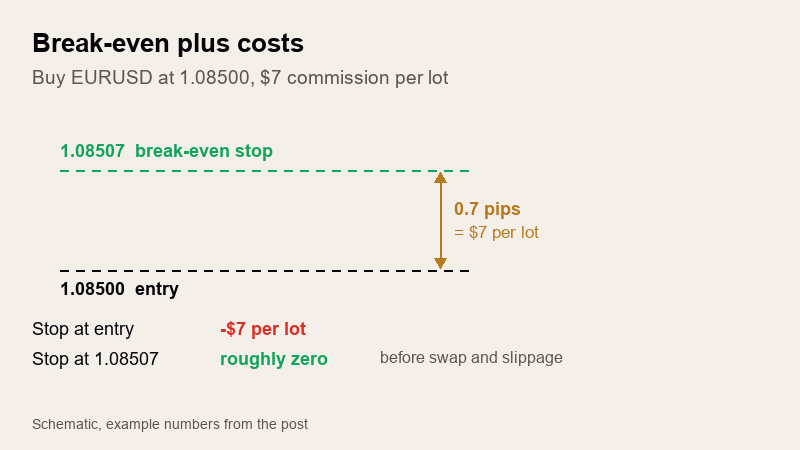
Buy at 1.08500, $7 commission per lot: break-even stop at 1.08507
4. When to move it
This is where traders disagree. There's no answer that suits everyone.
Move it early (at half the distance to your target or at 1R, one times what you risked) and you'll be stopped at break-even more often, on trades that would have gone on to win.
Move it late and you keep more winners alive but give back more on the ones that turn.
The honest way to choose is your own history. Look at your closed trades: how many reached 1R and then came back past entry? If it's many, an earlier break-even would have saved them. If most trades that reach 1R go on to the target, an early break-even mostly costs you winners.
5. Break-even with a partial close
Many traders combine the two. At 1R they close part of the position and move the stop to break-even on the rest. If the rest stops out, the trade still ends with the partial's profit, minus commission on both parts. Check that your partial respects the lot step: half of 0.03 lots is 0.015. No broker takes that.
6. A checklist for your own setup
- Where does your break-even stop sit: at entry or at entry plus commission?
- At what profit does it move: a number of pips or a multiple of your risk?
- Does it include swap if you hold overnight?
- Does your partial close round to the lot step? Which way?
How RiskDeck fits in
RiskDeck by Dojiwave has auto break-even at a threshold in R (1R is the amount you risk on the trade): the stop moves to entry plus your commission. It can also take partial closes and trail the stop by your plan. Your result in R counts swap and commission, so you can see in your own numbers what break-even really did for you.