Moving your stop loss to your entry price does not always mean you will close the trade with zero profit or loss.
And when you have multiple positions open, finding the actual break-even level becomes more complicated.
The reason is simple: your entry prices, position sizes, spreads, commissions, and swaps all affect the final result.
Let's look at how this works.
1. Break-Even Is Not Always Your Entry Price
Imagine you open a BUY position at 1.10000.
Later, the price moves in your favor, and you move your stop loss to 1.10000.
It looks like a risk-free trade.
But is it?
For most Forex BUY positions, the trade closes at the Bid price. If your stop loss is executed exactly at 1.10000, the price difference between entry and exit is zero.
However, you may still have trading costs:
- Commission paid when opening or closing the trade
- Swap charges for holding the position overnight
- Slippage during stop-loss execution
So even if the stop loss is filled at the original entry price, your final account result can still be negative.
Break-even on the chart is not necessarily break-even in your account.
2. The Break-Even Price Changes When You Add Positions
Now imagine you open three BUY positions on EURUSD.
| Position | Entry Price | Lot Size |
|---|---|---|
| Entry 1 | 1.10000 | 0.10 |
| Entry 2 | 1.09800 | 0.20 |
| Entry 3 | 1.09600 | 0.30 |
You now have a total position size of 0.60 lots.
Because the position sizes are different, you cannot simply average the three entry prices.
Instead, you need a lot-weighted average.
The calculation is:
(1.10000 × 0.10 + 1.09800 × 0.20 + 1.09600 × 0.30) ÷ 0.60
Weighted average entry price = 1.09733 (approximately)
This is the approximate price-only break-even level for these BUY positions, before commissions, swaps, and other execution costs.
If you had only the first two positions, the weighted average would be approximately 1.09867.
After adding the third position, it changes to approximately 1.09733.
That is why your combined break-even price changes every time you add another entry.
3. Spread Matters — But Be Careful Not to Count It Twice
A Forex chart may display Bid prices, while BUY orders are generally opened at Ask and closed at Bid.
This difference matters when planning entries, stops, and exits.
However, if your calculation already uses the actual executed BUY entry prices and the expected Bid closing price, the opening spread is already reflected in those prices.
You should not automatically subtract the same spread a second time.
For SELL positions, the opposite price sides generally apply: SELL orders open at Bid and close at Ask.
Understanding which price is used for execution is essential when calculating a realistic break-even level.
4. Commissions and Swaps Move the True Break-Even Level
Let's return to the three BUY positions.
Their weighted average entry price is approximately 1.09733.
If commissions and swaps create a net cost, the price must move slightly above that average for the combined positions to close at zero net profit or loss.
The exact adjustment depends on:
- The instrument's contract specifications
- Total position volume
- Commission structure
- Accumulated swaps
- The expected closing price
For example, a combined price profit of $5 does not mean the account result is +$5 if the total trading costs are $7.
The net result would be approximately -$2.
Swap credits can also reduce costs or contribute positively, depending on the positions and broker conditions.
The true financial break-even level is the price at which the combined net result is approximately zero after applicable costs.
5. Break-Even for Multiple Positions
When managing several positions, there are two different questions:
Individual break-even: At what price would one position close with approximately zero net profit or loss?
Combined break-even: At what price would all positions in the group close with approximately zero combined net profit or loss?
These are not necessarily the same.
One position might close at a profit while another closes at a loss, yet the total result can still be close to zero.
This is especially important for traders who scale into positions at different prices and with different lot sizes.
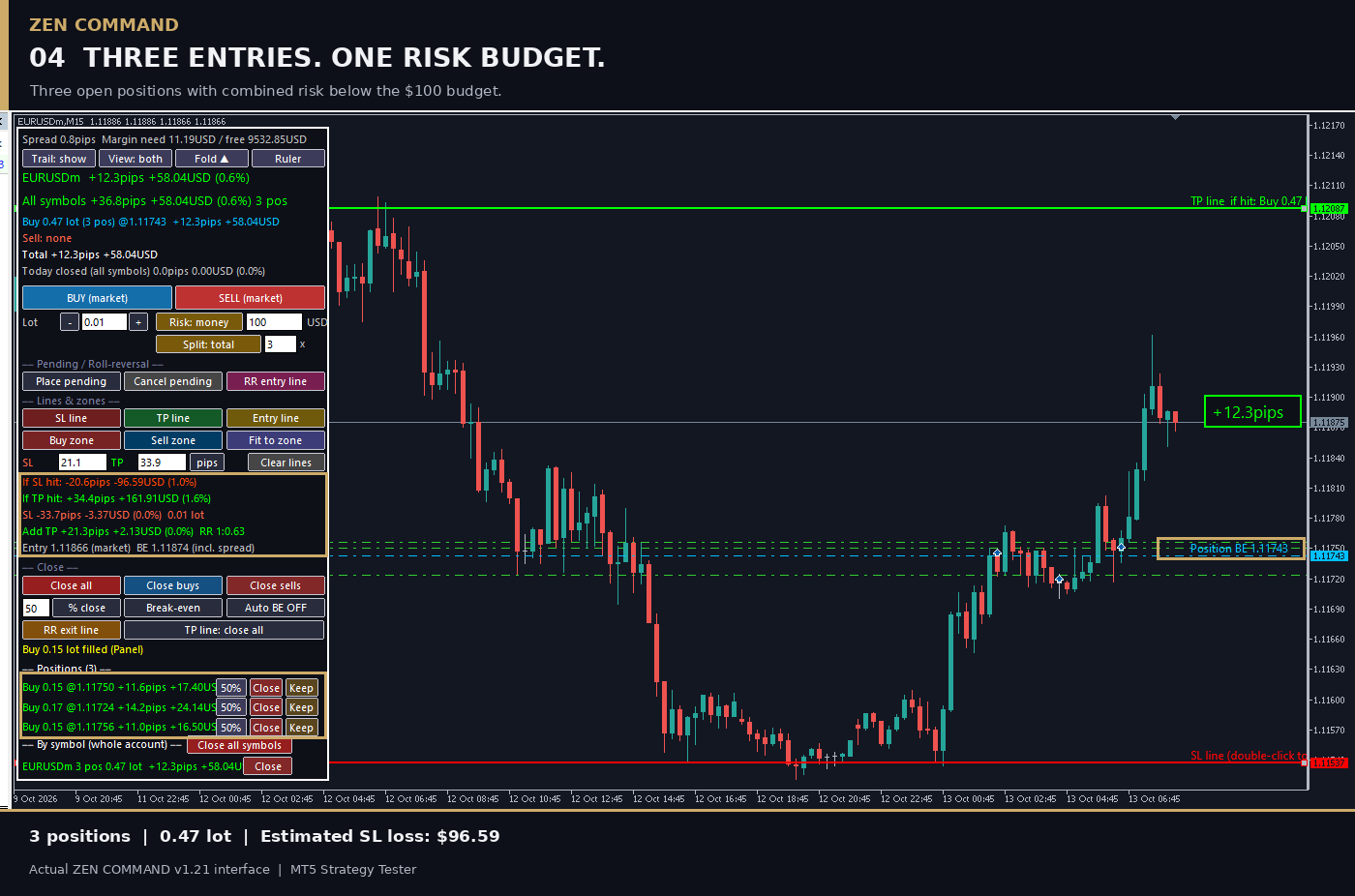
Some trade management panels, such as ZEN COMMAND, display a combined break-even level for multiple positions while accounting for relevant trading costs.
The purpose of such a display is to make position management easier to understand, not to guarantee an exact execution result.
6. A Practical Break-Even Checklist
Before moving your stop loss to break-even, check:
- Are you managing one position or several?
- Are the entry prices and lot sizes different?
- Are you using the correct Bid or Ask closing price?
- Have commissions and accumulated swaps been included?
- Could slippage affect the actual exit?
- Is the stop-loss modification permitted by your broker's minimum stop distance and freeze-level rules?
Remember that stop-loss orders do not guarantee execution at the requested price. Market gaps, slippage, and trading conditions can affect the final result.
Final Thoughts
Moving a stop loss to the original entry price may eliminate the planned price loss on a single position, but it does not automatically eliminate all financial risk.
And when you add positions, your combined break-even level changes because the weighted average entry price changes.
The key distinction is:
Entry-price break-even is a price calculation. True break-even is a net profit-and-loss calculation.
Understanding that difference can help you manage multiple positions with greater clarity.