[+58,615 USD] The Dollar Rallied Broadly but USD/JPY Could Not Hold Above 160: What to Watch for the Next Break to New H

Trading results | November 9–13, 2026
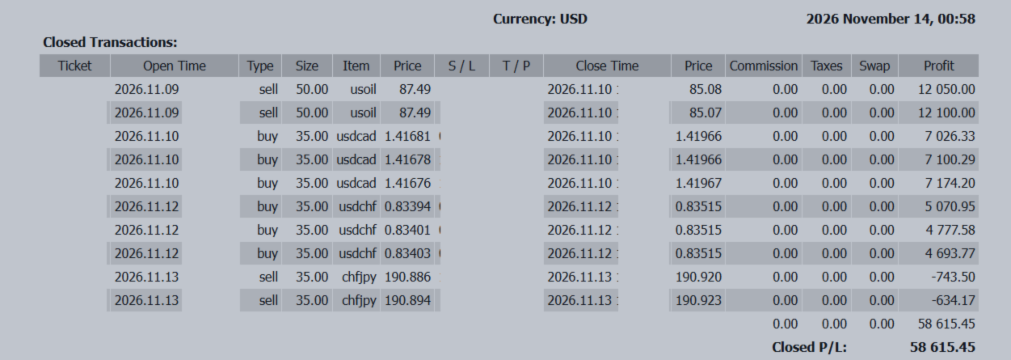
Weekly P&L | +58,615 USD
Weekly Review
Selling crude oil was the main source of profit this week. Long positions in USD/CAD and USD/CHF also added to the gains. The weekly result was +58,615 USD.
The turning point came with US CPI on November 10. USD/JPY had fallen to 157.67 early in the week, but rebounded after inflation came in higher than expected and US officials made comments supportive of further rate hikes. The pair reached 160.19 on November 13 and closed the week at 159.71.
Dollar buying also spread to European currencies. EUR/USD fell to 1.1020, while GBP/USD dropped into the low 1.32s. Even though UK GDP beat expectations, the pound failed to extend its gains. Rising US yields often outweighed currency-specific factors.
FX Strategy Update | November 16–20, 2026
After a Break Above 160, Watch for Buying on Pullbacks
Next week, the focus for USD/JPY will be whether buyers return on pullbacks after the pair moves back above 160. If the pair breaks this week’s high of 160.19 with US yields rising and can hold around 160 during a pullback, a continuation of the uptrend may be worth considering.
With official warnings against yen weakness in focus, a renewed rejection from above 160 followed by a break below the mid-159s could leave the pair vulnerable to a further unwinding of recent dollar buying if the recovery remains weak. Japan’s preliminary GDP on November 16, comments from BOJ Policy Board member Takata, and national CPI on November 20 will also show how much domestic yields and expectations for further BOJ rate hikes may shift.
Use US Retail Sales to Gauge Further Room for Dollar Buying
US retail sales on November 17 will show whether consumer spending remains resilient as prices rise. If strong data push US yields higher and dollar buying broadens against the euro and pound, it will be easier to view this week’s trend as continuing. If yields rise only briefly despite strong data, expectations for further rate hikes may already be priced in.
The FOMC minutes, due early on November 19 in Japan, reflect discussions held before the latest US CPI report. We will look at how widely officials shared concerns about inflation at the October meeting and compare the minutes with comments from policymakers after the CPI release.
Oil, the Canadian Dollar, and the Yen’s Response to Falling Equities
For USD/CAD, watch how Canadian yields respond to CPI on November 16 and retail sales on November 20. Even if oil falls, Canadian data may lift yields and support the Canadian dollar. In that case, we will reassess whether USD/CAD can continue higher. For crude oil shorts, we will look for lower rebound highs after inventory data or news about supply.
If Nvidia’s earnings trigger a sharp move in AI-related stocks, we will also monitor the impact on US Treasuries and FX. When equities fall and both the yen and dollar are bought, USD/JPY may lack a clear direction, while yen strength may be more visible in EUR/JPY and AUD/JPY.
Key Events Next Week
-
November 16: Japan’s preliminary GDP, comments from BOJ Policy Board member Takata, Canadian CPI
-
November 17: US retail sales, Nvidia earnings (US local date)
-
November 18: UK CPI, US weekly oil inventories
-
November 19: FOMC minutes early in the day; Australian employment data
-
November 20: Japan’s national CPI, UK and Canadian retail sales
Unless otherwise noted, dates refer to Japan time. Release schedules are subject to change.
Trading Plan for Next Week
If buying USD/CAD and USD/CHF at the same time, treat them as positions that could both move against us on a single dollar pullback. Set an exit level for each position, calculate the combined loss if both levels are reached, and adjust position sizes accordingly.
For USD/JPY, even if the pair breaks above 160 immediately after a data release, wait for buyers to return on the first pullback. If it falls below the mid-159s, check where the rebound stalls and focus on trades with a clearly defined exit level.
Afterword: Questioning What We Take for Granted Matters in Trading
In everyday life, we hold many beliefs that we accept without thinking.
For example:
-
“You lose the most body heat through your head when it’s cold.”
-
“A hot drink warms you up right away.”
-
“Cold weather gives you a cold.”
-
“You can’t get sunburnt in winter.”
We hear these things so often that, over time, we may assume they are facts.
But they are not always true.
Cold weather does not directly cause a cold. People spending more time close together indoors during winter can make it easier for infections to spread.
In snowy areas, it is also important to protect yourself from UV exposure in winter.
In other words, “people have always said it” and “it is actually true” are not necessarily the same thing.
The same is often true in the markets.
-
“Higher interest rates make a currency rise.”
-
“Risk-off means a stronger yen.”
-
“Strong employment data make the dollar rise.”
-
“Higher oil prices always strengthen the Canadian dollar.”
These are not wrong as basic ideas. But prices are not determined by any one factor alone.
The move may already be priced in. The market may be focused on something else. Positions may be so heavily skewed in one direction that prices move the other way even when the news is favorable.
That is why it is more important to watch what the market is actually doing than to rely on assumptions about what “should” happen.
When price action differs from your forecast, the market is not necessarily wrong. The assumption behind your view may be what needs reviewing.
The longer we trade, the more experience and successful examples we accumulate. That experience is a valuable asset. At the same time, it can become a fixed belief that “this is how the market behaves.”
In trading, the ability to question our assumptions matters just as much as gaining knowledge.
Next week, rather than drawing conclusions from headlines or past experience alone, we will stay flexible and assess actual price action, interest rates, relative currency strength, and the market’s response.