
Professional trading is about more than finding good entries and identifying market trends. Behind every disciplined trader is a technology setup designed to analyse markets, manage risk, execute trades, and maintain consistency.
In today's trading environment, technology plays an increasingly important role. From charting tools and automated strategies to account monitoring and trade management, the right combination of software can transform the way a trader operates.
But what does a professional trading technology stack actually look like? Let me break it down.
1. Market Analysis and Decision-Making Tools
Every trading decision starts with understanding the market.
Professional traders rely on charting tools, technical indicators, market structure analysis, and multiple timeframe assessments to identify potential opportunities. A good analysis setup should help traders:
- Identify prevailing market trends.
- Recognise important support and resistance levels.
- Monitor higher-timeframe candle levels.
- Evaluate momentum and market structure.
- Plan entries and exits before committing capital.
Multi-timeframe analysis is particularly useful because it helps traders understand the broader market direction without losing sight of lower-timeframe opportunities.
The objective is to make informed decisions rather than react emotionally to every price movement.
2. Trade Planning and Execution
Identifying an opportunity is only one part of the process. Executing it correctly is equally important.
A professional trading workstation should provide clear visibility of entry prices, stop-loss levels, take-profit targets, position sizes, and risk-to-reward ratios. Traders should know exactly how much they stand to lose before opening a position.
Tools such as the Ashinton Risk Console Pro help bring important trade-planning and risk-management functions together in one workstation. Features such as intelligent risk-based lot sizing and on-chart trade-level planning can help traders structure positions more systematically.
Good execution starts with a well-defined trading plan.
3. Intelligent Risk Management
This is arguably the most important component of any professional trading setup.
A profitable strategy without proper risk management can still lead to significant account losses. Professional traders need tools that help them monitor:
- Risk exposure per position.
- Position sizing and account equity.
- Daily loss limits.
- Overall drawdown.
- Available margin.
- Risk-to-reward ratios.
The Ashinton Risk Console Pro provides a dedicated environment for trade planning and risk calculations, while Ashinton Prop Guard Pro focuses on monitoring account performance and prop firm compliance. For traders operating under proprietary trading firm rules, monitoring profit targets, daily drawdown, and maximum drawdown can be particularly important.
The principle is simple: protecting trading capital must remain a priority, regardless of how attractive a market opportunity looks.
4. Automation and Strategy Execution
Automation has become an important part of modern trading.
Expert Advisors allow traders to implement predefined trading rules without manually executing every decision. Depending on the strategy, automated systems can handle:
- Entry and exit conditions.
- Position sizing.
- Stop-loss and take-profit management.
- Trailing stops.
- Trade monitoring.
- Strategy-specific execution rules.
A professional technology stack should combine automation with safeguards that help maintain control over trading activity.
5. Trade Synchronization Across Multiple Accounts
Traders managing multiple accounts or operating different trading terminals face another challenge: maintaining consistency across accounts.
Manual replication can introduce execution delays, incorrect position sizes, and inconsistent stop-loss or take-profit levels. A dedicated trade copier can help address these challenges.
Ashinton Trade Sync Pro is designed to synchronize trading activity between master and slave MT5 accounts.
Its technology includes:
- Synchronization heartbeat monitoring.
- Stale connection detection.
- Orphan trade management.
- Stop-loss and take-profit synchronization.
- Margin-aware execution logic.
- Execution retry handling.
- Trade state consistency monitoring.
These capabilities help create a more structured approach to managing multiple trading accounts.
6. Account Monitoring and Prop Firm Readiness
Professional trading doesn't end when a position is opened.
Traders need continuous visibility into account performance, drawdown, and compliance with their trading rules. This becomes especially important for prop firm traders, where breaching a daily loss limit or maximum drawdown threshold can result in account termination.
A dedicated monitoring tool can help traders maintain awareness of their account status and remaining risk allowance. The Ashinton Prop Guard Pro is built around this requirement, providing a focused account-monitoring and prop firm compliance environment.
The objective is to identify potential compliance problems before they become costly mistakes.
7. Build an Integrated Trading Environment
The real advantage comes when individual tools work together as part of a structured trading environment.
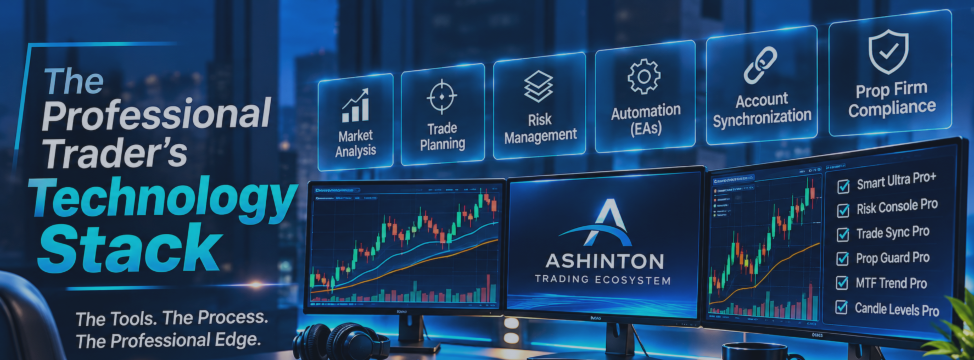
Consider the following technology stack:
| Trading function | Technology |
|---|---|
| Market analysis | Ashinton MTF Trend Pro |
| Higher-timeframe levels | Ashinton Candle Levels Pro |
| Trade planning and execution | Ashinton Risk Console Pro |
| Automated trading | Ashinton Smart Ultra Pro+ |
| Multi-account synchronization | Ashinton Trade Sync Pro |
| Prop firm monitoring | Ashinton Prop Guard Pro |
Each tool addresses a different part of the trading process.
Rather than relying on a single indicator or EA to do everything, traders can build a workstation where analysis, execution, automation, and risk management have clearly defined roles.