How Many Drawdown Limits Should You Actually Configure? — COPYLATOR – MT5 Trade Copier

Product link:
https://www.mql5.com/en/ market/product/191385
Open a trade copier's drawdown settings and you may find several values and options to configure: a daily limit, a total limit, a calculation basis, a reset time, and a choice about what happens when a threshold is reached.
Many traders enter two numbers, leave the remaining options at their defaults, and assume their protection is fully configured. But activating a feature and designing a risk-management plan are two different things. That difference often becomes clear only when the first significant drawdown occurs.
The more useful question is not how many settings are available, but how many should be deliberate decisions rather than untouched defaults.
The Minimum: Two Drawdown Limits
For a setup that supports both daily and total drawdown protection, these are the two fundamental thresholds to consider.
1. Daily Drawdown Limit
The daily limit is designed to respond to losses within a defined trading day. It can help prevent a difficult session from turning into an even larger loss.
Its calculation depends on the copier's measurement method and reset configuration. Traders should verify exactly how the daily reference value is established and when the counter resets rather than assuming that every copier measures from the day's peak or follows a universal 24-hour cycle.
2. Total Drawdown Limit
The total limit addresses cumulative account deterioration. It provides a broader boundary for the amount of drawdown the receiver is prepared to tolerate.
In COPYLATOR, the total drawdown baseline is not automatically reset by the daily reset. The baseline and reset behavior should be understood before configuring the protection.
These two limits address different risk scenarios. A daily limit alone may allow losses to accumulate across many trading days without triggering. A total limit alone may not provide the intended response to a particularly bad trading day.
For this reason, configuring both is a sensible starting point for accounts that need daily and cumulative loss controls.
The Third Decision: Equity or Balance
The calculation basis determines which account value is used to measure drawdown. This choice can materially affect when protection is triggered.
Equity-Based Calculation
Equity includes the effect of floating profit and loss. When open positions move into negative territory, equity can decline even though no position has been closed.
This makes equity-based monitoring useful when the receiver wants drawdown protection to respond to unrealized losses as well as realized losses.
Balance-Based Calculation
Balance reflects the account result after trades have been closed. It does not continuously reflect the floating profit or loss of open positions.
As a result, balance-based monitoring may not react to a substantial floating loss until that loss is realized through a position closure.
Neither method is universally correct for every strategy. The choice should reflect the account's risk policy and the way its external rules are calculated.
For example, if a prop firm measures its loss restrictions using equity, a receiver relying only on balance-based monitoring may not have a copier setting that responds to the same risk measure. Always check the firm's exact rules and the copier's calculation method.
The Fourth Decision: What Happens When the Limit Is Reached?
A drawdown threshold is only one part of the protection design. The response configured for that threshold is equally important.
In COPYLATOR, the CloseOrdersOnDrawdown setting determines whether the configured drawdown response includes closing positions and deleting pending orders.
Option 1: Block Further Copying
When automatic closing is disabled, the copier blocks further copying after the configured drawdown condition is reached. Existing receiver positions are not automatically closed by this setting.
This approach may suit traders who want to stop adding copied exposure while retaining control over positions that are already open.
Option 2: Block Copying, Close Positions, and Delete Pending Orders
When CloseOrdersOnDrawdown=true, COPYLATOR's configured response includes closing open positions and deleting pending orders when the drawdown condition is triggered.
This is a more aggressive response and may be appropriate when the receiver's plan requires the account to exit copied exposure after the threshold is reached.
However, closing orders is still subject to market conditions, broker execution, slippage, and available liquidity. It cannot guarantee that every position will close at the exact threshold or that no residual exposure will remain under all circumstances.
The correct choice depends on the receiver's strategy, account rules, and willingness to keep positions open after copying has been blocked.
The Fifth Decision: The Daily Reset Time
The daily reset time determines when COPYLATOR's daily drawdown counter is reset. This setting should be considered alongside the broker's server time and the account's trading schedule.
A reset at midnight broker time may occur during an active trading session. Depending on the strategy, this can divide one continuous trading period across two daily measurement periods.
For example, a strategy trading both London and New York sessions may still have significant activity around the broker's midnight reset.
There is no universal reset time that is suitable for every account. The appropriate time depends on:
- The broker's server time and daily rollover.
- The strategy's active trading sessions.
- The time zone used by any external account rules.
- The way the daily drawdown threshold is calculated.
Choose a reset time deliberately and verify it against the broker's server clock. Do not assume that a particular time, such as 02:00 or 04:00, is correct for every broker or strategy.
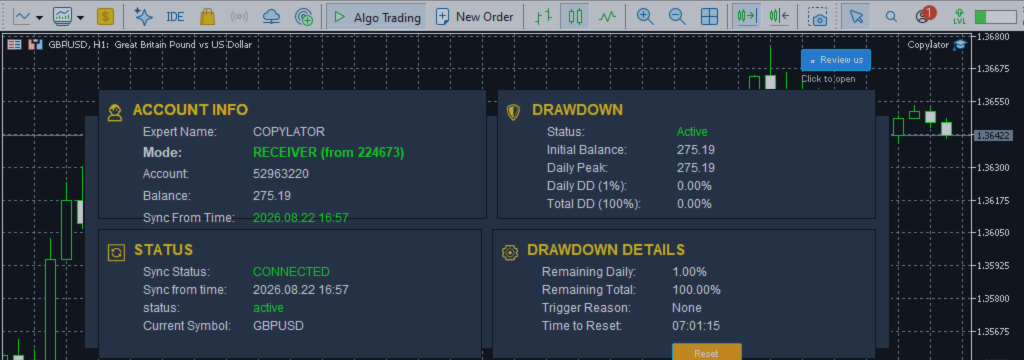
Important: COPYLATOR's automatic daily reset does not reset the total drawdown baseline. A manual reset through the Drawdown Details panel on the Receiver has different behavior: it resets daily and total drawdown and sets the initial balance to the current account balance. Use it only when that change is intended.
The Sixth Decision: The Maximum Lot Cap
A maximum lot cap is not a drawdown threshold, but it is an important part of controlling copied exposure.
Without an appropriate cap, a large copied position may create substantial risk before the account-level drawdown protection has time to respond.
For example, a receiver with a small account may not be able to tolerate the same position size as a sender with a much larger balance.
When selecting a maximum lot value, consider:
- The receiver's account balance and equity.
- The instrument's contract specifications and tick value.
- The stop-loss distance, if the strategy uses one.
- The account's leverage and margin requirements.
- The broker's minimum volume and volume-step restrictions.
- The possibility of several positions being open simultaneously.
A lot cap can reduce the risk associated with oversized individual positions, but it does not guarantee that one trade cannot breach the account's drawdown threshold. Gaps, slippage, missing stop-loss protection, and other execution conditions can still produce larger losses than expected.
Additional Risk Factors That Are Not Always Copier Settings
Some important risk quantities may not be available as individual copier settings. Nevertheless, the receiver should calculate and monitor them.
Maximum Simultaneous Exposure
A strategy may hold several positions at the same time. If five positions each carry an estimated 2% risk, the combined exposure could be substantially greater than 2%, particularly when the instruments are correlated.
For this reason, evaluating each trade separately is not enough. Consider the combined exposure of all open positions.
Distance to Margin Call or Stop-Out
The broker's margin requirements and stop-out rules impose another boundary on the account.
If margin becomes insufficient before the copier's drawdown threshold is reached, the broker may begin closing positions independently of the copier's protection settings.
Make sure the account has sufficient margin headroom and that the configured drawdown limits are consistent with the broker's conditions.
Execution and Market Conditions
News events, market gaps, low liquidity, and execution delays can affect the final result when a protection threshold is triggered.
A drawdown setting should therefore be treated as a risk-control mechanism, not as a guaranteed maximum-loss contract.
The Case for Fewer Settings
There is a valid argument for keeping a configuration simple.
Every additional parameter introduces another decision that must be understood, tested, and monitored. A complicated setup is not automatically safer than a simple one.
For many single-sender, single-receiver setups, a practical starting configuration includes six deliberate decisions:
- Daily drawdown limit: Set according to the account's daily loss tolerance and the strategy's normal behavior.
- Total drawdown limit: Set according to the maximum cumulative loss the receiver can accept.
- Calculation basis: Choose equity or balance according to the intended risk measurement and external account rules.
- Trigger response: Decide whether to block copying only or also close positions and delete pending orders.
- Daily reset time: Align it with the broker's server time and the account's trading schedule.
- Maximum lot cap: Set a position-size ceiling appropriate for the receiver's account and instruments.
This is a practical checklist, not a universal formula. Some accounts may require additional controls, while others may need a simpler configuration.
When More Detailed Configuration Is Necessary
Some trading environments require more attention than a basic six-point setup.
Prop Firm Accounts
Prop firms may impose separate daily and maximum loss rules, sometimes using equity, balance, or specific reference values. Their daily reset time may also differ from the broker's server-time reset.
The receiver should understand the firm's exact rules and configure copier thresholds with an appropriate safety buffer. The copier's settings do not replace the firm's own risk calculations.
Accounts Close to Their Margin Limits
An account with limited free margin may be vulnerable to broker stop-out before the copier's total drawdown threshold is reached.
In this situation, the receiver should evaluate margin requirements, open exposure, and the distance to the broker's stop-out level rather than relying only on historical strategy drawdown.
Cent and Micro Accounts
Cent and micro accounts may have different balance displays, contract specifications, and volume increments. A maximum lot cap should be checked against the broker's actual instrument specifications and minimum volume steps.
Do not assume that a lot value suitable for a standard account will be appropriate for a cent or micro account.
Multiple Senders Feeding One Receiver
When several senders feed a single receiver, the account's drawdown protection must be considered at the combined account level.
Losses from different senders can accumulate in the same receiver account. A total drawdown threshold therefore needs to account for the combined exposure, not just the historical performance of each sender individually.
The Configuration Record
Whatever configuration you choose, keep a written record of the decisions.
A useful record should include:
- Daily and total drawdown thresholds.
- The selected calculation basis.
- The action configured for a drawdown trigger.
- The daily reset hour and minute in broker server time.
- The maximum lot cap and lot-sizing method.
- The account balance and equity when the settings were established.
- The reason for choosing each value.
- The date of the last review or configuration change.
The reasoning behind each setting is particularly important. It helps you understand whether a change is justified when the account grows, the strategy changes, or market conditions become different.
Test the Configuration Before Going Live
Entering the values is not the final step. You should verify that the configuration behaves as expected.
Test the receiver's drawdown settings on a demo account or in another controlled environment before relying on them with live capital.
In particular, check:
- Whether daily and total thresholds are calculated using the intended basis.
- Whether the daily reset occurs at the expected broker server time.
- Whether copying is blocked when the configured threshold is reached.
- Whether positions and pending orders are handled according to the selected response.
- What happens to the total drawdown baseline after a manual reset.
- Whether the lot-sizing method and maximum volume behave correctly for the receiver's instruments.
A configuration that has not been tested should not be assumed to work exactly as expected during a live drawdown.
Summary
The question is not simply how many drawdown settings a copier offers. It is how many important risk decisions the receiver has made deliberately.
Daily and total drawdown limits provide the foundation. The calculation basis, trigger response, and reset time determine how that protection behaves. A maximum lot cap adds another important layer by helping control individual copied position sizes.
Other factors, including simultaneous exposure, margin requirements, broker execution, and external account rules, must also be considered.
For many traders, six deliberate configuration decisions provide a useful starting point. Record the values, understand the reasoning, and test the behavior before using the setup on a live account.
Activating drawdown protection is only the first step. Designing, testing, and understanding the configuration is what makes it part of a meaningful risk-management plan.
Product link:
https://www.mql5.com/en/ market/product/191385