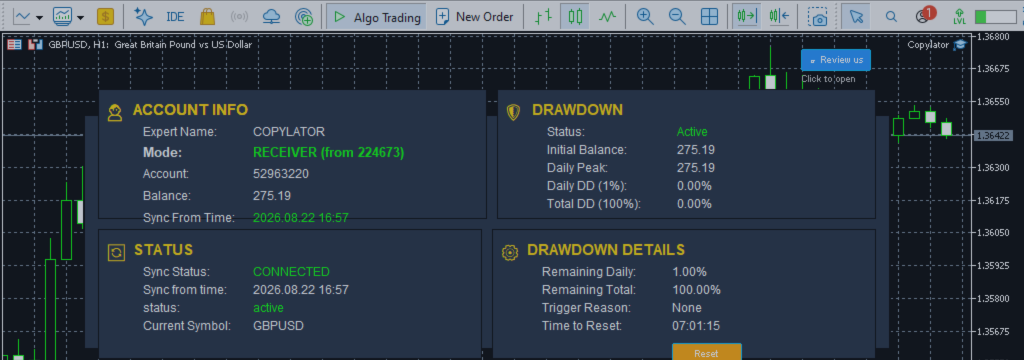
COPYLATOR – MT5 Trade Copier: When the Account Grows, Your Drawdown Limits Should Change

Product link:
https://www.mql5.com/en/ market/product/191385
A drawdown limit that was correct at $5,000 is not correct at $25,000. Not because the percentage changed, but because the absolute risk changed. A 10% limit on a $5,000 account protects $500. The same 10% limit on a $25,000 account protects $2,500. The number looks identical. The protection is not.
Most traders set their drawdown limits once, at the beginning, and never revisit them. The account grows or shrinks, the strategy evolves, and the limits stay the same. In some cases this is harmless. In others, it quietly removes the protection that was originally designed.
This is a practical guide to reviewing and updating drawdown limits as the account changes over time.
WHY THE PERCENTAGE IS ONLY HALF THE STORY
Drawdown limits are expressed as percentages. This makes them portable across account sizes, which is useful. But it also hides the fact that the absolute loss they permit grows in proportion to the account.
A trader who is comfortable with a $500 loss may not be comfortable with a $2,500 loss. The percentage is the same. The psychological and financial impact is not.
The first review question is not "is the percentage still right?" It is "is the absolute loss still acceptable?" If the account has grown 5x, the same percentage permits 5x the loss. That may be fine, or it may not be.
THE COMPOUNDING TRAP
A specific problem arises with strategies that compound. If the lot size is scaled by balance ratio, the positions grow as the account grows. A 10% drawdown on a $50,000 account involves positions that are ten times larger than the same 10% drawdown on a $5,000 account.
The absolute loss is proportionally the same, but the market impact may not be. Larger positions experience more slippage, wider effective spreads, and greater difficulty exiting during volatile conditions. A 10% drawdown that took three days to recover at $5,000 may take three weeks to recover at $50,000, because the positions cannot be closed as cleanly.
The drawdown limit was not the problem. The lot sizing was. But the two are linked, and reviewing one without the other is incomplete.
WHEN TO REVIEW THE LIMITS
There is no fixed schedule. But there are specific triggers that should prompt a review.
- After a significant account change. A deposit or withdrawal that alters the account balance by more than 25% is a signal to revisit the limits. The absolute risk has changed, even if the percentage has not.
- After a strategy change. If the sender has modified their approach, changed timeframes, or altered the instruments they trade, the drawdown profile may have changed. The limits were calibrated to the old behavior.
- After a drawdown event. Whether the protection triggered or not, any significant drawdown is information. It should prompt a review of whether the limits reflected the actual risk the account experienced.
- After a market regime change. Volatility is not constant. Periods of sustained higher volatility make the same percentage drawdown larger in absolute terms and more likely to be reached. The limits may need to be adjusted for the current regime.
THE THREE-QUESTION REVIEW
A practical review uses three questions.
Question one: What is the maximum absolute loss the account can absorb right now without materially affecting the trader's financial situation? This is not a percentage. It is a number in the account's currency.
Question two: What percentage does that number represent of the current balance? This becomes the new total drawdown limit if the trader wants to maintain the same absolute protection.
Question three: Is that percentage consistent with the strategy's historical behavior? If the new percentage is smaller than the strategy's worst historical floating drawdown, the protection will trigger during normal operation. If it is much larger, the protection may be too loose.
The three answers together determine whether the current limits are still appropriate.
THE CASE FOR KEEPING LIMITS UNCHANGED
It is worth noting that keeping the limits unchanged as the account grows is sometimes the correct choice. A trader who is comfortable with a fixed percentage of risk across account sizes may prefer to leave the limit alone.
This is defensible when the trader's financial situation has not changed in proportion to the account. A trader who deposited $5,000 and is now managing $25,000 may not have five times the disposable income. The absolute risk that was acceptable at $5,000 may still be the acceptable risk at $25,000.
In this case, the percentage should be reduced as the account grows, so that the absolute loss remains constant. A 10% limit at $5,000 becomes a 2% limit at $25,000 if the trader wants to keep the same absolute risk.
THE CASE FOR TIGHTENING LIMITS
Tightening the limits as the account grows is the more conservative choice. It reflects the reality that larger accounts are harder to recover. A 20% loss on a $5,000 account requires a 25% gain to recover. The same 20% loss on a $50,000 account requires the same 25% gain, but the absolute recovery takes longer and involves more trades.
Tighter limits at larger account sizes also reduce the risk of a single catastrophic event. A large account has more capital exposed at any moment. If a tail event occurs, the loss is larger. Tighter limits cap the exposure before the event can do disproportionate damage.
THE CASE FOR LOOSENING LIMITS
Loosening the limits is appropriate in specific circumstances.
If the strategy has demonstrated significantly better behavior than its historical record suggested, the original limits may have been too conservative. A strategy that was expected to experience 20% drawdowns but has never exceeded 8% over two years may warrant a looser limit.
If the account has grown substantially and the trader's financial situation has improved in proportion, the absolute risk that was uncomfortable at $5,000 may now be acceptable at $50,000.
If market conditions have become quieter than they were when the limits were set, the same percentage is less likely to be reached. Loosening may be justified, though this is the most speculative case.
THE RESET BASELINE PROBLEM
One specific issue that arises when reviewing limits is the total drawdown baseline. If the account has grown through deposits, the baseline set at the original time no longer reflects the current account.
A deposit increases the balance, which reduces the calculated total drawdown percentage. This can make it appear that the account has recovered when it has not. Conversely, a withdrawal decreases the balance, which increases the calculated drawdown percentage even though no trading loss occurred.
The manual reset addresses this by establishing a new baseline at the current balance. It should be used deliberately after any deposit or withdrawal that materially changes the account.
DOCUMENTING THE CHANGES
Each adjustment to the drawdown limits should be recorded with the date, the old value, the new value, and the reason. This record serves two purposes.
It allows the trader to see the trajectory of the limits over time. If the limits have been tightened five times in six months, that is a signal—either the account is growing faster than the trader's risk tolerance, or the trader is becoming more cautious. Either way, the pattern is worth noticing.
It also provides a comparison point during drawdowns. If a drawdown exceeds the current limit, the trader can look back at previous limits and see whether the current limit was already adjusted for a reason that no longer applies.
A PRACTICAL REVIEW SCHEDULE
A reasonable schedule is a quarterly review, plus a review after any significant event.
The quarterly review examines the current balance, the recent drawdown history, the strategy's performance, and the trader's financial situation. Any change to the limits is made deliberately based on these factors.
The event-driven reviews happen after deposits, withdrawals, strategy changes, or significant drawdowns. These reviews are shorter and focus on the specific change that prompted them.
COMMON MISTAKES
Three mistakes appear repeatedly.
- Never reviewing the limits. The limits set at the beginning are left in place indefinitely, even after the account has grown tenfold. The protection is no longer calibrated to the account.
- Adjusting the limits reflexively. After a drawdown, the trader tightens the limits without analysis. After a profitable period, they loosen them. The limits become a reaction to recent performance rather than a considered risk parameter.
- Treating the percentage as the protection. The percentage is a means to an end. The protection is the absolute loss the account can absorb. Confusing the two leads to configurations that look correct but do not protect what the trader thinks they protect.
SUMMARY
Drawdown limits are not permanent settings. They are calibrated to a specific account size, a specific strategy, and a specific market environment. As any of these change, the limits should be reviewed.
The review is not a matter of opinion. It is a matter of three questions: what is the maximum absolute loss the account can absorb, what percentage does that represent, and is that percentage consistent with the strategy's behavior.
Document the changes. Review quarterly. Review after significant events. Adjust deliberately, not reactively.
A drawdown limit that was correct two years ago may be wrong today. The protection only works if it is calibrated to the account as it currently exists, not as it existed when the limit was set.
Product link:
https://www.mql5.com/en/ market/product/191385



![[iVISTscalp5]: XAUUSD. Forecast First. Market Reaction Afterwards](https://c.mql5.com/6/1035/splash-preview-777232.png "[iVISTscalp5]: XAUUSD. Forecast First. Market Reaction Afterwards")