Why a Copier Without a Drawdown Limit Is Not a Risk Tool — COPYLATOR – MT5 Trade Copier

Product link:
https://www.mql5.com/en/ market/product/191385
There is a structural problem at the center of copy trading that many traders overlook: the person making the trading decisions and the person bearing the financial consequences are not necessarily the same person.
The sender decides when to enter and exit trades, how much to trade, and which risks to accept. The receiver's account is exposed to the copied trades, even though the receiver may have different financial goals, account conditions, and risk tolerance.
This raises a fundamental question: what happens when the sender's strategy performs poorly and the receiver has no predefined mechanism to limit further exposure?
Drawdown protection helps address this problem. It is not simply another feature in a copier. Properly configured, it gives the receiver a predefined boundary for acceptable account losses and a mechanism for enforcing that boundary.
The Position the Receiver Is Actually In
Imagine allowing someone else to trade your account without setting a maximum acceptable loss or deciding in advance what should happen when that loss is reached.
This is the position of a receiver who copies trades without an effective drawdown-control plan.
The sender does not have to be careless or malicious. They may simply be following a strategy designed for their own capital, risk tolerance, broker conditions, and investment horizon. Those assumptions may not suit the receiver.
For example, a sender might be comfortable with a 25% drawdown because they have substantial capital and a long investment horizon. A receiver with a smaller account may be unable to tolerate the same decline.
Even if the strategy eventually recovers, the receiver may face financial pressure or reach a personal or account-specific loss threshold before that recovery occurs.
The important principle: a sender's willingness to accept a particular drawdown does not mean the receiver should accept it too.
The Asymmetry of Information
The sender may understand the strategy's entry rules, exit conditions, risk assumptions, and reasons for holding a position. The receiver may see only the trades being opened, modified, and closed.
Copying a trade does not automatically give the receiver the information needed to evaluate the strategy or decide whether its current behavior remains acceptable.
A predefined drawdown threshold offers one practical way to manage this uncertainty. It establishes a boundary independent of the sender's decisions:
Whatever the strategy's reasoning may be, my account should not continue copying beyond the loss level I have chosen without a new decision.
This boundary does not replace strategy analysis, but it reduces dependence on the sender's judgment alone.
The Mathematics of Operating Without a Limit
Every trading strategy can experience losses beyond those observed in its historical results. A historical maximum drawdown describes what happened during a particular sample of market conditions; it does not establish the largest drawdown that can ever occur.
A strategy that historically experienced a 15% drawdown could experience a larger decline in the future. Market conditions can change, positions can remain exposed longer than expected, and execution conditions can differ from historical assumptions.
Without a predefined drawdown threshold, the receiver has no configured loss boundary at which copying must stop or other protective actions must be taken.
With a threshold, the receiver can define a point at which the copier blocks further copying or, if configured and supported by the system, attempts to close positions and remove pending orders.
However, a drawdown threshold is not a guarantee that the realized loss will stop at precisely that percentage. Slippage, market gaps, execution delays, and other trading conditions can cause the final result to exceed the configured level.
The purpose of the limit is to establish a risk-control rule, not to promise a mathematically guaranteed maximum loss under every market condition.
The Copier as a Risk Multiplier
A copier transfers trade instructions, but the financial risk transferred to the receiver depends on how those instructions are sized and executed.
The sender and receiver may have different account balances, leverage, contract specifications, brokers, and margin requirements. Identical trade volumes can therefore create very different levels of risk.
Consider this example:
- A sender has a $50,000 account and opens a position with a potential loss of $1,000, equivalent to 2% of the account.
- A receiver has a $5,000 account.
- If the receiver copies the same exposure without appropriate scaling, a comparable $1,000 loss would equal 20% of the receiver's account.
The actual loss depends on the instrument, entry price, exit price, position size, and execution conditions. The example illustrates why copying the sender's lot size is not necessarily equivalent to copying the sender's percentage risk.
Two forms of control are especially important:
- Position-sizing controls: Fixed lots, multipliers, balance-based sizing, and maximum lot caps can help adapt copied positions to the receiver's account.
- Account-level drawdown controls: Daily or total drawdown thresholds can define when copying should be blocked and whether configured protective actions should be taken.
These controls serve different purposes. A maximum lot cap limits the size of individual copied positions; it does not by itself limit the cumulative loss across multiple trades. Drawdown protection addresses the account-level risk, subject to its configuration and execution limitations.
Three Failure Modes a Drawdown Limit Can Help Address
Without a predefined loss threshold, a receiver may continue copying through several types of adverse performance.
1. The Slow Decline
A strategy may lose gradually over several weeks or months. No single trade appears disastrous, so the receiver may keep waiting for performance to improve.
A properly configured drawdown threshold can trigger when the cumulative decline reaches the chosen level, creating a predefined point for reassessing the strategy instead of relying entirely on hope.
2. A Sudden Market Event
News releases, market gaps, unexpected volatility, and correlated movements can cause losses that exceed ordinary expectations.
Drawdown protection may trigger configured actions when the account reaches its threshold. Nevertheless, it cannot guarantee that positions will close at the threshold price or prevent every loss associated with a sudden market move.
3. A Change in Market Conditions
A strategy that performed well under one set of market conditions may struggle when volatility, trends, liquidity, or other conditions change.
A drawdown threshold can help stop additional copied exposure after losses accumulate, giving the receiver an opportunity to review the strategy before allowing further copying.
In all three cases, the threshold provides a predefined response to deteriorating performance. It does not diagnose the cause of the losses or determine whether the strategy will recover.
The Difference Between Hoping and Having a Plan
A receiver without a drawdown limit may find themselves hoping that the strategy will recover, that the losing streak is temporary, or that the sender will intervene before the losses become unacceptable.
A receiver with a predefined limit has already made an important decision: they have established a loss threshold and chosen what the system should do when that threshold is reached.
This does not make the outcome predictable, nor does it ensure that the account will remain profitable. It makes the risk-management process more explicit and less dependent on last-minute decisions.
Drawdown protection does not improve the underlying trading strategy. Its purpose is to help the receiver control continued exposure when performance moves outside an acceptable range.
Why the Limit Should Be Set in Advance
A drawdown threshold is most useful when it reflects a considered decision made before a stressful losing period begins.
Suppose a trader initially sets a maximum drawdown of 12%, then changes it to 25% after losses reach 11%. If the only reason for the change is the desire to avoid stopping the strategy, the original risk boundary has effectively been abandoned at the moment it matters most.
Changing a threshold is not automatically wrong. New evidence, a revised strategy, or a meaningful change in account circumstances may justify a review. The important distinction is whether the change follows a reasoned reassessment or is simply a reaction to the discomfort of being in a drawdown.
Consider documenting the following when setting the limit:
- The maximum drawdown the account can realistically tolerate.
- The reason for choosing that threshold.
- The actions the copier should take when the threshold is reached.
- The conditions that would justify reviewing or resetting the protection.
- The possible consequences of stopping copying while receiver positions remain open.
A written plan makes it easier to distinguish a deliberate change in risk policy from an impulsive attempt to recover losses.
The Limit and the Sender's Performance
One common objection is that a drawdown limit may stop copying just before a losing strategy recovers.
That possibility is real. A threshold can trigger during a temporary decline, and the strategy may subsequently return to profitability. The receiver must therefore choose a limit that reflects both the account's loss tolerance and the strategy's characteristics.
A threshold set too tightly may interrupt normal strategy fluctuations. One set too loosely may allow a decline that the receiver cannot comfortably sustain.
The goal is not to guarantee that every recovery will be captured. It is to establish a defensible boundary between acceptable and unacceptable exposure.
Without a limit, losses may continue beyond the receiver's intended tolerance. With a limit, the receiver has a predefined response, although the final loss can still exceed the threshold because of execution conditions and market risk.
Risk controls should be evaluated as part of an overall trading plan, alongside strategy quality, position sizing, diversification, and the receiver's financial circumstances.
How COPYLATOR Supports Drawdown Management
COPYLATOR – MT5 Trade Copier includes drawdown-protection options designed to help receivers manage copied-trading exposure.
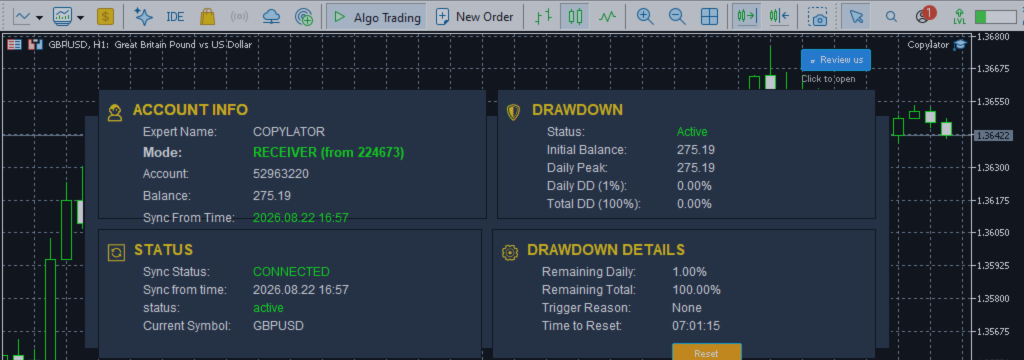
- Daily and total drawdown controls: Configure thresholds for monitoring account drawdown.
- Copying protection: Block further copying when the configured drawdown condition is triggered.
- Optional protective actions: Depending on the configuration, the copier can close positions and delete pending orders when the drawdown threshold is reached.
- Manual and automatic reset options: Use the available reset mechanisms according to the intended risk-management plan.
- Flexible lot management: Choose an appropriate lot-sizing method and, where suitable, configure a maximum lot cap.
These features must be configured and tested for the receiver's account and trading environment. A copying block does not necessarily close positions that are already open unless the relevant protective behavior is enabled. Similarly, stopping copied trading does not itself eliminate market risk from positions that remain open.
Before using drawdown protection on a live account, verify how the selected settings behave, including what happens to open positions, pending orders, and the account's drawdown baseline when a reset is performed.
The Real Question Before Copying a Sender
Before copying any strategy, do not ask only whether it has been profitable. Ask what your account's predefined response will be if it stops performing as expected.
If there is no loss threshold, no clear stopping rule, and no plan for managing existing positions, the receiver may be leaving a critical risk decision until after losses have already accumulated.
If there is a carefully chosen threshold and a tested response, the receiver has taken a more active role in managing the consequences of copied trades.
Drawdown protection does not remove the need to evaluate the sender, understand the strategy, or monitor the account. It adds a defined risk-control mechanism to that process.
Summary
Copy trading separates the person making trading decisions from the person whose account bears the financial consequences. Because the sender's risk tolerance and account conditions may differ from the receiver's, copying trades without independent risk controls can expose the receiver to unsuitable levels of loss.
A drawdown limit helps the receiver define in advance when copying should stop or when additional protective actions should be triggered. Combined with appropriate lot sizing and a clear plan for existing positions, it can make copy trading more disciplined and better aligned with the receiver's own risk tolerance.
It does not guarantee profitability, prevent every loss, or ensure that the final drawdown will remain below the configured threshold. Its value lies in establishing a predefined response instead of leaving the decision entirely to the sender or to the receiver's emotions during a losing period.
A copier can transfer trades. A properly configured drawdown-control plan helps the receiver manage how much risk they are willing to accept.
Product link:
https://www.mql5.com/en/ market/product/191385