Your Drawdown Limit Should Be Set Above Your Broker's Margin Call Level, Not Your Comfort Level

Product link:
https://www.mql5.com/en/ market/product/191385
Most traders choose a drawdown limit based on what feels tolerable. They look at their account, decide that a 10% loss would be painful but survivable, and configure the protection accordingly. The number feels considered, but it may have little relationship to the mechanism that can close their positions if conditions deteriorate: the broker's margin call and stop-out system.
This can expose traders to unexpected losses. Drawdown protection and margin call are separate mechanisms operating on the same account. They use different calculations and do not coordinate with each other. Which one acts first depends on the account's equity, margin requirements, position sizes, and configured protection limits.
What Margin Call Actually Is
A margin call or stop-out event occurs when an account's margin level reaches a threshold specified by the broker. Margin level is calculated as equity divided by used margin, expressed as a percentage.
For example, if equity is $1,000 and used margin is $2,000, the margin level is 50%. Some brokers use a margin-call level of 100% and a stop-out level of 50%, but thresholds and liquidation rules vary by broker and account type.
When the account reaches the broker's stop-out threshold, the trading platform may automatically close positions according to the broker's liquidation rules. The trader may have limited or no control over which positions are closed, in what order, or at what price. The resulting loss can differ from the equity level observed when the stop-out process begins.
Why the Two Systems Do Not Coordinate
Drawdown protection measures account equity against a configured loss threshold. Margin level measures equity relative to used margin. These are different calculations.
A trader can breach a 15% drawdown limit while the margin level remains comfortably above 200%, if the positions are small relative to the account. Conversely, an account can reach the broker's stop-out threshold before its drawdown reaches the configured limit if used margin is high relative to equity.
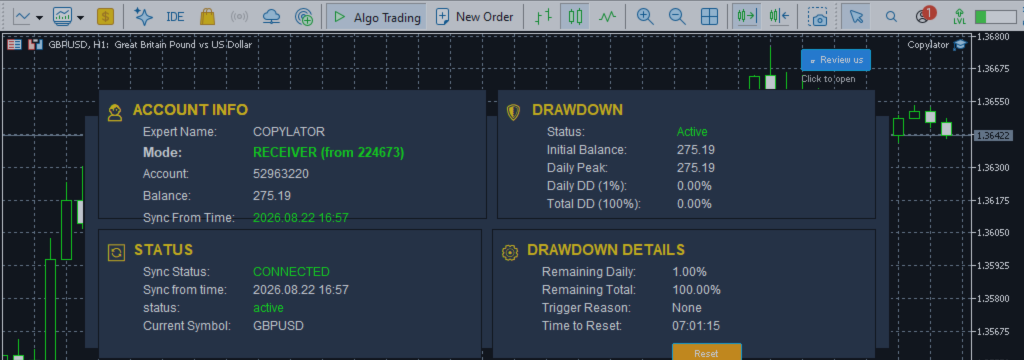
The two mechanisms can therefore act in either order. A copier's drawdown protection does not necessarily monitor the broker's margin level, and the broker's stop-out system does not know the copier's configured drawdown threshold.
The Dangerous Configuration
A potentially dangerous configuration occurs when the copier's total drawdown limit is set beyond the point at which the broker is likely to trigger a stop-out.
The trader may believe the account is protected up to a 20% drawdown, while the broker's stop-out system could begin closing positions at a smaller loss. In that situation, the copier's configured threshold may never be reached before the broker acts.
This risk can be significant when an account carries large positions relative to its equity. The margin level can fall quickly, depending on price movements, instrument-specific margin requirements, and the amount of used margin.
The More Common Configuration
The preferred arrangement is for the copier's drawdown protection to trigger before the broker's stop-out threshold is reached. If the configured conditions are met and the copier successfully closes the positions, the account may avoid a broker-initiated liquidation.
However, traders should not assume this will happen simply because their drawdown percentage appears conservative. They need to consider used margin, leverage, position sizes, broker rules, and how quickly the copier can execute its protective actions.
The Missing Calculation
Estimating which mechanism is likely to act first requires understanding the relationship between account equity and used margin.
A practical starting point is to review the maximum position load the strategy is expected to produce and observe the resulting margin level. Using the broker's stop-out threshold and the account's margin requirements, estimate how much equity could be lost before that threshold is reached.
This estimate is not a fixed prediction. Used margin can change as positions open or close, instrument prices move, and the broker applies different margin requirements. The calculation should therefore consider plausible adverse scenarios rather than relying on one snapshot.
If the estimated stop-out point is reached before the configured total drawdown threshold, the broker may act before the copier's drawdown protection does.
Leverage as a Key Variable
Leverage affects the margin required to support a position and therefore influences the relationship between drawdown protection and stop-out risk. However, its effect depends on the instrument, position size, margin rules, and how much exposure the strategy takes.
For the same notional position, higher available leverage often means less margin is required. This can leave more room before the margin level reaches the stop-out threshold. Lower leverage can require more margin for the same exposure, bringing the account closer to stop-out.
But higher leverage does not make an account safer overall. It can allow traders to open larger positions, increasing their exposure and the speed at which losses accumulate. The relevant comparison is not leverage alone, but the actual positions, used margin, and equity in the account.
The Third Limit: Distance to Stop-Out
A complete risk-management assessment considers three figures:
- Daily drawdown limit: The daily loss threshold configured in the copier.
- Total drawdown limit: The overall loss threshold configured in the copier.
- Estimated distance to broker stop-out: The equity loss that could bring the account to the broker's stop-out threshold under the current or modeled exposure.
The first two can be configured in the copier. The third depends on the broker's terms, account equity, margin requirements, and the strategy's position load.
As a general risk-management principle, the total drawdown limit should be sufficiently conservative to allow the copier to act before the account approaches stop-out. The margin of safety must account for execution delays, slippage, and changes in used margin.
For example, if a scenario-based estimate suggests that stop-out could occur after an 18% equity loss, setting the copier's total drawdown limit at 20% would not provide the intended protection. A lower threshold could provide more room, but the appropriate setting depends on the reliability of the estimate and the account's actual risk profile.
How to Estimate the Distance
Start by gathering three key pieces of information:
- The broker's stop-out level: Check the account conditions and applicable trading specifications. The rules may vary by account type and instrument.
- The strategy's maximum expected used margin: Estimate the margin required for the maximum plausible number of simultaneous positions at the intended lot sizes.
- The account's equity and current exposure: Consider how equity and used margin could change under adverse market movements.
Use these details to estimate the equity level at which the broker's stop-out threshold could be reached. Compare that level with current equity to estimate the available loss buffer.
Because used margin and margin requirements can change, this should be treated as a scenario estimate rather than a guaranteed stop-out percentage. If the broker provides a margin calculator or specific liquidation rules, use those details to improve the estimate.
The Buffer
Even if the configured drawdown limit is below the estimated distance to stop-out, a safety buffer is important.
The buffer should account for several factors:
- Execution delay: Market conditions may continue to change between the protection trigger and the completion of closing operations.
- Slippage: Positions may close at prices less favorable than expected, especially during fast-moving markets.
- Changing margin requirements: Used margin and broker calculations may change as exposure and market conditions change.
- Partial execution or rejected requests: Some closing operations may fail or take longer than expected, depending on trading conditions and broker restrictions.
A buffer of 20% to 30% of the estimated stop-out distance may be used as an initial scenario for testing, but it is not a universal rule or guarantee. The appropriate margin of safety depends on volatility, execution conditions, exposure, and the reliability of the estimate.
What Happens When the Broker Acts First
When the broker initiates a stop-out before the copier's drawdown protection triggers, positions may be closed according to the broker's own liquidation rules rather than the trader's intended risk-management plan.
Depending on the broker's procedure, positions may be closed individually until the margin level recovers sufficiently. This can leave the account holding only part of its original portfolio.
After broker-initiated closures, the copier may need to reconcile its internal tracking with the positions that remain open. The exact behavior depends on the copier's implementation and how it handles externally closed positions. Traders should check the logs and account state rather than assume that every internal record or displayed exposure figure immediately reflects the broker's actions.
This is one reason to test drawdown protection and position synchronization on a demo account before relying on them in live trading.
The Checklist
Before relying on drawdown protection, verify the following:
- Confirm the broker's margin-call and stop-out rules for the account and instruments being traded.
- Estimate the maximum used margin under the strategy's plausible worst-case position load.
- Calculate or model the equity level at which the broker's stop-out threshold could be reached.
- Set the total drawdown limit conservatively enough to provide a meaningful buffer before the estimated stop-out point.
- Choose a daily drawdown limit appropriate to the total limit and the strategy's risk profile. A ratio of one third to one half can be a starting point for evaluation, not a universal requirement.
- Test the configuration on a demo account, including realistic position sizes and simultaneous exposure.
- Review the copier's logs and confirm that protective closing and blocking behavior works as expected.
Summary
Drawdown protection and broker stop-out are independent mechanisms operating on the same trading account. Which one acts first depends on equity, used margin, position sizes, broker rules, and the configured limits. If traders do not evaluate this relationship, the broker may close positions before the copier reaches its drawdown threshold.
A prudent configuration sets the total drawdown limit conservatively, leaving a buffer before the estimated stop-out point. The daily limit should also reflect the strategy's risk profile and the total drawdown setting.
Leverage influences margin usage, but it does not determine safety on its own. Actual exposure and used margin matter just as much, if not more. Higher leverage can reduce the margin required for a given position, but it can also encourage larger positions and greater risk.
Taking time to assess the relationship between drawdown protection and stop-out can help traders identify weaknesses in their configuration before those weaknesses become costly.
Product link:
https://www.mql5.com/en/ market/product/191385