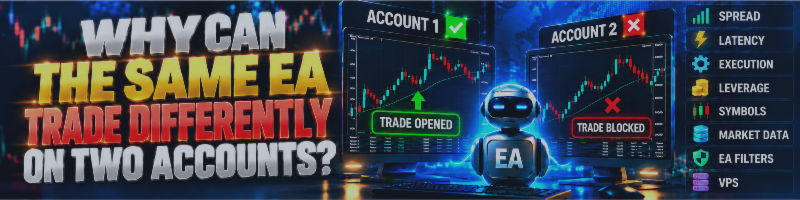

Many people believe that if an Expert Advisor is properly programmed, then it should trade exactly the same on any account using the same broker, the same configuration, and the same market.
However, in practice, that does not always happen.
And it does not necessarily mean that the system is failing.
In fact, one of the most common mistakes when evaluating an algorithm is assuming that if a trade was opened on one account but not on another, then the problem must automatically be with the EA.
The reality is that there are several external factors that can cause the same system to trade differently on two accounts, even when both seem almost identical.
In this post, I am going to explain the main reasons.
1. The First Difference: The Execution Environment
An Expert Advisor does not operate in a vacuum.
It operates within a real environment made up of:
- broker,
- server,
- account type,
- connection,
- VPS or local computer,
- market data,
- internal account configuration.
Therefore, even if the EA file is exactly the same, the surrounding conditions can change the final result.
The algorithm may be ready to execute an entry, but if any condition in the environment does not match, that trade may be blocked or may not be executed at all.
2. The Spread Is Not Always the Same
One of the most common reasons is the spread.
Many automated systems filter trades when the spread exceeds a certain maximum value.
This is completely normal and, in fact, it is a healthy protection designed to avoid entering the market under unfavorable conditions.
So what happens?
Two accounts from the same broker may show small differences in spread at the same moment, especially during periods of lower liquidity, session changes, news events, or market openings.
On one account, the spread may be within the allowed limit and the trade is executed.
On the other, the spread may slightly exceed that filter and the trade is blocked.
From the outside, this may seem strange.
But from the system's logic, it makes perfect sense.
3. Execution and Latency Also Matter
Another key factor is the speed at which the account receives and processes information.
Trading is not the same:
- from a home computer,
- from a slow or unstable VPS,
- from a VPS located close to the broker's server.
Latency can change the exact moment when the system receives the tick that triggers the entry.
And when a strategy depends on very specific conditions, even a few moments of difference can cause an opportunity to exist on one account and disappear on another.
This does not necessarily mean that the broker is doing anything unusual.
It simply means that in algorithmic trading, timing is also part of the result.
4. Leverage Can Change the Behavior
Two accounts may have the same balance but different leverage.
And that can also have an impact.
Why?
Because the available margin changes, and some systems or copy trading services adjust position size based on that margin.
As a result, one account may open a trade normally, while the other may open it with a smaller size, round it differently, or even fail to open it if the minimum volume or margin requirements are not met.
At first glance, it may look like the same amount of capital.
But technically, it does not always represent the same trading capacity.
5. Broker Symbols May Not Be Exactly the Same
This may seem like a minor detail, but it can create many problems.
Not all brokers name their instruments in the same way.
For example:
- EURUSD
- EURUSDm
- EURUSD.a
- NAS100
- NAS100s
If the EA was prepared for one naming convention and the account uses another, the system may fail to identify the correct symbol or may process a different instrument than expected.
In some cases, the bot works perfectly.
In others, it simply does not detect anything.
That is why, when analyzing why two accounts are not trading in the same way, checking the symbol names is essential.
6. Not All Accounts Receive Exactly the Same Data
Even when using the same broker, two accounts may not receive exactly the same sequence of ticks at the same moment.
And in strategies that are sensitive to specific conditions, this can create differences.
For example:
- a liquidity sweep may be detected at a specific moment;
- an indicator crossover may appear for one tick and disappear immediately;
- a candle may close slightly differently.
If the system's logic depends on those details, one account may validate the entry while the other does not.
From the outside, this may look like a contradiction.
But in reality, it is a normal consequence of how the market works in real time.
7. Internal System Filters May Block One Account but Not the Other
Very often, the problem is not in the signal itself, but in the EA's own safety filters.
For example:
- spread limit,
- maximum number of simultaneous trades,
- daily loss lock,
- time restriction,
- global exposure control,
- minimum Stop Loss distance validation,
- minimum lot size or lot step.
So this can happen:
the signal exists, the market provided the opportunity, but one account meets the filter conditions and the other does not.
In that case, the EA is not “missing an entry.”
It is doing exactly what it was programmed to do.
And this is very important to understand, because many times a difference between accounts is not an error, but a protection mechanism.
8. The VPS May Be Connected but Still Behave Differently
Another very common mistake is assuming that if the VPS is running, then everything must be working perfectly.
That is not always the case.
A VPS may experience:
- interruptions,
- slow performance,
- high resource usage,
- temporary disconnections,
- delayed updates,
- synchronization problems.
And all of that can affect the behavior of the EA.
That is why, when two accounts are not trading in the same way, it is always worth checking:
- whether the VPS is actually stable,
- whether the Expert log is printing normally,
- whether the system is reading the markets,
- whether MetaTrader is receiving data correctly.
9. So, How Should This Problem Be Analyzed Properly?
When two accounts are not trading in the same way, the analysis should not begin by blaming the algorithm.
The correct approach is to review, step by step:
- Same broker and same account type
- Same leverage
- Same available symbols
- Same EA configuration
- Same risk filters
- Same execution environment
- Same connection or VPS quality
- Review of logs and the Expert Journal
Only after checking all of this does it make sense to consider a real programming issue.
10. Conclusion
The fact that the same EA trades differently on two accounts does not automatically mean that the bot is malfunctioning.
In algorithmic trading, the result does not depend only on the code.
It also depends on the environment in which that code is running.
Spread, latency, leverage, symbols, market data, internal filters, and VPS stability can create completely real differences between one account and another.
That is why, before jumping to conclusions, it is important to understand something fundamental:
an EA does not only need a good strategy; it also needs the right environment to execute it.
And very often, when two accounts show differences, the real problem is not in the system's logic, but in everything surrounding it.