Zulu Strategie Studio: How Gann Signals, Market Structure and AI Form a Controlled Trading Workflow

View Zulu Strategie Studio on the MQL5 Market – currently for $249 USD
Zulu Strategie Studio is receiving a major expansion: In addition to the existing three operating modes Classic Gold, AI Auto and Semi-AI, the new Gann AI mode is being added.
The integration combines signals from Gann Atlas with structured market analysis, configurable trading rules, and subsequent management of open positions and pending orders.
The new mode is currently undergoing live technical testing . This involves testing the entire process: signal detection, data processing, parallel AI queries, execution verification, broker confirmation, and subsequent trade management.
Zulu Strategie Studio is currently available for $249. With the release of the Gann update on the MQL5 Market, the price will increase to $349.
The new Gann function requires the separately available Gann Atlas indicator . It is not included in the studio price. Existing operating modes can still be used without the Gann Atlas.
Images: translated illustrations of the development interface. Image translations do not imply additional interface-language availability.
What the AI actually receives for analysis
The quality of an AI-supported decision depends significantly on what information is available, how it is processed, and what rules apply.
Zulu therefore compiles a structured data package for each analysis. It contains the state of the selected market at a documented point in time, the relevant strategy information, and the conditions under which a trade may be executed.
This gives the AI a specific analysis task: evaluating a new setup, checking an existing position, or assessing a pending order that has already been placed.
Market trends across multiple timeframes
The data package includes candlestick data from the selected analysis timeframe and supplementary higher timeframes. For example, in an M15 configuration, M15, H1, and H4 can be viewed together.
Limited excerpts of the completed candle history are transmitted, as well as the current, still-incomplete candle separately. This distinction is important: A running candle can still change its shape.
The current data package considers up to 64 completed candles from the analysis timeframe for a new entry. When reviewing an open position, up to 96 candles are considered. Additionally, up to 32 or 24 candles from higher contextual timeframes are included, if available.
This places the short-term trigger in a broader context. For example, a buy signal on a short timeframe might coincide with a larger downward trend. Conversely, a short-term pullback could be within a continuing upward trend.
The available data enables this distinction; the evaluation remains the task of the model within the given strategy.
Market structure, price zones and liquidity events
Zulu supplements the price data with calculated structural information. This includes, among other things:
- confirmed highs and lows as well as the direction of the short-term and higher-level structure,
- identified structural breaks,
- Equal highs and lows,
- identified overshoots of relevant highs or lows with retracements, so-called liquidity sweeps,
- selected active order block zones,
- Fair Value Gaps, i.e., areas of imbalance identified between candles according to the definition used.
These terms are transferred as concrete data with price levels and time references. Regarding zones, Zulu prioritizes nearby active areas and indicates when other areas are not included in the package due to space limitations.
The practical benefit: The AI can assess whether a relevant counter-structure already exists between the entry point and the profit target. A target may mathematically offer a good risk-reward ratio, but still be poorly positioned from the perspective of the transmitted market structure.
Volatility and the amount of movement already made today
A price difference is only meaningful in relation to the market. Therefore, the AI receives, among other things, the ATR over 14 periods of the respective time frame.
In addition, the average daily trading range over 20 days, the current range for the day, and their relationship to each other are provided. The highs and lows of the previous day and week are also included in the context – including information on whether these levels have already been reached or exceeded in the current period.
For suitable M15 intraday configurations, Zulu adds historical price action analysis for the remaining time period. This analysis evaluates contiguous historical price segments with comparable broker time.
This data is explicitly labelled as historical movements . It is neither a probability of success nor a fixed limit for today's movement.
For example, the AI can assess whether a distant profit target is appropriate given the remaining trading time and the observed market environment.
Gann's information goes far beyond the signal direction.
Gann Atlas provides the standalone strategy trigger. The studio transmits the original trading direction, the reference entry, the original stop-loss, and all three original profit targets: TP1, TP2, and TP3 .
Additionally, the underlying Gann geometry is provided:
- confirmed upper and lower swing anchors,
- Time and age of these anchors
- the price scaling used per completed candle,
- Ascending and descending Gann fans with the ratios 1×4, 1×2, 1×1, 2×1 and 4×1,
- One-eighth levels of the underlying range,
- Distances of the fan lines to the reference price, expressed in ATR units,
- Separately recorded Gann context of higher time levels.
Depending on the activated filters, additional signal characteristics such as strength information and distances to supply and demand zones are added.
The fans are described using specific price values and a defined scale. Their meaning therefore does not depend on how a chart window is currently enlarged or compressed.
The AI should weigh the three Gann targets against each other: Which target fits the structure? What obstacles lie in the way? Is the closer target still worthwhile considering the costs? Is the more distant target plausible given the market context?
If SL/TP adjustments are disabled, the original stop must be maintained and one of the original targets chosen. If adjustments are allowed, structurally justified alternatives can be suggested.
A new entry remains tied to the direction of the Gann signal. The AI must not independently convert a Gann buy signal into a sell trade.
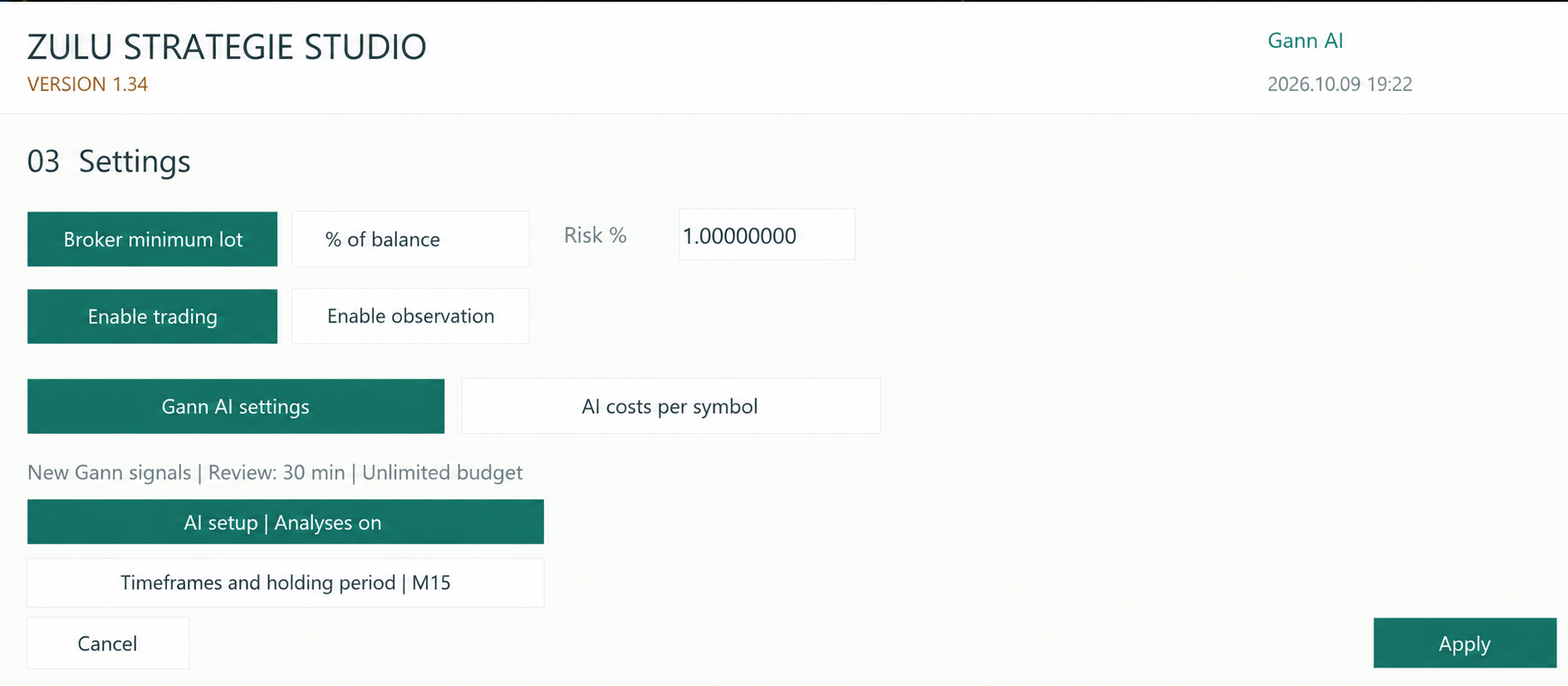
Gann configuration and settings – technical development status.
Costs and brokerage terms are part of the evaluation.
An attractive gross ratio between profit target and stop distance does not yet tell you what will remain after trading costs.
Zulu therefore transmits, among other things:
- current bid and ask prices as well as the spread,
- the spread in relation to the ATR
- configured or automatically estimated commissions,
- a slippage approach explicitly identified as an estimate,
- Tick size, tick values and contract size,
- minimum lot size, volume steps and maximum lot size,
- The broker's stop and freeze distances,
- Trading mode and reported trading sessions.
The AI also receives the set requirements for net reward-to-risk ratio, minimum distances for SL and TP, and the ratio between target and cost.
This means that a setup can be rejected despite being fundamentally in the right direction, for example if the achievable goal is too small in terms of cost.
Local execution checks then recheck the actual feasibility. Broker minimum lot and percentage risk remain separate settings: if the minimum lot is used, the planned loss at the stop may exceed the desired percentage budget.
Trading hours and economic calendars are part of the context
An intraday setup must be appropriate for the remaining trading time. Therefore, the data includes the relevant time windows, the intended exit point, and information about the end of the broker's trading session.
If calendar data is available and valid, relevant events from the MT5 economic calendar are added. These include events of medium and high importance for the currencies concerned, upcoming dates, and recently published information.
Where available and already published, actual values, forecasts and previous values will be provided.
Zulu clarifies the limitations of this information: The economic calendar is not a comprehensive news service. Unforeseen headlines are not automatically covered. Missing or outdated calendar data is indicated as such.
An example of the interplay
Suppose Gann Atlas generates a buy signal and provides three possible profit targets.
The first target is relatively close. After considering the spread, commission, and slippage, the remaining return for the set net reward-to-risk ratio might be too low.
The second target might be a better economic fit, but it lies directly before a relevant price zone.
The third target offers more distance but requires a larger move. Higher timeframes, current volatility, and remaining intraday time could argue against this target.
The AI's task is now to jointly evaluate this information. It can select a permissible target, suggest a reasoned adjustment if appropriate permission is granted, or refrain from entering a trade.
Setting a higher minimum reward-to-risk ratio is not an instruction to arbitrarily move the take-profit farther away. It is an additional condition that a well-founded setup must meet.
This example illustrates the intended decision logic. It is not a promise that every model will correctly assess every situation.
For open trades, the actual position is checked.
For a position review, a new market data package is combined with the associated position data.
The AI receives information such as the current entry point, volume, stop-loss and take-profit levels, as well as the original entry and stop-loss values. It also receives the opening time, the original intraday exit time (if applicable), the last management action, and any stop-loss adjustments already made.
The financial situation is also taken into account: current profit or loss, swap, already booked results and costs, and an estimate of the net result upon closure.
Zulu also provides observed favorable and unfavorable executable prices during the recorded position phase. The observation period and any data gaps are indicated. These values are not presented as a complete tick history.
This allows a position to be examined in relation to its original plan and the current market.
In Gann mode, possible decisions under the respective permissions include, for example , maintaining, adjusting the stop, adjusting the stop-loss/take-profit, or closing . An existing stop-loss order may not be moved farther away in a way that increases risk. A change of target requires a specific structural justification.
Each trade has its own review time.
The set review interval applies individually to each position or pending order.
With a 30-minute interval, this means that a new trade should initially be allowed its intended time interval. It will not be automatically re-examined a few seconds later simply because a general time block is beginning.
Subsequent checks are also based on individual progress. The display "Next check from... broker time" shows when a follow-up check is scheduled at the earliest. The actual processing may take place later, depending on available analysis slots and technical conditions.
Gann pending orders are differentiated into retain and delete . A position review does not constitute approval for any new entry.
From AI response to broker confirmation
The AI delivers a structured response with predefined actions and price fields. The studio reviews this response before a broker order can be generated from it.
Depending on the action, this includes, among other things, the validity of the proposal, current prices, permissible price differences, costs, risk, margin, permissions and the account balance currently available.
This is particularly important when time passes between data collection and AI response: The market may have changed, a pending order may have already been executed, or a position may have been closed in the meantime.
After transmission, the result is compared with the available broker information. A proposal, a transmitted order, and a confirmed execution are distinct states. This distinction is also reflected in the log.
Parallelism and comprehensible display
The new version supports up to eight parallel AI queries. This allows for the simultaneous processing of analyses of multiple symbols, while maintaining the association of each response with its original task.
Parallel processing reduces waiting times when multiple tasks are pending. It does not automatically improve a single analysis and does not replace execution checks.
For a quick overview, there's a new card view for open trades and pending orders. It displays current position values, profit or loss including swap, take-profit progress, stop-loss risk relative to the take-profit target, last AI decision, and next review time.
Closed positions and removed pending orders disappear from this current overview. The action log remains for tracking purposes.
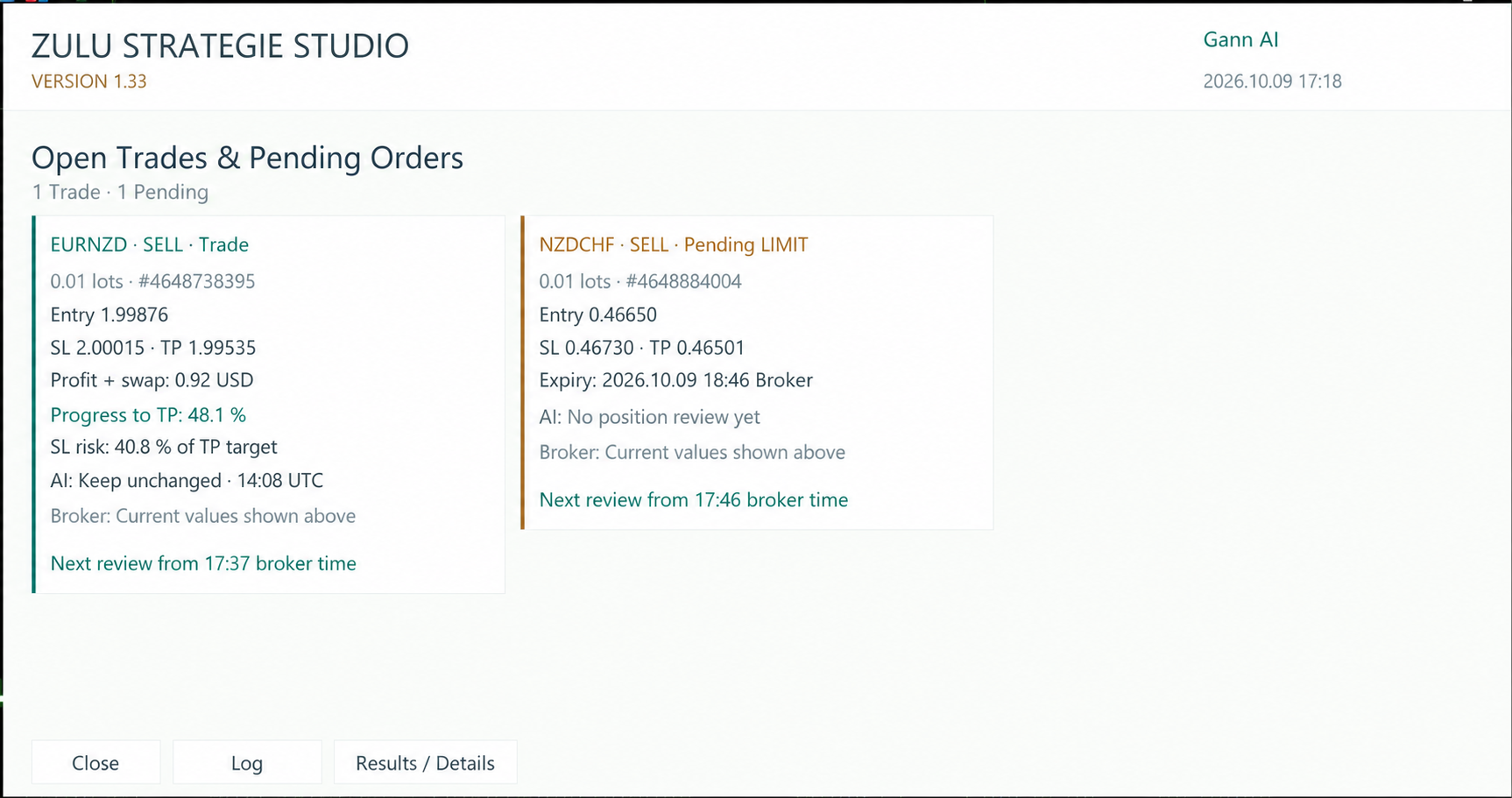
Open trade and pending order with individual AI review – current state of technical development.
What the development effort entails
The scope of Zulu is primarily evident in the combination of these tasks:
Market data must be chronologically consistent. Gann signals must be clearly identified. Cost assumptions and data gaps must remain visible. Parallel responses must not be confused. Repetitions must not generate duplicate orders. A confirmed broker action must subsequently reappear in the interface and be included in the next verification cycle.
In addition, there are the different procedures for new entries, open positions, pending orders and partial fills.
We are working on this end-to-end processing. AI is a component of it; data preparation, strategy integration, execution, and follow-up are organized by the studio.
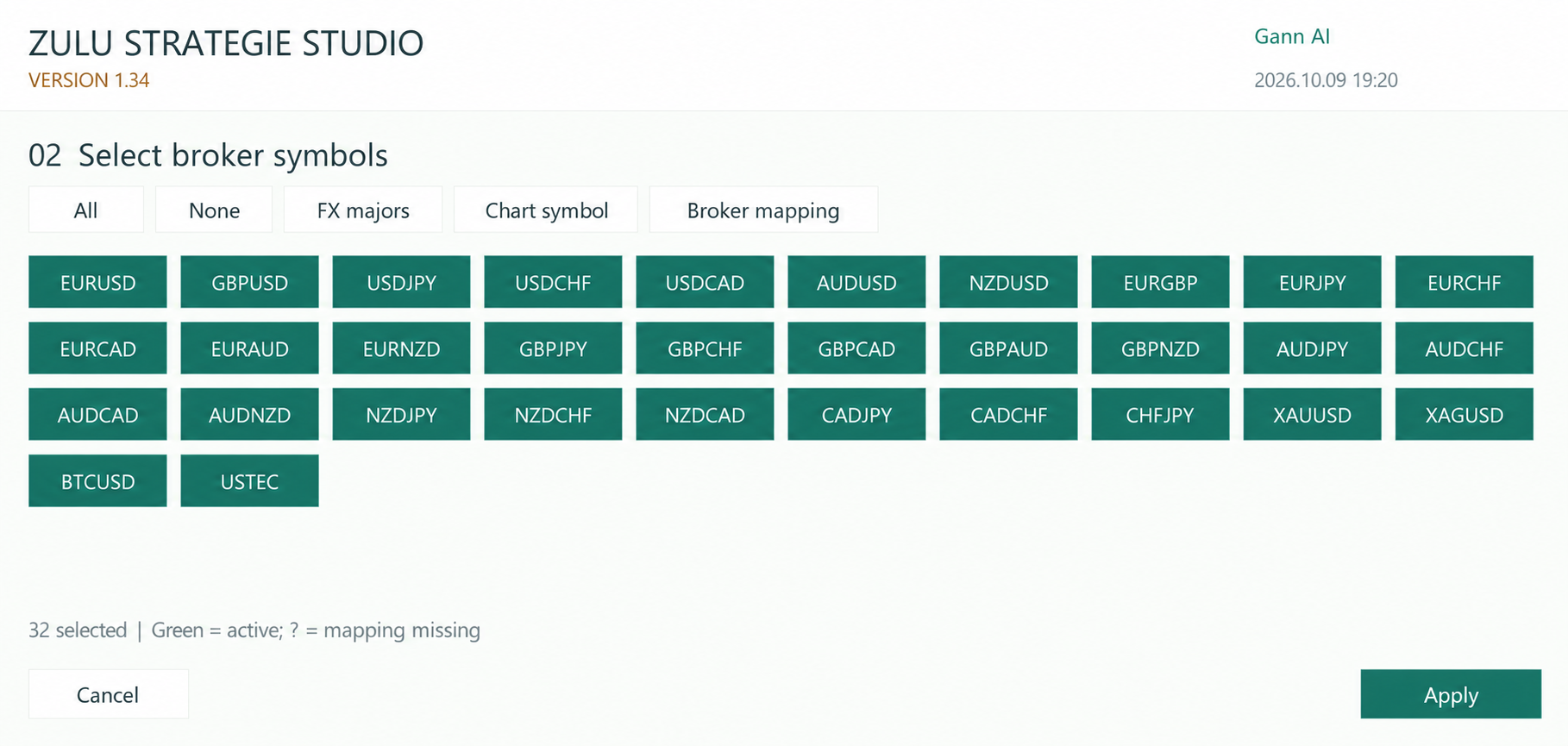
Symbol selection in the studio – technical development status.
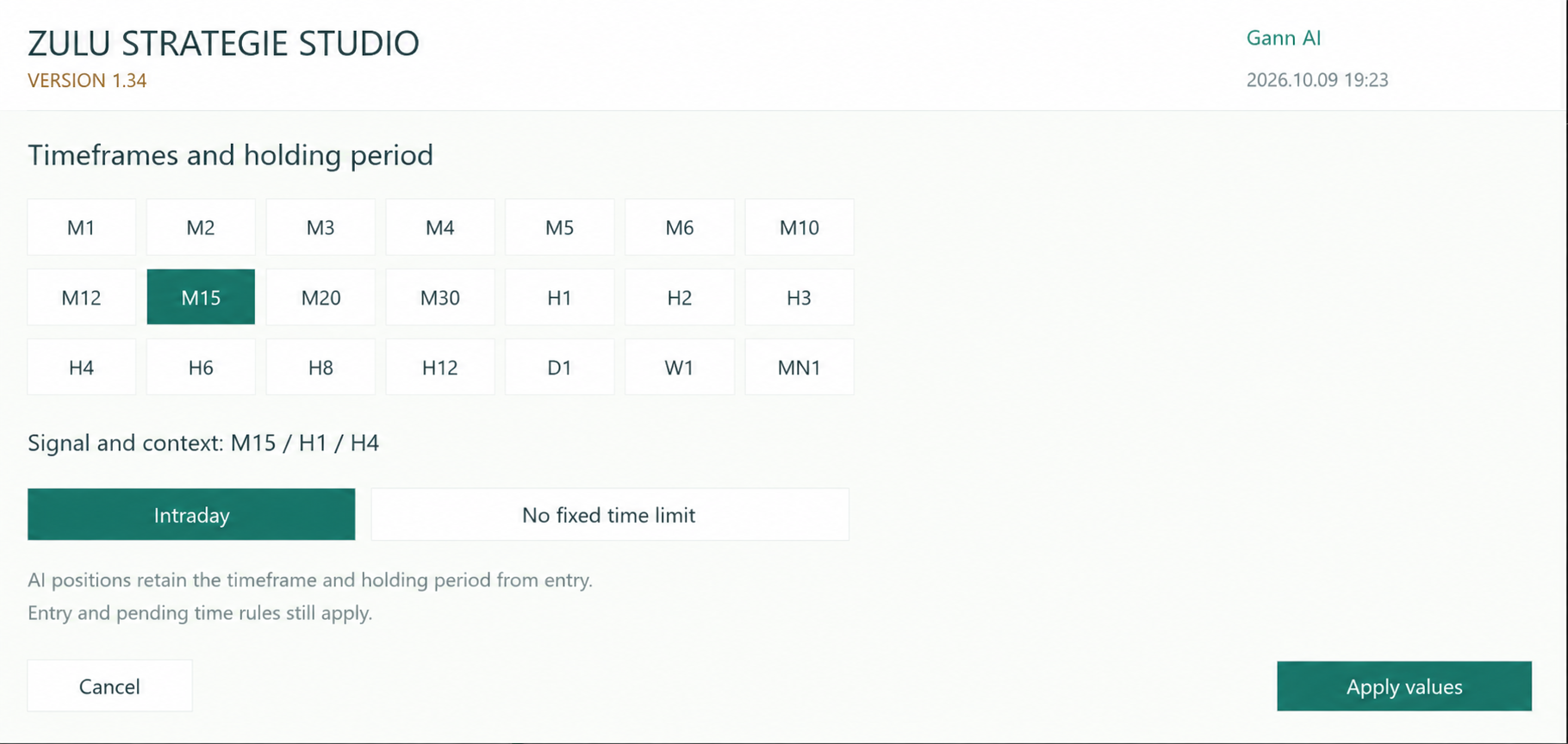
Analysis timeframe and holding period – state of technical development.
Current status and requirements
Gann Mode is currently undergoing live technical testing. The screenshots shown are from this development stage and demonstrate features of the upcoming update.
The Gann mode requires Zulu Strategie Studio and the separately sold Gann Atlas . AI use also requires a separate, supported API access. API usage is billed separately by the provider and is not included in the product price.
The model and the reasoning effort can be selected. More expensive models or those that take longer to calculate are not automatically more profitable. Likewise, more frequent position checks do not necessarily lead to better trading results.
Technical testing examines reliable processing and execution. A long-term trading advantage must be evaluated separately. Trading remains associated with risks of loss; AI can make incorrect decisions.
Zulu Strategie Studio is currently available for $249. With the release of the Gann update on the MQL5 Market, the price will increase to $349. The required Gann Atlas indicator is available separately.