Flat before the close: what an intraday robot buys by never holding overnight, and what it pays

Most robot pages list "no overnight positions" next to "no martingale", as if both were simply good. The second one is. The first one is a trade-off: it buys some things and it costs others, and a buyer should see both lists before paying for either. Here they are, using our own Index Cadence as the example. It trades the US tech index CFD during the day and closes everything before the end of every trading day.
What the day looks like
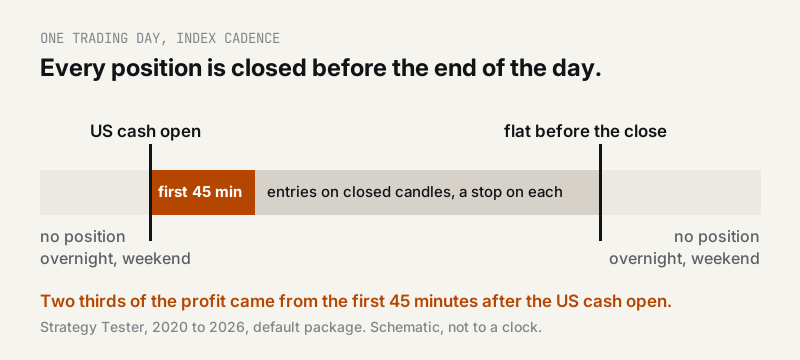
The robot's day is anchored to the US cash open. It enters only when a 15-minute candle closes outside a band drawn from how far this market normally travels by that time of day, and every position goes out with a hard stop on the broker's server. Before the end of the day everything is closed. Nothing is held overnight and nothing over a weekend, so each session starts from zero.
What being flat buys you
No gap past the stop. A position held overnight or over a weekend can open on the far side of its stop, because the news of a whole night is priced in one jump. A stop can still fill worse than its level in a fast market during the day. What an intraday position never meets is that jump.
Prop rules. Many prop firms restrict overnight exposure. A system that is flat by the end of every day never carries it, so that rule is never the one that ends a challenge.
Each day settles. A bad day ends as a closed loss, not as an open position you have to decide about tomorrow morning. The daily and weekly loss breakers block new entries only, and the positions already open stay managed until they close.
What it costs
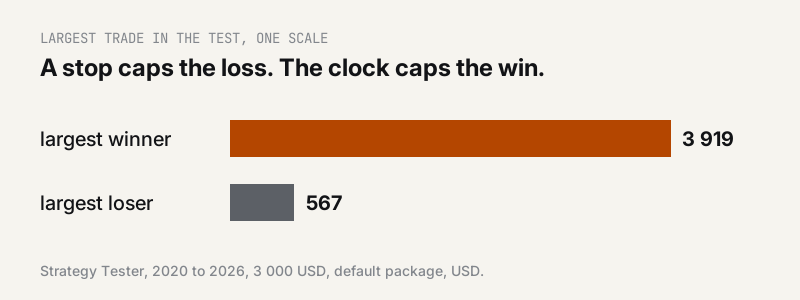
The clock caps the winner. The listing says it in one line: a hard stop caps what a loss can become, and nothing caps a winner except the end of the day. In the test the largest winning trade made 3,919 and the largest losing trade lost 567, both in USD. A move that keeps running after the close is not this robot's to keep.
One session carries the result. Two thirds of the profit came from the first 45 minutes after the US cash open. That is also when spreads are widest, so your broker's spread at the open matters more than its average. Across the five brokers we measured, the result ran from 9.9% worse to 5.9% better than our reference feed, with the profit factor between 1.34 and 1.42. If your broker charges a separate commission, enter it in the commission input, so the robot's cost gate counts it.
Small accounts pay at the minimum lot. Below about 2,000 USD the broker's minimum lot can no longer size a trade the way your risk setting asks, and it is the widest-stop trades from the most volatile weeks that run into it. The robot takes them anyway and says so on its panel. Measured on 500 USD, the worst single position risked 3.9% against a 1.0% setting.
The tested numbers, and the one to plan with
Strategy Tester, 2020 to 2026, 3,000 USD account, default package: about 275 trades a year, 57.2% a year, profit factor 1.36, and a worst equity drawdown of 16.9%. Read that last number as a floor, not an expectation. Out of sample the same mechanism drew down roughly twice as deep, so plan the default package for 25 to 35 percent. This is not a holy grail. It is one measured edge on prices that have already happened.
Who it suits
A trader who wants every day to end in cash: a funded account with an overnight rule, an account that already runs a swing robot and should not add more overnight exposure to it, or someone who simply does not want to wake up to a gap. It suits a trader less who wants to catch a move that lasts for days, because that is exactly the part it hands back at the close. And it is one instrument in one session. The listing calls it one bet, not a portfolio, and that is how it should sit in an account.
Before you rely on it
Run the free demo on your own broker's data. At startup the robot prints its session anchor, the entry cut-off and the flat time into the journal, so check those against your broker's server clock before the first live day. Then read the report's profit factor and drawdown before its return.
Index Cadence on the MQL5 Market, 149 USD: https://www.mql5.com/en/market/product/190845