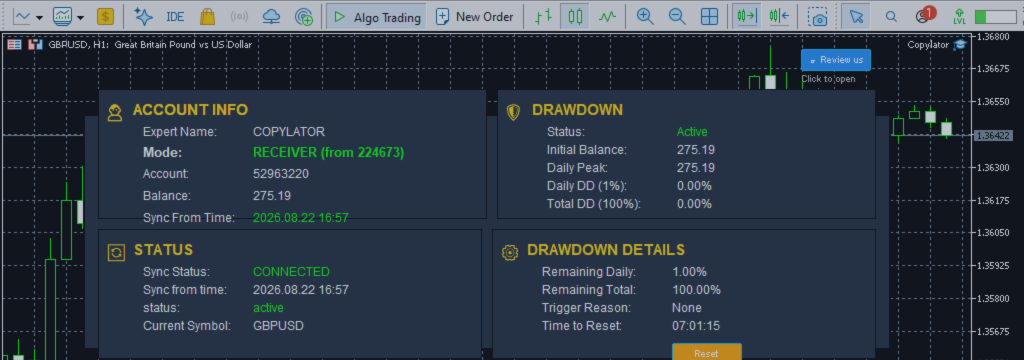

Product link:
https://www.mql5.com/en/ market/product/191385
Cent and micro accounts are often used by traders who want to start copy trading with smaller capital, test a strategy under live market conditions, or verify a complete MT5 Trade Copier configuration before increasing account size.
These account types can provide much finer volume control than many standard accounts, but they also introduce configuration considerations that should not be ignored. Minimum lot size, volume step, contract specifications, symbol availability, spread, margin requirements, and broker rules can all differ from the Sender account.
As a result, copying a trade from a standard account to a cent or micro account is not simply a matter of duplicating the same lot size. The Receiver must calculate and execute a volume that is valid for its own trading environment.
1. What Are Cent and Micro Accounts?
A cent account generally displays the account balance in cent units rather than standard currency units. For example, depending on the broker's account structure, a deposit equivalent to $100 may be displayed as 10,000 account currency cents.
A micro account may also provide smaller contract or volume specifications than a conventional account, depending on the broker and instrument.
The exact implementation is broker-specific. Therefore, traders should always check the account's contract specifications instead of assuming that every cent or micro account behaves identically.
The key point for copy trading is that the Receiver's balance representation and trading-volume rules may differ substantially from those of the Sender.
2. Why Small Accounts Require Special Attention
A standard account may accept a minimum trade volume of 0.01 lots, while another account may support smaller increments such as 0.001. However, these values are not universal.
For every symbol, the Receiver broker can define:
- Minimum volume.
- Maximum volume.
- Volume step.
- Contract size.
- Margin requirements.
- Stop Level.
- Freeze Level.
- Trading hours.
- Spread conditions.
This means a volume that is valid on the Sender may not be valid on the Receiver.
3. The Importance of Volume Step
One of the most common technical issues with small accounts is the volume step.
Imagine that a calculation produces:
Calculated volume = 0.007
If the Receiver accepts volume steps of 0.001, this may be a valid volume. But if the Receiver requires a 0.01 step, the same volume cannot be submitted as calculated.
The trading system must therefore normalize the requested volume according to the Receiver symbol's specifications.
This is especially important when using balance-ratio scaling, multipliers, or other dynamic lot-sizing methods.
4. Balance-Ratio Scaling for Cent and Micro Accounts
Balance-ratio scaling can be useful when the Sender and Receiver have significantly different account sizes.
For example, suppose the Sender has a balance of $10,000 and the Receiver has an equivalent balance of $100. A balance-based calculation may scale the Receiver's volume according to the relationship between the two balances.
This can be more flexible than blindly copying the Sender's fixed lot size.
However, balance ratio should not be interpreted as a guarantee of identical monetary risk.
Actual risk can also depend on:
- Stop Loss distance.
- Symbol contract size.
- Leverage.
- Margin requirements.
- Broker specifications.
- Currency conversion.
- Execution conditions.
Therefore, balance-ratio scaling should be tested on the actual Receiver account before being used with meaningful capital.
5. Fixed Lot Sizing on Small Accounts
Fixed lot sizing is another possible approach.
For example, a trader may configure the Receiver to use a predetermined volume for every copied trade.
The important question is not simply whether the volume is technically accepted. The trader must also determine whether that volume is appropriate for the Receiver account.
A fixed lot of 0.10 may be valid on an account that accepts it, but that does not automatically mean the resulting exposure is appropriate for a small account.
Technical validity and risk suitability are two different questions.
6. Maximum Lot Cap on Cent and Micro Accounts
A maximum lot cap can provide an additional layer of volume control.
If a calculation or Sender trade would result in a volume greater than the configured maximum, the Receiver can limit the copied volume according to the configured cap.
For example:
Calculated volume: 0.25
Maximum allowed:  0.10

Receiver volume:   0.10
This can be particularly useful when account balances are small and a single oversized position could have a large effect on account equity.
However, a maximum lot cap controls volume. It does not independently calculate the monetary risk of the trade. Stop Loss distance and symbol specifications still matter.
7. Combining Balance Ratio with a Lot Cap
A practical configuration can combine balance-ratio scaling with a maximum lot limit.
The balance ratio determines the calculated volume based on account size, while the maximum lot cap prevents the final volume from exceeding a predefined ceiling.
This creates two levels of control:
- Scale the volume according to the Receiver account.
- Limit the resulting volume to a maximum value.
This approach can be useful when managing multiple Receivers with different balances.
8. Symbol Availability Is Not Guaranteed
A Sender may trade a symbol that does not exist on the Receiver.
For example, the Sender could use a particular gold, index, or cryptocurrency symbol while the Receiver broker uses another symbol name or does not offer the instrument at all.
In this situation, the Receiver cannot simply execute the original symbol.
COPYLATOR's automatic symbol mapping is designed to help identify corresponding symbols. If automatic detection cannot find a suitable match, manual mapping can be configured where appropriate.
For example:
XAUUSD:XAUUSDm
The exact mapping depends on the symbols offered by the Receiver broker.
9. Symbol Mapping for Cent Accounts
Symbol mapping becomes particularly important when testing a strategy on a cent account because the account may use different symbol names from the main account.
Before live copying, verify:
- Every required symbol exists.
- The symbol is enabled for trading.
- The contract specifications are appropriate.
- The minimum volume is known.
- The volume step is known.
- The trading session is available.
- The symbol's spread is acceptable.
10. Receiver Spread Matters More Than Sender Spread
Another important distinction is the spread.
The Receiver executes trades using its own broker's market conditions. Therefore, the spread experienced by the Receiver can differ from the Sender's spread.
This is particularly relevant for small accounts because transaction costs can represent a larger proportion of the account's trading activity.
If a spread filter is used, it should be configured according to the Receiver's actual trading environment.
A filter based on the Sender's spread alone cannot guarantee that the Receiver will have the same execution conditions.
11. Execution and Slippage on Small Accounts
Copy trading does not guarantee identical execution prices between Sender and Receiver.
There can be differences caused by:
- Broker liquidity.
- Market volatility.
- Execution speed.
- Spread differences.
- Slippage.
- Server location.
- Symbol specifications.
These differences can become particularly noticeable in fast-moving markets or short-term strategies.
A cent account should therefore be treated as a real execution environment during testing, not simply as a mathematical simulation.
12. Stop Loss and Take Profit Restrictions
Cent and micro accounts may also have broker-specific restrictions on how close Stop Loss and Take Profit levels can be placed relative to the current market price.
For example, the Receiver may reject a copied Stop Loss if it violates the symbol's minimum stop distance.
This means successful trade copying requires more than correct volume calculation.
The Receiver must also satisfy its own trading rules for:
- Stop Loss.
- Take Profit.
- Pending orders.
- Order modification.
This is one reason demo or cent-account testing is valuable before moving to a larger account.
13. Pending Orders on Small Accounts
Pending orders can introduce additional requirements.
A Receiver may need to satisfy minimum distance rules for Buy Limit, Sell Limit, Buy Stop, and Sell Stop orders.
If the Sender's pending order is valid on its broker but violates the Receiver broker's rules, the Receiver may reject it.
Therefore, traders should test pending-order replication separately from market-order copying.
14. Drawdown Protection for Small Accounts
Drawdown protection can be especially relevant for small accounts because a relatively small monetary loss can represent a significant percentage of the account.
COPYLATOR provides configurable daily and total drawdown protection on the Receiver.
Depending on the configuration, reaching a drawdown limit can block new copying. If CloseOrdersOnDrawdown is enabled, COPYLATOR can also close positions opened by the copier and delete its pending orders when the configured limit is exceeded.
If it is disabled, the protection can block new copying without automatically closing existing positions.
The appropriate configuration depends on the trader's risk plan and should be tested before live use.
15. Cent Accounts as a Testing Environment
A cent account can be useful for testing an entire copy-trading workflow with real broker infrastructure and smaller financial exposure.
It can help reveal configuration problems involving:
- Volume calculation.
- Volume normalization.
- Symbol mapping.
- Spread.
- SL/TP restrictions.
- Pending orders.
- Partial closes.
- Drawdown protection.
- Execution differences.
This can make the transition to a larger account more structured.
16. Recommended Testing Procedure
Step 1 — Verify the Receiver
Check the Receiver broker's minimum volume, maximum volume, volume step, contract size, leverage, margin requirements, and trading conditions.
Step 2 — Configure Symbol Mapping
Verify that every Sender symbol exists on the Receiver. Add manual mappings when automatic mapping cannot identify the correct symbol.
Step 3 — Configure Lot Management
Choose fixed lot, multiplier, balance ratio, or a combination of applicable controls. Configure a maximum lot cap where appropriate.
Step 4 — Test Market Orders
Open several controlled test positions and verify the copied volume and execution.
Step 5 — Test SL/TP
Verify that Stop Loss and Take Profit are copied and that subsequent modifications behave as expected.
Step 6 — Test Partial Close
If the strategy uses partial position management, verify that the Receiver correctly handles a reduction in position volume.
Step 7 — Test Pending Orders
Test Buy Limit, Sell Limit, Buy Stop, and Sell Stop where applicable.
Step 8 — Test Protection
Verify the configured drawdown protection and understand exactly what happens when the limit is reached.
17. Common Mistakes with Cent and Micro Accounts
| Mistake | Potential Result |
|---|---|
| Copying the Sender's lot size directly | Receiver exposure may be inappropriate |
| Ignoring minimum volume | Orders may be rejected |
| Ignoring volume step | Calculated volume may be invalid |
| Ignoring symbol availability | Trades may not be copied |
| Using Sender spread assumptions | Receiver execution costs may differ |
| No maximum lot cap | Unexpectedly large calculated volume may be accepted |
| Skipping live-condition testing | Broker-specific issues may appear later |
| Ignoring leverage and margin | Valid volume may still cause margin problems |
18. Cent Account Does Not Automatically Mean Low Risk
The word "cent" can create a misleading sense of security.
A smaller displayed balance does not automatically mean that every trading configuration is low risk.
Risk still depends on position size, contract specifications, Stop Loss distance, leverage, margin, and market movement.
A trader can configure an excessively large position even on a cent account.
The account type is therefore only one part of the risk-management structure.
19. Balance Ratio Does Not Guarantee Identical Risk
Balance-ratio scaling is useful for adjusting volume between accounts of different sizes, but it should not be interpreted as perfect risk equivalence.
Consider two accounts with different leverage and different symbol contract specifications. Even if their balances are scaled proportionally, the margin requirement and monetary exposure can still differ.
For this reason, the Receiver configuration should always be validated using the actual broker conditions.
20. Multi-Account Copying with Small Receivers
COPYLATOR can be used in multi-Sender and multi-Receiver configurations.
This makes it possible to distribute trades to Receivers with different balances, including smaller accounts where supported by the broker.
Each Receiver should be treated as its own execution environment.
For every Receiver, verify:
- Correct SenderAccountNumber.
- Correct symbol mapping.
- Valid lot settings.
- Maximum lot cap.
- Spread conditions.
- Margin requirements.
- Drawdown limits.
21. VPS and Continuous Operation
If copy trading is expected to operate continuously, a stable environment is important.
A VPS is strongly recommended for many automated setups because it can keep MT5 terminals running continuously with stable connectivity.
However, a VPS is not technically mandatory if the trader has a dedicated computer that remains powered on, connected to the internet, and running the required MT5 terminals reliably.
The important requirement is continuity of operation.
22. Practical Small-Account Configuration Example
Consider a small Receiver account where the trader wants to copy a larger Sender.
A possible configuration structure could be:
Mode: RECEIVER

Lot Management:
Balance Ratio = Enabled

Maximum Lot:
Conservative predefined cap

Symbol Mapping:
Automatic detection
+
Manual mapping where required

Risk Protection:
Daily Drawdown = Configured
Total Drawdown = Configured

Filters:
Spread filter = Based on Receiver conditions
Direction filter = According to trading plan
Time filter = According to trading plan
The exact values should be determined from the Receiver account, broker specifications, strategy, and the trader's risk tolerance rather than copied blindly from another account.
23. What to Check Before Moving to a Larger Account
Before increasing capital, review the complete test history.
- Were all Sender trades copied correctly?
- Were any trades rejected?
- Were volumes normalized correctly?
- Did symbol mapping work consistently?
- Were spreads acceptable?
- Did SL/TP modifications synchronize?
- Did partial closes work correctly?
- Did pending orders behave as expected?
- Did drawdown protection behave according to the configuration?
- Were there any connection or execution errors?
The goal is not simply to confirm that one trade was copied. The objective is to verify the complete workflow under realistic conditions.
24. Final Checklist
- Confirm the Receiver account type and broker specifications.
- Check minimum and maximum volume.
- Check the volume step.
- Verify contract size and margin requirements.
- Verify all required symbols.
- Configure automatic or manual symbol mapping.
- Choose an appropriate lot-sizing method.
- Consider a maximum lot cap.
- Configure Receiver-side spread filtering where appropriate.
- Test Stop Loss and Take Profit.
- Test pending orders.
- Test partial closes.
- Configure drawdown protection.
- Run the system on demo or a small live account first.
- Review logs and rejected-order messages.
- Only then consider increasing the account size.
Conclusion
Cent and micro accounts can provide a practical environment for learning and testing copy trading with smaller capital. However, their smaller account size does not eliminate the technical requirements of automated trade replication.
The Receiver still has its own minimum volume, volume step, contract specifications, spread, leverage, margin requirements, symbol availability, and execution conditions.
For this reason, a successful MT5 Trade Copier configuration should never assume that the Sender and Receiver are identical.
Balance-ratio scaling can help adapt position size between accounts, while a maximum lot cap can provide an additional volume boundary. Symbol mapping helps address broker-specific symbol names, while spread and drawdown controls can help enforce predefined Receiver-side rules.
Most importantly, test the complete configuration before increasing exposure.
With careful volume management, verified symbol mapping, appropriate risk controls, and realistic testing, a cent or micro account can be used as a structured environment for developing and validating an MT5 copy-trading setup.
Product link:
https://www.mql5.com/en/ market/product/191385