

What I learned from the experience of losing money with a trading robot, and why I started building my own system.
Before I wanted to develop and provide trading systems, I was also a customer who purchased a trading system and suffered losses.
I spent a significant amount of time and money searching for a decent Expert Advisor (EA). As I looked at EAs boasting smooth asset growth curves, impressive returns, and excellent win rates, I kept thinking, 'If the results are this convincing, it must work in my account too.'
They did not meet my expectations. Having experienced it firsthand with my own money, I realized that presenting impressive figures and choosing a system that is actually operational are completely different skills.
The most expensive lesson was this:
The fact that a seller has a performance chart does not mean the seller is liable for your account.
Sellers earn money when buyers purchase a product. Buyers only realize what they have purchased when their capital begins to be traded. However, these motivations do not always align. That is why I would like to know if developers trade identical versions and settings, what losses they accept, and how they explain the situation when problems arise.
That does not mean all sellers are dishonest. MQL5 has competent and responsible developers as well. However, in my experience, descriptions of potential profits were much easier to find than descriptions of strategies that could result in losses.
Market approval does not guarantee profitability. According to MQL5 regulations, automated inspection is intended to find known programming errors, and passing the inspection does not guarantee future profitability or error-free operation. MQL5 Market Regulations
If you are buying EA for the first time, I will share some questions I wish I had considered more seriously.
1. Understand what happens if the transaction goes wrong.
The Martingale strategy involves expanding the size of a position after a loss occurs, while the Grid strategy involves placing orders at various price levels. Although these two strategies are different concepts, they can be combined into a system that continuously increases exposure when the market moves in an unfavorable direction.
Such systems can generate multiple small profits while incurring significant losses. The balance curve may appear reassuring until a sustained downtrend places a heavy burden on the account.
Large accounts and low return targets do not completely eliminate risk. Increasing capital can extend the lifespan of the system, but it does not create loss limits where there are none.
Before buying, you must understand the maximum number of additional purchases, the maximum total exposure amount, basket liquidation rules, and what happens if available margin becomes insufficient.
The statement "it will eventually come back" is not a risk management plan.
2. Identify your loss limit before entering an investment.
If you are a beginner, it is best to start with a strategy where the expected loss per trade is clear. I prefer setting stop-loss orders directly with the brokerage firm.
However, not all sound strategies require a fixed take-profit price. Trailing exits or time-based exits can also be reasonable choices. What matters is a consistent and verifiable set of rules for entry, stop-loss, and position liquidation.
Stop-loss orders do not guarantee an exact execution price. Larger losses may occur due to price discrepancies and slippage. Additionally, multiple small positions moving together can pose significant risk to your account. You must consider both the risk per trade and the total risk.
3. Even with a high win rate, you can still suffer losses.
In the past, I used to marvel at win rates of 70%, 90%, or even 99%. However, such numbers alone do not provide sufficient information.
Let's consider 100 hypothetical trades. 90 trades resulted in a profit of $10 each, while 10 trades resulted in a loss of $100 each. Consequently, despite a win rate of 90%, a total loss of $100 is incurred after deducting transaction costs .
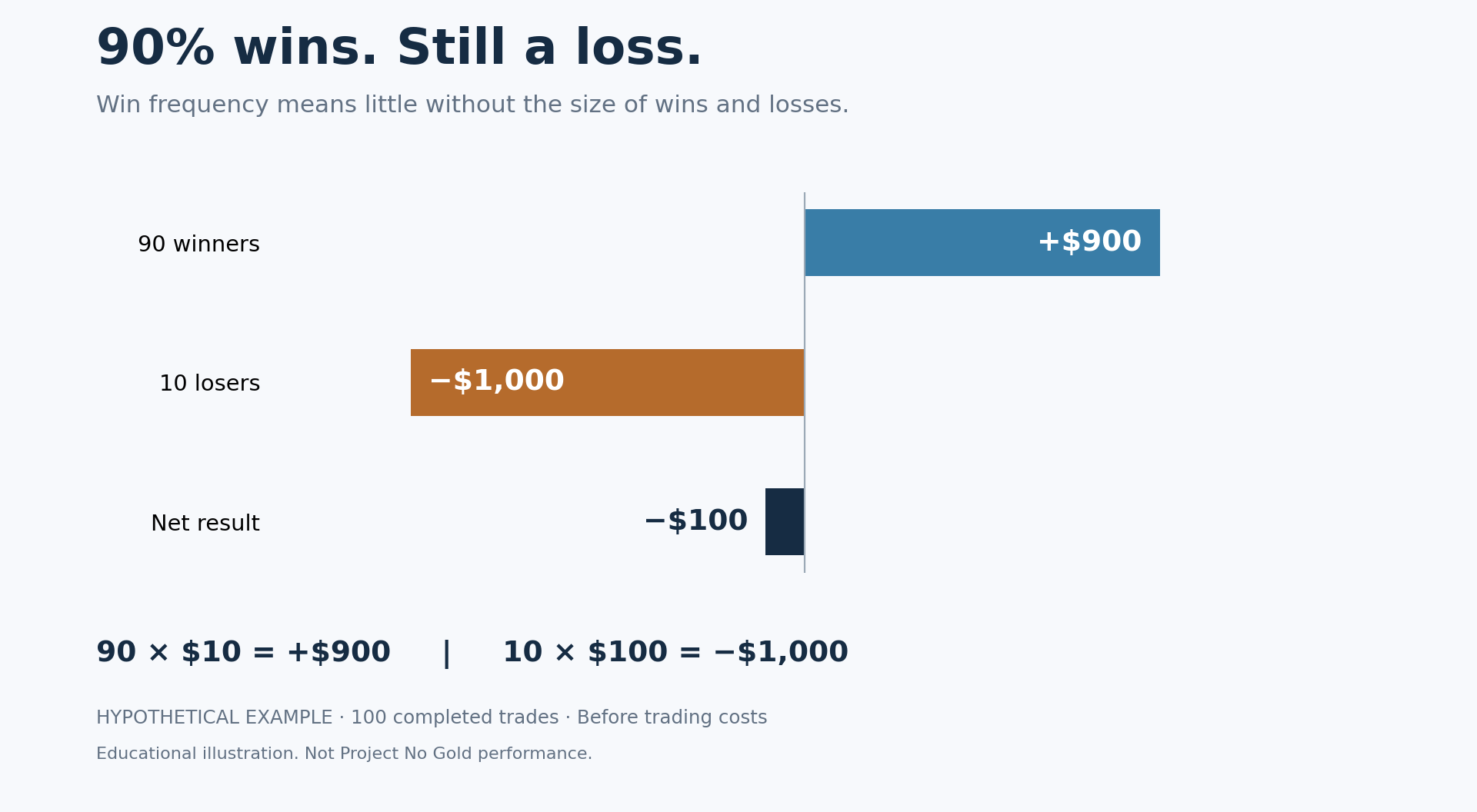
Ask a simple question. Is this a strategy where you win small amounts frequently but occasionally suffer much larger losses?
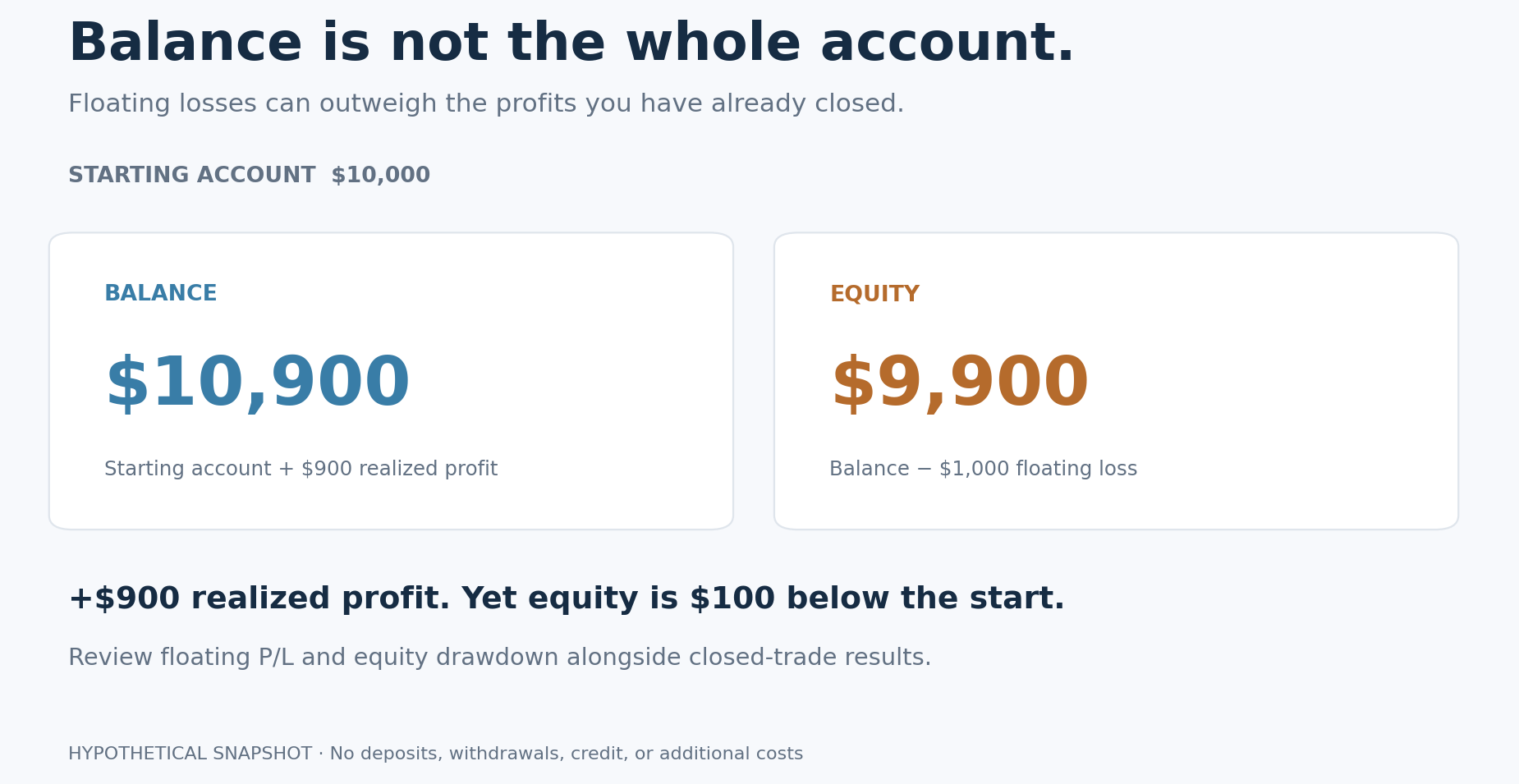
Check both the balance and capital. The balance records realized account results, while capital reflects variable gains and losses. Account value may decrease simultaneously with an increase in the balance. MT5 reports decreases in balance and capital separately. MT5 Test Report
4. "AI" is not exempt from the obligation to submit evidence.
Artificial intelligence and machine learning can be useful tools. However, simply including these words in a product name does not guarantee a competitive edge in business.
What does this model actually do? Did it work properly even on data not used for model development? Is there a possibility that information could be leaked during future tests? What changes occur if the AI components are disabled?
Leveraging historical data and achieving results based on new market data yield different outcomes. As complexity increases, it can become more difficult for buyers to discern these differences.
I do not expect developers to disclose all the source code. However, if the description ends with the phrase "AI handles it" and there is no meaningful content to verify, I will not purchase it.
5. Price and popularity do not prove profitability.
An expensive EA is not necessarily bad, because development, testing, maintenance, and support all come at a cost. Likewise, a cheap EA is not necessarily safer.
The seller sets the price. Future transaction profits do not determine the price.
I seek evidence to support my purchase. This includes actual operational records, an easy-to-understand risk structure, reproducible test conditions, and troubleshooting history.
Selling software is a legitimate business. However, when a seller explains more clearly why a purchase should be made today than the fact that the system might cause losses tomorrow, I find myself pausing to think.
6. A single favorable market situation cannot constitute complete verification.
While observing the market, I came across XAUUSD EAs and products several times that promised excellent results in a short period.
The gold market itself is not inherently bad. Scalping strategies are also not inherently bad strategies. The problem is what conditions this system depends on.
If strong trends or unusually large price fluctuations generated the majority of your profits, what happens when those conditions change? Analyze performance over several years, trading direction, and various volatility conditions. Determine whether a small number of trades or trades over short periods generated the majority of your profits.
Holding multiple EAs does not automatically constitute diversification. If all EAs trade gold in the same direction at similar times, it simply means holding multiple identical positions.
7. Find valid results even under unfavorable assumptions.
If the annual return reaches 1,000% or 10,000%, it is bound to attract attention. I was the same way.
However, return figures alone cannot reveal the risk taken to achieve them. All factors, such as position size, compounding effects, choice of start date, selective reporting, and iterative optimization, can influence the results.
The period for selecting settings and the period for evaluating settings must be separated. External sampling periods should not be considered during the development process. If the system is repeatedly modified based on such periods, it will no longer be a completely independent test.
Check surrounding parameter values, various broker data, actual costs, execution delays, and adverse slippage. Small profit strategies can be particularly sensitive to these details.
Excellent backtest results are not proof of failure. Nor are they a permit to skip verification.
8. Check what measures the developer takes when the price drops.
I value consistent records more than a few screenshots of profitable days.
Is it a real account or a demo account? What version and settings were used? Has the risk level changed? Are there any unexplained gaps? A developer trading their own system can be useful evidence, but it does not prove safety.
When losses occur, can they distinguish between expected strategic actions and execution problems or incorrect assumptions?
Changing settings every time a loss occurs is dangerous. It is also dangerous to explain every problem by saying, "Please wait until it is recovered."
9. Purchasing an EA is different from establishing an operational plan.
Before investing, you must decide how much to invest, when to stop investing, under what circumstances to reconsider the investment, and whether you can tolerate multiple investment strategies incurring losses simultaneously.
The past maximum loss rate is not an upper limit for future losses. Just because a backtest recorded a loss rate of 5% does not mean that the actual account loss rate will stop at 5%.
A quiet strategy is not necessarily wrong. Especially in cases of low trading frequency, the strategy itself is not automatically invalidated simply because losses occurred over a month. However, if risk limits have been exceeded or execution errors are recurring, an investigation is necessary before expecting a recovery.
The reason I started Project No Gold
Those experiences are precisely why I started building my own system.
I believe it is possible to develop a model that pursues long-term profitability through consistent rules. However, finding and maintaining such a model is much more difficult than reading a sales page and clicking a "buy" button.
Project No Gold started from that conviction. The core of this approach is to intentionally exclude XAUUSD and review various assets and strategies. However, simply excluding gold is not enough to secure a competitive advantage. It must be proven whether the strategies capture different opportunities and reduce redundant losses.
Maintaining such a combination in actual trading would yield very unusual results. I would not take on more risk to the system simply to achieve a target rate of return. Actual returns may be lower than the target or even negative, and the maximum drawdown may exceed the target.
If someone has chosen my work, I do not want to take that trust lightly. I cannot promise a loss-free transaction. I would like to clearly explain what I have verified, what I do not yet know, and any remaining risk factors.
Greed does not reduce market risk. It merely makes us willing to take on risks we do not understand.
I have previously looked for EAs that showed the most impressive returns. Now, I want to build a system that can explain losses and limits.
Please apply the same standards to my work. Before trusting the words of developers (including myself), please examine the evidence and risk factors first.