MT5 Trade Copier: Multi-Sender and Multi-Receiver Configuration in Copy Trading

Product link:
https://www.mql5.com/en/ market/product/191385
One of the most powerful capabilities of a professional MT5 Trade Copier is the ability to support multiple senders and multiple receivers simultaneously. This flexibility allows traders to create complex copying topologies that match their specific portfolio management needs, ranging from simple signal distribution to sophisticated multi-strategy portfolio management.
Instead of limiting trade copying to a simple one-to-one configuration, a multi-account copier allows several MT5 accounts to participate in the same copying environment. Each account can operate independently while being connected to other accounts according to the required configuration.
What Is Multi-Sender and Multi-Receiver Copy Trading?
In a traditional trade copying setup, one trading account generates trades and another account receives them. While this configuration is useful for many traders, professional multi-account traders often require considerably more flexibility.
A Multi-Sender / Multi-Receiver configuration allows several MT5 accounts to participate in the same trade replication environment. Different accounts can act as senders or receivers depending on the desired portfolio structure.
This makes it possible to distribute one strategy across multiple accounts, combine several strategies into a single account, or create customized networks where different senders are connected to different receivers.
Three Main Copy Trading Topologies
There are three primary configurations used in multi-account copy trading:
- One-to-Many – one sender distributes trades to multiple receivers.
- Many-to-One – multiple senders contribute trades to one receiver.
- Many-to-Many – multiple senders distribute trades to multiple receivers in different configurations.
One-to-Many Configuration
The One-to-Many configuration is one of the most common applications of an MT5 Trade Copier.
In this setup, one Sender account generates the trading signals while multiple Receiver accounts replicate those trades.
| Sender | Receivers |
|---|---|
| Account A | Account B |
| Account A | Account C |
| Account A | Account D |
| Account A | Account E |
When the Sender opens, modifies, or closes a trade, the corresponding action can be replicated across the connected Receiver accounts according to their individual settings.
Who Can Benefit from One-to-Many?
- Signal providers distributing trades to multiple accounts.
- Traders managing several personal MT5 accounts.
- Prop firm traders operating multiple accounts.
- Portfolio managers managing multiple trading accounts.
- Traders using different brokers for the same strategy.
Many-to-One Configuration
The Many-to-One configuration works in the opposite direction. Several Sender accounts can contribute trades to a single Receiver account.
| Senders | Receiver |
|---|---|
| Strategy A | Portfolio Account |
| Strategy B | |
| Strategy C |
This approach can be useful when a trader wants to combine several independent trading strategies into one portfolio account.
For example, one Sender could represent a trend-following strategy, another a scalping strategy, and another a swing strategy. Their trades can be routed into the designated Receiver according to the configured setup.
Advantages of Many-to-One
- Combining multiple trading strategies.
- Portfolio diversification.
- Reducing reliance on a single strategy.
- Centralizing several trading signals into one account.
- Creating a diversified automated trading portfolio.
Many-to-Many Configuration
The Many-to-Many configuration provides the highest level of flexibility.
Multiple Sender accounts can distribute trades to multiple Receiver accounts, while each Receiver can be configured to copy the appropriate Sender.
| Sender | Receiver | Purpose |
|---|---|---|
| Strategy A | Account 1 | Low-risk portfolio |
| Strategy A | Account 2 | Standard portfolio |
| Strategy B | Account 3 | Alternative strategy |
| Strategy C | Account 4 | Diversified portfolio |
This topology is particularly useful when different accounts require different strategies, risk levels, lot sizes, or trading conditions.
Unique Account Identification
Correct account identification is essential in a multi-account copying environment.
Each Sender should have a unique account number, while each Receiver specifies the account number of the Sender it should follow.
This creates a clear relationship between source and destination accounts and helps prevent trades from being copied to the wrong account.
Sender 10001 Receiver 20001 → copies 10001 Receiver 20002 → copies 10001 Sender 10002 Receiver 30001 → copies 10002
With this structure, different Receiver accounts can follow different Sender accounts simultaneously.
Independent EA Instances
Each COPYLATOR instance operates independently as either a Sender or Receiver.
This makes it possible to create complex copying configurations without requiring separate external copy-trading software.
Multiple MT5 terminals can operate simultaneously on the same computer or VPS, allowing traders to build a complete local trade replication environment.
Multi-Sender / Multi-Receiver and Real-Time Replication
A professional multi-account copier must do more than simply replicate the initial trade.
Depending on the configuration, the copying system can synchronize:
- Market Buy and Sell orders.
- Pending orders.
- Stop Loss modifications.
- Take Profit modifications.
- Trade openings.
- Trade closures.
- Position management changes.
COPYLATOR is designed for real-time trade replication between connected MT5 terminals, including market orders, pending orders, SL and TP synchronization.
Different Lot Sizes for Different Receivers
One of the major advantages of a multi-receiver setup is that every Receiver can have its own risk configuration.
For example, the same Sender trade can be copied using:
- Fixed lot sizing on Receiver 1.
- Multiplier-based sizing on Receiver 2.
- Balance-ratio scaling on Receiver 3.
- A different maximum lot limitation on Receiver 4.
This allows traders to distribute the same strategy across accounts with different balances and risk tolerances.
Multi-Account Risk Management
Multi-account copying becomes significantly more powerful when combined with independent risk management.
Different Receiver accounts can use different drawdown limits and lot management settings.
A trader may configure one account with conservative risk while another account uses a higher risk multiplier.
This means that the same trading signals do not necessarily have to produce identical monetary exposure across every Receiver.
Drawdown Protection in Multi-Receiver Systems
Drawdown protection is particularly important when managing multiple Receiver accounts.
If a Receiver reaches its configured daily or total drawdown limit, the protection system can block new copying for that account. Depending on the configuration, it can also close open positions and delete pending orders.
This allows each Receiver to maintain its own risk boundaries instead of relying entirely on the Sender account's performance.
Different Brokers and Symbol Mapping
Multi-account environments often involve different brokers, and different brokers may use different symbol names.
For example:
- XAUUSD
- XAUUSDm
- GOLD
- GOLD.m
A professional MT5 Trade Copier should therefore be able to identify symbol differences and map the Sender symbol to the correct Receiver symbol.
COPYLATOR includes automatic symbol mapping and provides a warning when a required symbol cannot be found. Manual mappings can also be specified when broker symbol names differ.
For example:
XAUUSD:XAUUSDm
This allows the Sender and Receiver to use different broker symbol names while maintaining trade replication.
Multi-Sender and Different Trading Strategies
Many-to-One and Many-to-Many configurations become especially useful when several trading strategies are involved.
Consider a trader running three independent strategies:
| Sender | Strategy | Risk Profile |
|---|---|---|
| Sender A | Trend Following | Medium |
| Sender B | Scalping | High |
| Sender C | Swing Trading | Low |
These strategies can be distributed to different Receiver accounts or combined according to the trader's portfolio design.
Dashboard and Monitoring
Managing many MT5 terminals can become difficult without proper monitoring.
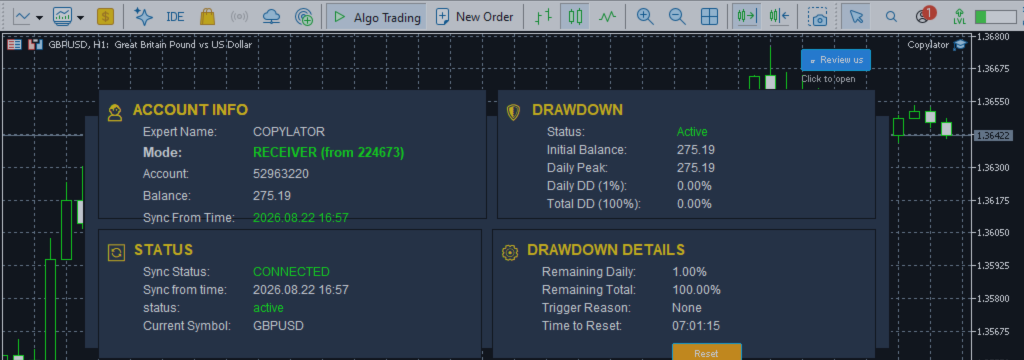
A graphical dashboard provides a convenient way to review account information, synchronization status, operating mode, latency, and other important operational information.
When multiple instances are operating simultaneously, monitoring becomes especially important because a problem with one terminal should be identified quickly.
Scaling from a Small Setup to a Large Network
One of the advantages of a multi-account architecture is that traders can start small and expand gradually.
- Start with one Sender and one Receiver.
- Verify that trade replication works correctly.
- Add a second Receiver.
- Test different lot management configurations.
- Introduce additional Senders if required.
- Monitor the complete network before adding more accounts.
This gradual approach makes it easier to identify configuration problems before the system becomes more complex.
Multi-Sender / Multi-Receiver for Prop Firms
Prop firm traders can benefit significantly from multi-account copying.
When several accounts follow the same strategy, a single Sender can distribute trades to multiple Receiver accounts. Individual Receiver settings can then be used to adapt lot sizes and risk management to each account.
This can reduce repetitive manual trading and help maintain consistent execution across multiple accounts.
Multi-Account Portfolio Distribution
Portfolio managers can also use multi-receiver configurations to distribute strategies according to account objectives.
For example, a conservative portfolio may receive trades with a smaller lot multiplier, while a higher-risk portfolio may use a larger multiplier.
This allows one trading strategy to serve multiple portfolio profiles without requiring separate manual execution.
Important Considerations
- Every Sender should have a unique account number.
- Each Receiver should specify the correct Sender account number.
- All required MT5 terminals should remain running.
- A reliable VPS is recommended for continuous operation.
- Different broker symbol names should be checked and mapped when necessary.
- Lot sizing should be configured according to each account's balance and risk tolerance.
- Drawdown protection should be configured independently where appropriate.
- The complete configuration should be tested on demo accounts before live deployment.
Example of a Complete Multi-Account Setup
| Instance | Mode | Account | Configuration |
|---|---|---|---|
| EA 1 | SENDER | 10001 | Primary Strategy |
| EA 2 | RECEIVER | 20001 | Copies 10001 |
| EA 3 | RECEIVER | 20002 | Copies 10001 |
| EA 4 | SENDER | 10002 | Second Strategy |
| EA 5 | RECEIVER | 30001 | Copies 10002 |
This setup creates two independent copying networks running simultaneously on the same system.
Best Practices
- Start simple: Test one Sender and one Receiver before creating a large network.
- Use unique account identification: Avoid ambiguous Sender configurations.
- Check symbols: Confirm that all Receiver brokers provide the required instruments.
- Configure risk independently: Use suitable lot and drawdown settings for each Receiver.
- Monitor continuously: Keep an eye on synchronization and terminal status.
- Use a VPS: Continuous operation is important for reliable trade replication.
- Test before going live: Validate the complete topology on demo accounts.
Conclusion
Multi-Sender and Multi-Receiver functionality transforms an MT5 Trade Copier from a simple account-to-account copying tool into a flexible multi-account trading infrastructure.
With One-to-Many configurations, traders can distribute one strategy across multiple accounts. With Many-to-One, several strategies can be combined into a single portfolio. With Many-to-Many, traders can create customized routing between multiple strategies and multiple accounts.
The ability to combine independent lot management, drawdown protection, symbol mapping, SL/TP synchronization, and account-specific settings provides additional flexibility for professional multi-account trading.
For traders managing several personal accounts, prop firm accounts, signal distribution networks, or multiple strategies, a properly configured copier can simplify trade execution and portfolio management.
COPYLATOR is designed to support Multi-Sender / Multi-Receiver configurations while allowing each instance to operate independently. This makes it possible to build scalable MT5 copy trading environments on a local computer or VPS.
Product link:
https://www.mql5.com/en/ market/product/191385


