Trade Copier for MT4 and MT5: How to Copy Trades Between Accounts and Size Every Copy by Confidence

Most trade copiers do one thing. A trade opens on one account, and the same trade opens on another account, multiplied by a fixed number you typed in once and probably never changed.
That fixed number is the weak point. A 3x multiplier treats a signal in a clean trending market exactly the same as a signal fired into a choppy, wide-spread session an hour before the weekend. The source account cannot see the conditions on your account. Your broker's spread, your equity, your open exposure and your symbol's volatility are all invisible to it.
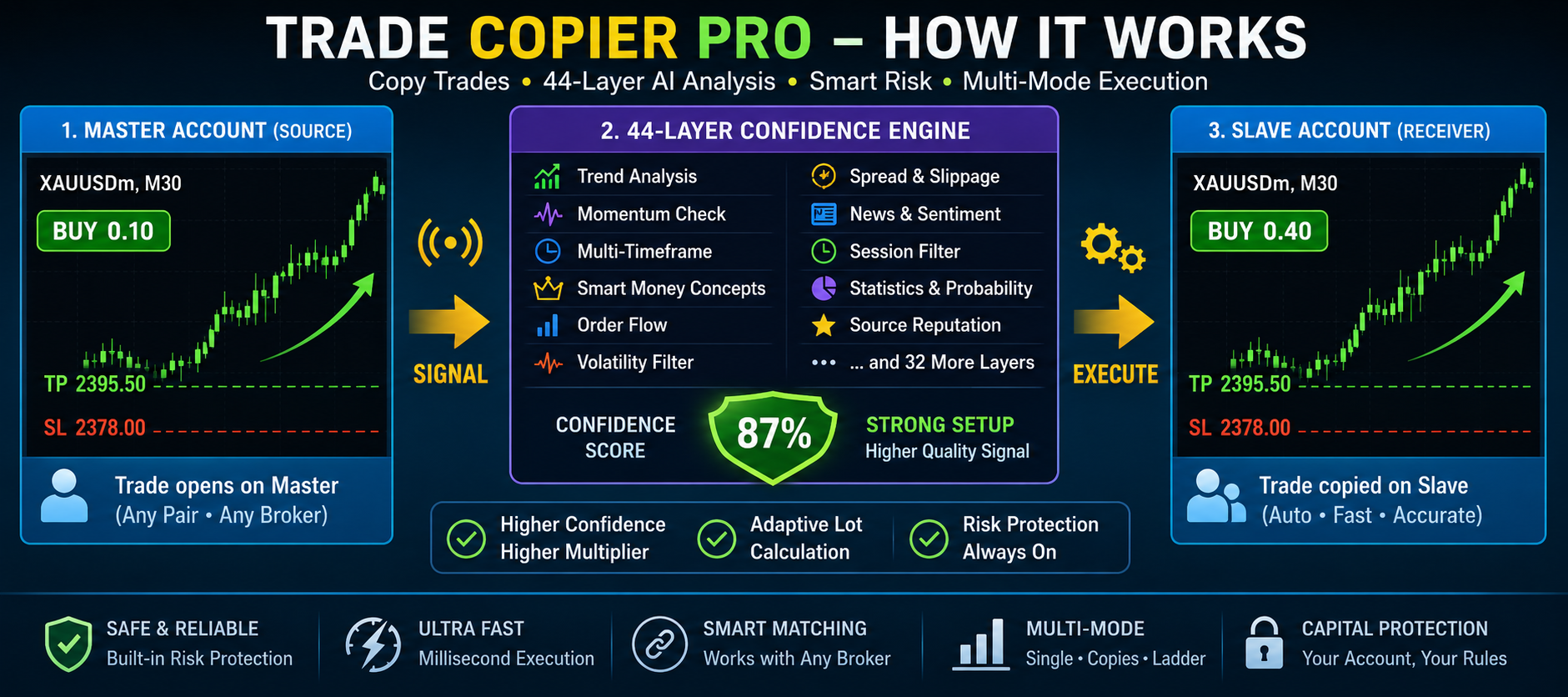
This article explains a different approach, and walks through the full setup for MetaTrader 4 and MetaTrader 5. Every signal that arrives is re-scored on the receiving account before anything is sent to the broker, and the lot size is derived from that score.
The article covers:
- What the tool does and what it does not do
- How the confidence score is built
- The four operating roles and when to use each
- Step-by-step setup for MT4 to MT4, MT5 to MT5, and MT4 to MT5
- How lot sizing actually works, with worked arithmetic
- Risk controls and how to configure them
- Managing many accounts from one screen
- Troubleshooting a link that will not connect
- Frequently asked questions
What This Tool Is, and What It Is Not
It is a trade copier and a position sizing engine in one file. It copies trades between MetaTrader terminals and decides how large each copy should be.
It is not a trading strategy. It does not decide when to buy or sell. It has no opinion about market direction on its own. Every trade it opens is a response to a trade that was opened somewhere else, either by you, by another expert advisor, or by an account you are following.
This distinction matters. If the source account loses money, the copier will faithfully copy those losses. What the copier can do is control how much of your capital is exposed to each signal, refuse signals that arrive under poor conditions, and stop everything when a drawdown limit is reached.
Anyone selling you a copier as a profit engine is describing the wrong product. A copier is risk plumbing. Good plumbing is worth having, but it does not create water.
The Problem With a Fixed Multiplier
Consider a source account that opens 0.10 lots on EURUSD. You set your copier to 3x. You now open 0.30 lots.
Three questions the fixed multiplier never asks:
Is 0.30 lots the right size for your account? If the source account holds 50,000 USD and yours holds 5,000 USD, you have just taken thirty times the relative risk the source did. A fixed multiplier multiplies volume, not risk.
Are conditions on your broker the same? Your spread might be four times wider at that moment. The price may have already moved half an ATR away from the source's entry by the time the signal reaches you. You are entering a different trade at a different price with different costs.
Has this source earned the size? If a particular source magic number has lost on its last eight trades, a fixed multiplier keeps sizing it identically to a source that has been profitable for months.
A copier that answers these three questions before sizing is doing something meaningfully different from one that does not.
How the Confidence Score Works
When a signal arrives, the receiving account runs 44 independent measurements on the symbol, on the receiving broker's own price data. Each returns a value between -1 and +1. They fall into five groups.
Trend and momentum. EMA separation measured in ATR units, rate of change, multi-timeframe alignment across M30, H1 and H4, a momentum heatmap across five timeframes, and regression slope.
Market structure. Break of structure and change of character, order blocks, fair value gaps, liquidity sweeps, premium and discount position inside the dealing range, support and resistance proximity, Fibonacci retracement depth, range position, VWAP deviation and volume profile point of control.
Statistical measures. Hurst exponent by rescaled range, price z-score, variance ratio, Shannon entropy of the return distribution, return skew, and lag-1 autocorrelation.
Order flow and pattern. Tick delta proxy from candle close position, cumulative volume delta proxy, effort versus result, candlestick patterns, harmonic XABCD ratio scanning, Elliott impulse approximation and Gann angle.
Context and execution. Currency strength differential for FX pairs, correlated instrument confirmation, a k-nearest-neighbour forward return estimate, round number proximity, hour-of-day and day-of-week realised edge, source reputation, direction versus regime fit, your own realised edge, slippage health and entry drift.
None of these are indicator handles. Everything is computed from raw price arrays, which is why the tool runs without loading a single indicator and works identically on both platforms.
Regime weighting
Before the scores are combined, the engine classifies the current market into one of four regimes: quiet, trending, volatile or chaotic. It does this from the ratio of current ATR to its own recent average, combined with directional efficiency, which is net movement divided by total path length.
Each regime re-weights the layers. In a trending market, trend and structure layers gain weight while mean-reversion layers such as z-score and range position are cut to roughly a third. In a quiet range, that reverses. In a chaotic regime, almost everything is reduced to 45 per cent weight and only spread, volatility, entry drift, slippage and risk-reward keep full influence.
The reasoning is simple. A support and resistance reading is genuinely useful information in a range and genuinely misleading in a strong trend. Weighting them identically in both wastes the measurement.
Self-learning
After each copy closes, the engine records which layers had been pointing the right way. Over a rolling window of closed trades it adjusts each layer's weight toward its realised hit rate, blended at a configurable rate so no single result swings it.
Layers that consistently call the market correctly on your symbols and your broker gain weight. Layers that do not, lose it. The learning state is saved to disk and survives restarts.
Source reputation
Every source is tracked separately by magic number and account. The engine records trade count, win rate, gross profit, gross loss and expectancy in R multiples. A source with a strong profit factor gradually earns a larger multiplier. A source that keeps losing gets shrunk. You can also set a minimum win rate below which a source is ignored entirely.
The Four Roles
The same file runs in four modes. You set the role in the inputs.
MASTER. Publishes this account's trades so other terminals can copy them. Does not copy anything itself.
SLAVE. Receives signals from a master and opens sized copies. Does not publish.
LOCAL. Copies trades opened on this same terminal, by hand or by another expert advisor, and multiplies them on the same account. No second terminal is needed. This is the mode to use if you want to scale up an existing EA's trades without touching its code.
HYBRID. Publishes to other terminals and also multiplies locally.
Most setups are one MASTER and one or more SLAVE terminals.
MT4 https://www.mql5.com/en/market/product/189390?source=Site+Market+My+Products+Page
MT5 https://www.mql5.com/en/market/product/188472?source=Site+Market+My+Products+Page
Setup Guide
Before you start
Both terminals must share the same Common Files folder. On Windows this is normally:
%APPDATA%\MetaQuotes\Terminal\Common\Files
MT4 and MT5 both use this same folder, which is what makes cross-platform copying possible.
A terminal launched with the /portable switch uses its own private folder and will never see the other terminal. If you use portable mode, either stop using it for these terminals, or switch the copier to the optional relay transport.
Step 1: Install the file
Copy the .mq5 file into MQL5\Experts for MetaTrader 5, or the .mq4 file into MQL4\Experts for MetaTrader 4. Refresh the Navigator, or restart the terminal.
Step 2: Configure the source terminal
Open a chart on the account whose trades you want to copy. Any symbol, any timeframe. The chart symbol does not restrict what gets copied.
Attach the expert advisor and set:
- Operating role: MASTER
- Channel name: TCX1
- Friendly label: something you will recognise, for example Main Account
Enable AutoTrading. Confirm the Experts tab shows the startup self-test.
Step 3: Configure the receiving terminal
Open a chart on the account that should receive the trades. Attach the same expert advisor and set:
- Operating role: SLAVE
- Channel name: TCX1, exactly matching the master
The channel name is a plain text label. Both sides must use the identical string. A trailing space counts as a difference.
Step 4: Verify the link before trading
This is the step most people skip, and it is the step that saves the most time.
On the receiving terminal, press SETTINGS on the dashboard, then open the LINK tab. It shows:
- The full Common Files path this terminal is using
- Whether another terminal has been detected, shown as PARTNER SEEN or ALONE
- Every terminal currently reporting in, with platform, login, role and channel
- Which channel the master is publishing on, flagged if it does not match yours
- The age of the heartbeat and signal files
- Whether a saved settings file is overriding your inputs
Compare the folder path on both terminals. If the paths differ, no file-based copier can work between them and you need to fix the installation first. If both show PARTNER SEEN in green, the link is working.
If the channel names differ, the LINK tab flags a mismatch and names the master's channel. You can correct it manually, or enable automatic channel adoption in the inputs.
Step 5: Test with a small trade
Open a small manual trade on the master. Within a second, the slave dashboard should show a received signal count and open a copy.
If nothing happens, the dashboard shows why. Every rejection has a stated reason: spread too wide, symbol not tradable, confidence below floor, daily loss limit reached, and so on. The reason line is there specifically so you are never left guessing.
MT4 to MT5 and MT5 to MT4
Cross-platform copying needs no extra configuration. Both platforms write the same file format and both publish timestamps in GMT, so brokers in different server timezones do not cause signals to be judged stale.
Symbol names are resolved automatically. The engine reduces any decorated broker name to the instrument inside it, so a master running mEURUSD matches a slave running EURUSD.pro without configuration. Prefixes, suffixes, both together, and vendor aliases such as GOLD and XAUUSD are all handled. Manual symbol mapping is available if your broker uses a name that no rule could infer.
Lot Sizing: The Arithmetic
This is the part worth understanding properly, because it is where a copier either protects you or quietly ruins you.
There are six base lot methods. The base lot is calculated first, then the confidence multiplier is applied on top.
Mirror. Same volume as the source. Simple, and appropriate only when both accounts are similar in size.
Fixed. A lot size you specify, regardless of the source.
Balance ratio. Source volume scaled by the ratio of your balance to theirs, with a cap. If they hold 50,000 and you hold 5,000, their 0.50 lots becomes 0.05.
Risk percent. Sized so that the distance from entry to the copied stop loss represents a chosen percentage of your equity.
Risk parity. Matches the source's proportional money risk in your account currency. If the source risked 1.2 per cent of their balance, you risk 1.2 per cent of yours, capped at a multiple of your configured risk percentage.
Fractional Kelly. Derived from your own realised win rate and average return, with a hard risk ceiling.
A worked example
Your account holds 10,000 USD. You use risk percent sizing at 1 per cent. A signal arrives on EURUSD with a 250-point stop.
At 1 per cent, your risk budget is 100 USD. On a standard EURUSD lot, 250 points is roughly 25 USD per 0.10 lots at typical tick values. Your base lot is therefore approximately 0.40.
Now the confidence score is applied. Suppose it returns 81 and your tier table maps that to 3x. The multiplier is not applied blindly:
- 3.00 from the confidence tier
- multiplied by the warm-up fraction, which starts at 35 per cent for a new installation and rises as closed trades accumulate
- multiplied by the recovery factor, which is 0.45 while the account is in drawdown beyond the trigger level
- multiplied by the source reputation bias, between 0.35 and 1.9
- multiplied by the freshness decay, which reduces size as the signal ages
- multiplied by the slippage governor, which shrinks size while your fills keep slipping
On a fresh installation with no history, that 3.00 becomes roughly 1.05 after the warm-up alone. Your 0.40 base becomes about 0.42 lots, not 1.20.
This is intentional. A new installation on a new account with no track record should not be trading at full size on day one. As the record builds, the warm-up rises toward 100 per cent and the full multiplier applies.
Every result is then clamped by your maximum lot per copy, maximum total open lots, maximum lots per symbol, and optionally maximum net exposure per currency.
The three multiplier modes
Single position. One trade, volume multiplied. Cleanest.
N separate copies. The multiplier becomes a trade count. A 3x signal opens three separate positions at market. Useful if you want to scale out at different targets.
ATR ladder. One position at market and the remainder as pending orders spaced by a fraction of ATR below or above, so you average into the move rather than committing at one price.
The dashboard shows the resulting trade count directly, reading for example x2.50 = 3 trades , so you always know what a signal will do before it fires. A single button toggles the multiplier off entirely for straight 1:1 copying.
Risk Controls
These run continuously and independently of the copy logic.
Daily loss limit. Percentage of day-start equity. When breached, copying stops. Optionally stays locked for the rest of the day.
Maximum drawdown. Percentage from peak equity.
Equity curve protection. Samples equity on a timer, builds a moving average of those samples, and pauses if live equity falls a set percentage below its own average. This catches slow bleeding that a hard drawdown limit would not trigger on until much later.
Recovery sizing. Once drawdown passes a trigger, size is reduced by a configurable factor until the account recovers. Reduced size in drawdown is one of the few risk techniques with a genuinely sound basis.
Consecutive loss attenuation. Confidence is penalised after consecutive losses, so sizing tightens automatically.
Margin level floor. No new copies open below a chosen margin level.
Anti stop-hunt cooldown. After a wick larger than a multiple of ATR, copying pauses for a cooldown period.
News blackout windows. Specified in plain text, for example FRI 13:00-14:00;WED 18:00-19:00 , evaluated in GMT.
Session filter, weekend block, Friday close. Self-explanatory, all optional.
Kill switch. Drop a named file into the Common Files folder and every terminal stops opening new copies. This works even if you cannot reach the charts.
Equity floor. An absolute number. Below it, nothing opens.
Managing Many Accounts
If you run more than two or three accounts, going terminal to terminal does not scale.
The PEERS tab lists every connected account in one table: login, balance, equity, live drawdown percentage, open lots, and status including why an account is stopped if it is.
Select one account, or all accounts, and issue commands directly:
- Pause and resume
- Flatten everything
- Close only profitable positions
- Move stops to breakeven
- Multiplier on or off
- Change slave mode
- Set maximum drawdown, risk percentage, daily loss limit or ladder leg count
Commands are written as small files that each account polls. Each account executes anything newer than the last command it ran, then reports back the sequence number it executed, so the master can distinguish between a command that was sent and a command that actually landed.
Any account can refuse remote control with a single input, which matters if you are managing accounts you do not personally own.
Additional Tools
The TOOLS tab provides broker, GMT and PC clocks side by side, which FX sessions are currently open, a countdown to the next session change, live symbol facts including spread, stops level, tick value, contract size, swaps and margin per lot, a risk calculator that works in both directions, and current exposure with floating profit and loss. It also has one-click management: close buys, close sells, delete pendings, breakeven all, close half, flatten all. All are filtered by magic number, so they never touch trades this tool did not open.
The CHART tab offers sixteen chart styles. Three are native to MetaTrader. The rest are drawn by the expert advisor: Heikin Ashi, hollow candles, high-low bars, baseline, area, step line, Renko, range bars, line break, Kagi, point and figure, volume profile and market profile TPO.
A note on honesty here, since it affects how you should describe this feature. Renko, range bars, line break, Kagi and point and figure advance on price movement rather than time. Drawn as an overlay on a MetaTrader chart, they are laid out left to right in sequential slots. The shapes and the logic are correct. The horizontal axis is positional rather than chronological. Anyone who has used an overlay chart tool in MetaTrader will recognise this, and stating it plainly is better than having a buyer discover it.
Who This Is For
Traders running several accounts. Personal account, a larger account, a family member's account. One decision, sized appropriately for each.
Signal followers who want control. Following a signal provider but wanting your own risk limits, your own stop behaviour and your own sizing on top of their entries.
Prop firm challenge accounts. Hard daily loss limits and maximum drawdown limits are exactly what these accounts require. The controls here map directly onto typical prop firm rules. Set the limits to sit inside the firm's limits, with margin to spare.
Traders scaling an existing EA. LOCAL role multiplies trades from an EA already on your terminal without modifying that EA at all.
Money managers. The PEERS tab was built for exactly this: many accounts, one screen, per-account control.
Troubleshooting
The slave says no master heartbeat. Open the LINK tab. If it says ALONE, the terminals do not share a folder. If it says PARTNER SEEN but no heartbeat, the master is publishing on a different channel and the tab will name it.
Trades are not copying but the link is green. Read the reason line on the dashboard. Common causes are a spread above your configured maximum, a slave mode set to receive-only or multiply-only, or a saved settings file overriding your inputs. The LINK tab flags all three, and includes a button to clear saved settings and restore your inputs.
Lots are smaller than expected. Almost always the warm-up ramp. Check the current warm-up percentage on the dashboard. It rises as closed trades accumulate, or you can switch warm-up off in the inputs.
Pending orders rejected. Check the stops level for your symbol on the TOOLS tab. Some brokers require a wider minimum distance than the copied stop provides. Enable the stops fallback option, which opens the position first and attaches stops immediately afterwards.
Frequently Asked Questions
Does this work between MT4 and MT5? Yes, in both directions. Both platforms use the same shared folder and the same file format.
Do the two terminals need to be on the same computer? For the default file-based transport, yes. For separate machines or VPS instances, use the optional relay transport, which requires whitelisting the relay URL in the terminal's WebRequest settings.
Does it work if brokers use different symbol names? Yes. Symbol resolution handles prefixes, suffixes and common aliases automatically. Manual mapping is available for unusual cases.
Will it copy trades from another expert advisor? Yes. You can watch specific magic numbers, exclude others, or watch all of them.
Will it copy manual trades? Yes, and this is enabled by default.
Can I reverse the direction of every copy? Yes, there is an input for it.
Does it copy stop loss and take profit? Yes, and it keeps them synchronised if the source moves them. If your own breakeven or trailing logic has already moved a stop to a better level, the sync will not move it backwards.
What happens when the source closes? The copies close, unless you disable that. Partial closes are mirrored proportionally.
How many accounts can connect? There is no fixed limit in the design. Practical limits come from your machine and your broker.
Does it need a VPS? Not for the file transport on one machine. If you want the terminals running continuously without your computer being on, a VPS is sensible for any automated trading.