The Future of Automated Trading: How AI Is Replacing Traditional Algorithms — And Why the Window for Early Adoption Is

Every major technological shift in financial markets follows the same adoption curve. Institutions access the technology first — at enormous cost, with dedicated engineering teams, and with infrastructure that no retail participant can replicate. Over time, the cost falls. The engineering becomes commoditized. The capability that was once the exclusive domain of a handful of quantitative hedge funds becomes accessible to individual traders with a MetaTrader 5 account and a willingness to look beyond conventional indicators.
This is the curve that electronic trading followed. Then algorithmic trading. Then systematic high frequency strategies. In each case, retail traders who recognized the shift early and positioned themselves accordingly gained an edge that persisted for years before the broader market caught up. Those who recognized it late entered after the edge had been competed away.
Adaptive AI trading — systems that learn, adapt, and respond to market conditions in real time rather than executing fixed rules — is the current frontier of this curve. The institutions have been building it for years. The retail accessible implementations are arriving now. The window between "early access" and "mainstream adoption" is the period that creates the largest asymmetric advantage for the traders who move first.
This article examines where that curve currently stands, what the trajectory looks like from here, and why the products available through ICONIC.FX today represent the leading edge of what retail traders can access at this moment in that adoption cycle.
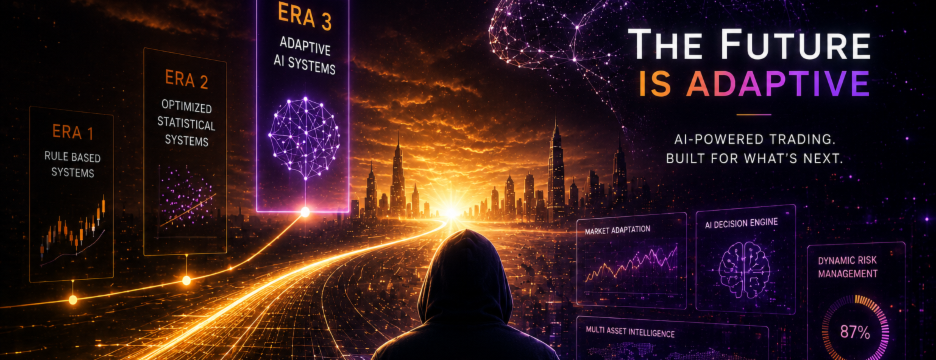
THE THREE ERAS OF ALGORITHMIC TRADING
Era One: Rule Based Systems
The first era of algorithmic trading was the era of rule based systems. Moving average crossovers. RSI thresholds. Bollinger Band breakouts. Hardcoded logic that converted indicator readings into buy and sell orders without human hesitation or emotion in the execution loop.
This was a genuine advance over pure discretionary trading. Rules enforced consistency. Execution was faster than any human hand. The system did not skip trades out of fear or overtrade out of greed. For a period, the discipline of rule based execution alone was sufficient to generate positive expected value in markets where the majority of participants were still trading discretionally.
That period is largely over. When the majority of trading volume is generated by algorithmic systems, the edge of being algorithmic itself disappears. What matters is which algorithm — and how it responds when market conditions change. Fixed rule based systems have no response. They continue executing the same logic until an operator manually intervenes. The era of competitive advantage through rule based automation has passed for most liquid markets.
Era Two: Optimized Statistical Systems
The second era introduced statistical optimization: testing thousands of parameter combinations on historical data, selecting the highest performing configurations, and deploying them into live markets. Machine learning techniques — initially simple regression models and decision trees, later neural networks and ensemble methods — were applied to price data to identify patterns that fixed indicators could not capture.
This era produced significant advances in institutional trading desks. Quantitative funds applied statistical learning to massive datasets across hundreds of instruments simultaneously, identifying correlations and patterns invisible to human analysis. The resulting strategies outperformed conventional systematic approaches by substantial margins.
For retail traders, access to this era came primarily through preoptimized Expert Advisors — systems that incorporated the output of statistical optimization without exposing the process. The limitation was the same one that afflicts all statically optimized systems: the parameters reflected the past, not the future. As market conditions evolved, the optimized parameters expired. The second era produced better performing fixed systems. It did not solve the fundamental problem of regime blindness.
Era Three: Adaptive AI Systems
The third era — the current frontier — is the era of adaptive intelligence. Systems that do not optimize parameters on historical data and freeze them. Systems that update their behavior from live market interactions. Systems that detect regime changes and respond to them. Systems that model causal relationships between assets rather than treating correlation as a sufficient signal. Systems that allocate capital through game theoretic optimization rather than static rules.
This is the era that quantitative hedge funds have been operating in for the past decade. Reinforcement learning trading agents, reservoir computing architectures, evolutionary strategy search, information theoretic market modeling — these are not research concepts. They are production technologies deployed in live markets by the largest and most sophisticated trading operations in the world.
They are also, through the ICONIC.FX product lineup, now available in a MetaTrader 5 Expert Advisor. Not as a simplified approximation. As genuine implementations of these architectural principles, running natively in the MT5 execution environment without external dependencies.
WHAT INSTITUTIONAL AI TRADING LOOKS LIKE — AND WHY THE GAP IS CLOSING
Institutional AI trading systems share several defining characteristics. They learn from live market data rather than relying on preoptimized static configurations. They model relationships between multiple instruments simultaneously, exploiting information that exists in the interaction between assets rather than in any single asset alone. They adapt their capital allocation in response to changing performance profiles across strategy components. And they incorporate hard risk constraints that operate at the execution level, unconditionally, regardless of what the signal generating components recommend.
These are precisely the characteristics that define the three products in the ICONIC.FX lineup.
ICONIC BTC AI+ learns from live market interactions through its evolutionary quality diversity archive and its Hebbian plasticity mechanism. Its MAP Elites structure continuously searches for better performing strategies across the behavioral niche space — the same quality diversity optimization approach used in cutting edge robotics and reinforcement learning research. Its hindsight experience replay mechanism extracts learning signal from failed trades — a technique proven in institutional multi agent reinforcement learning systems before being implemented here in a retail Expert Advisor.
ICONIC NEUROCORE AI+ models the relationship between Bitcoin and Gold through Transfer Entropy, uses a reinforcement learning agent that discovers policy through live market interaction, and applies covariance risk parity — the same capital allocation framework used by multi asset institutional portfolios — to dynamically balance exposure between two instruments continuously.
ICONIC KYBERNETIC AI brings the full institutional architecture stack to a single MetaTrader 5 chart: bidirectional causal inference between assets through Transfer Entropy, high dimensional temporal feature processing through a 500-node Liquid State Machine, hard margin constraints through the Physics Informed Margin Axiom, and Nash equilibrium capital allocation through Stochastic Tunneling optimization. These are not simplifications of institutional approaches. They are the institutional approaches, implemented natively in MQL5.
The gap between what institutional trading desks have access to and what retail traders can deploy in MetaTrader 5 has never been smaller than it is right now.
THE ADOPTION CURVE CREATES ASYMMETRIC OPPORTUNITY
Understanding the adoption curve matters because it defines the competitive landscape of the market you are trading in. At each stage of the curve, the population of participants using a given level of technology determines how much edge that technology provides.
When institutional traders were the only ones using electronic execution, their speed advantage over manual floor traders was enormous. As electronic execution spread to retail traders, the speed advantage persisted — but as a feature of the infrastructure, not a source of alpha. The edge from electronic execution was competed away as it became universal.
When sophisticated backtested systematic strategies were exclusive to quantitative funds, they generated exceptional returns against a market dominated by discretionary traders. As retail algorithmic trading proliferated, the edge of being systematic diminished — not to zero, but substantially. The market adapted to the presence of algorithmic participants.
Adaptive AI trading is currently in the early phase of its adoption curve at the retail level. The institutional participants have been operating here for years and have already adapted to each other's presence. The vast majority of retail algorithmic traders are still operating with first and second era technology — fixed rule based systems and statically optimized Expert Advisors. The gap between what early adopters of adaptive AI can access and what the average retail algorithmic trader is using is larger today than the gap between discretionary trading and electronic execution was in the early days of that transition.
This gap compresses over time. As adaptive AI systems proliferate in the retail market, their presence becomes priced into market behavior and the structural edge reduces — the same dynamic that has played out at every previous stage of the adoption curve. The traders who are positioned ahead of that compression benefit most. The traders who wait until adaptive AI is mainstream have entered after the most favorable window has closed.
WHAT COMES NEXT — AND WHY IT MAKES CURRENT ACCESS MORE VALUABLE
The trajectory of AI in financial markets points in one direction: increasing sophistication, increasing accessibility, and increasing prevalence across all asset classes and timeframes. The techniques that define the frontier today will be standard practice within a decade. The techniques that will define the frontier a decade from now do not yet exist in production form.
In this environment, being positioned on the current frontier rather than on last decade's best practices is not just an edge for this quarter. It is a structural advantage that compounds over the adoption period. A trader who begins operating with adaptive AI technology now develops experience with these systems, builds intuition for their behavior across different market conditions, and accumulates performance history that informs future decisions — before the systems themselves become commoditized.
The technology inside ICONIC BTC AI+, ICONIC NEUROCORE AI+, and ICONIC KYBERNETIC AI is not a temporary feature set that will be replaced next quarter. The architectural principles — evolutionary quality diversity search, reinforcement learning with temporal credit assignment, causal inference between assets, reservoir computing for temporal feature extraction, Nash equilibrium capital allocation — are the foundational building blocks of the next generation of trading system design. Learning to operate with these systems now is positioning for a much longer horizon than the next trade.
THE DEMOCRATIZATION ARGUMENT: WHY THIS MOMENT IS UNIQUE
For most of the history of financial markets, access to the best technology was restricted by capital requirements. The infrastructure needed to run institutional grade quantitative strategies cost millions of dollars in hardware, data, and engineering talent. Retail traders were structurally excluded from competing at that level regardless of their mathematical sophistication.
MetaTrader 5's native matrix and vector types, combined with the hardware available on a standard personal computer, have made it possible to implement genuine machine learning architectures natively inside an Expert Advisor — without external infrastructure, without institutional resources, without a team of engineers. What required a dedicated quant research team and server farm a decade ago can now run on a standard VPS with MetaTrader 5 installed.
This democratization is not theoretical. It is the literal engineering basis of every product in the ICONIC.FX lineup. ICONIC BTC AI+, ICONIC NEUROCORE AI+, and ICONIC KYBERNETIC AI run entirely in native MQL5 — no DLLs, no external APIs, no cloud dependencies. The intelligence runs inside MetaTrader 5 itself. On a standard broker server. Accessible to any retail trader with a MetaTrader 5 account.
The institutional grade capability is here. The access requirement is a MetaTrader 5 account and a decision.
WHERE TO START
The full ICONIC.FX product lineup is available on MQL5 — three distinct AI architectures, three different entry points into the adaptive trading era, all documented in full detail on the developer profile.
For traders new to the lineup, the comparison guide in the blog section of the profile breaks down the specific differences between ICONIC BTC AI+, ICONIC NEUROCORE AI+, and ICONIC KYBERNETIC AI in terms of architecture, market scope, and trader profile fit.
Live market analysis, daily trading updates, and AI system behavior across Bitcoin and Gold:
instagram.com/iconicfxofficial
Community, announcements, and direct contact:
t.me/iconicfxofficial
The era of adaptive AI trading is not arriving. It has arrived. The question is only which side of the adoption curve you intend to be on.