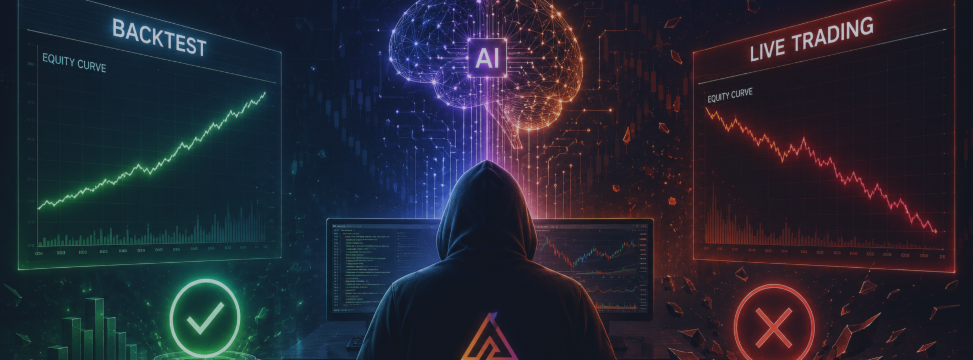
Why Your Expert Advisor Worked in Backtest and Failed Live: The Complete Guide to Backtesting Limitations

Every developer on the MQL5 marketplace has a beautiful backtest. Smooth equity curves. Minimal drawdown. Consistent monthly returns extending across years of historical data. The backtest looks exactly like what every trader wants their account to look like.
Then the EA goes live. Within weeks or months, the performance diverges. Sometimes it collapses immediately. Sometimes it holds for a period and then falls apart as soon as market conditions shift slightly. Occasionally it continues to perform — but these cases are the exception, not the rule. The gap between backtested performance and live performance is one of the most documented phenomena in retail algorithmic trading.
Understanding why this gap exists is not optional knowledge for any trader evaluating an Expert Advisor. It is the foundational filter that separates serious evaluation from wishful thinking. This article explains the specific mechanisms behind backtest failure — curve fitting, data mining bias, look ahead bias, tick data quality, slippage modeling, and parameter instability — and then explains why adaptive AI architecture addresses each one in ways that fixed parameter systems structurally cannot.
THE CORE PROBLEM: OPTIMIZATION IS NOT PREDICTION
Every backtest is a search process. The developer defines a set of rules, defines a parameter space, and runs thousands of combinations against historical data to find the configuration that produced the best historical performance. This process is called optimization.
Optimization is extraordinarily good at one thing: finding parameters that work on the specific historical dataset being tested. It is not good at finding parameters that will work on future data. The historical dataset and the future data are different. Optimized parameters fit the past. They do not predict the future.
This distinction — between fitting the past and predicting the future — is the source of nearly every backtest to live performance gap. The process of optimization itself introduces a systematic bias: the more parameters you optimize, the more thoroughly you will fit the historical data, and the less well your system will perform on new data.
This failure mode has a name: curve fitting. An overfitted system has learned the historical data rather than learning the market. In backtest, it recognizes every past pattern because it was optimized to recognize them. In live trading, those specific patterns do not recur exactly. New variations appear. The system has no response to them — because it was never designed to generalize. It was designed to fit.
DATA MINING BIAS: THE STATISTICAL ILLUSION OF EDGE
Related to curve fitting but more subtle is data mining bias. When a developer tests hundreds or thousands of strategy variations on the same dataset and selects the best performing one for publication, the published result is not an honest representation of that strategy's expected performance. It is the result of a selection process that guarantees the best historical outcome will be chosen — regardless of whether that outcome reflects genuine predictive power.
Imagine testing 1,000 completely random trading systems on historical Bitcoin data. Some of them, purely by chance, will show strong historical performance. If you select the best performing random system and publish its backtest, it will look like a genuine edge. It is not. It is noise that happened to align with the specific dataset it was tested on.
The more combinations a developer tests, the more this bias inflates the apparent quality of the selected result. A system chosen from 10,000 parameter combinations on a single dataset carries enormous data mining bias. Its historical performance tells you almost nothing about its future performance.
The only partial remedy for data mining bias is genuine out of sample testing — reserving a portion of historical data that was never used during optimization, then testing the optimized parameters on that reserved data. If performance holds on the out of sample data, the strategy has demonstrated some degree of generalization beyond the optimization period. If it collapses, the strategy was overfitted to the in sample data and carries no genuine edge.
Most backtests published on MQL5 do not clearly disclose whether out of sample validation was performed. This is itself a signal worth noting.
LOOK AHEAD BIAS: USING TOMORROW'S DATA TO TRADE TODAY
Look ahead bias occurs when a backtest uses data that would not have been available at the moment a trade decision was made in real time. The most common version is closing price calculation: some backtesting implementations allow indicators to access the closing price of a candle that has not yet closed. In live trading, that candle is still forming. The closing price does not exist yet. The signal generated in the backtest was calculated using information the system could not have had.
Look ahead bias can also appear in news filter implementations, spread calculations, and commission accounting. A backtest that applies today's known spread to every historical trade is using information that was not available at each trade's actual moment of execution. Historical spreads vary significantly — particularly around major news events, low liquidity periods, and broker specific conditions.
The practical consequence is a backtest that performs better than any live system ever could — not because the strategy is good, but because it was built on data that did not exist at the moment of decision.
MetaTrader 5's backtesting engine has significantly reduced look ahead bias compared to MT4 through its tick by tick simulation mode. But it does not eliminate all possible sources. Developers who are not rigorous about their implementation can still introduce subtle look ahead effects that inflate backtest quality while contributing nothing to live performance.
SLIPPAGE AND SPREAD: THE INVISIBLE PERFORMANCE KILLERS
A backtest executed with fixed spread and zero slippage does not represent live trading conditions. It represents an idealized environment that has never existed.
Spread is not constant. On BTCUSD, spread widens during high impact news events, low liquidity overnight periods, and during large directional moves when market makers widen their quotes to protect against adverse selection. A system that enters and exits dozens of trades per month will experience the full range of spread conditions across its trading history. Backtesting with a fixed low spread assumption understates the actual transaction costs the system will face in live conditions.
Slippage is the difference between the price at which a trade is requested and the price at which it is actually executed. In fast moving markets — which characterize Bitcoin trading — slippage on market orders can be significant. A breakout entry requested at 43,000 USD that executes at 43,050 USD has experienced 50 USD of adverse slippage per unit. Multiplied across a year of trades, unmodeled slippage can transform a modestly profitable system into a net loser.
The systems in the ICONIC.FX lineup incorporate maximum spread filters as an entry condition. ICONIC BTC AI+, ICONIC NEUROCORE AI+, and ICONIC KYBERNETIC AI all check current spread against a configurable maximum before placing any order. If the spread at the moment of the signal exceeds the defined threshold, the order is not placed. This filter eliminates entries during abnormal spread conditions — news spikes, low liquidity periods — where execution quality is degraded and the expected value of the entry deteriorates.
PARAMETER INSTABILITY: THE OPTIMIZATION THAT EXPIRES
Even a well validated system with genuine out of sample performance faces a structural problem: the parameters that worked during the testing period may not continue to work as market conditions evolve. Markets are not stationary. Volatility regimes shift. Correlation structures change. The behavior of institutional participants evolves as the market matures.
A fixed parameter system optimized on data from a specific market period carries an implicit assumption: that the market conditions that made those parameters work will persist indefinitely into the future. This assumption is almost never correct over multi year horizons. The parameters expire. The system continues executing them long after they have stopped being appropriate for current conditions.
This is the problem that adaptive AI architecture solves — and it is the core reason why the products in the ICONIC.FX lineup are specifically designed around adaptation rather than optimization.
ICONIC BTC AI+ does not optimize parameters for a historical period and then freeze them. Its MAP Elites archive is a living structure that continuously updates the best known strategy for each behavioral niche based on live market interactions. When Bitcoin's volatility regime shifts, the archive shifts with it — demoting strategies that no longer perform in the new regime and elevating strategies that do. The system does not expire. It adapts.
ICONIC NEUROCORE AI+ solves parameter instability through reinforcement learning. The Q function that drives trading decisions is not optimized on historical data and frozen. It is updated continuously from live trading outcomes. Every trade result — win or loss — updates the agent's estimate of which actions produce the best outcomes in which market states. The policy evolves as the market evolves. There is no optimization period to expire because optimization never stops.
ICONIC KYBERNETIC AI addresses parameter instability at the system architecture level. The Transfer Entropy causal gate, the Liquid State Machine reservoir, and the Stochastic Tunneling Nash allocator all update their internal state continuously from live market data. The system's behavior at any given moment reflects the current market structure — not a historical period that may have ended months or years ago.
TICK DATA QUALITY: WHY THE SIMULATION IS NEVER THE REALITY
MetaTrader 5's backtesting engine simulates historical price action using tick data. The quality of this simulation depends entirely on the quality of the tick data available. Brokers provide historical tick data, but this data is often incomplete, resampled from lower resolution data, or missing the bid ask spread dynamics that existed at each moment in history.
A system that trades based on intra candle price movement — particularly one that places pending orders, trailing stops, or uses precise entry and exit levels — will behave differently depending on the tick data quality used in the simulation. With high quality true tick data, the simulation approaches live conditions. With low quality or resampled tick data, the simulation introduces its own biases that may favor or penalize the strategy in ways unrelated to its actual merit.
The practical consequence: two backtests of the identical strategy on the identical broker's historical data can produce different results depending on which tick data source was used. Neither result is guaranteed to match what the system will actually do in live conditions.
WALK FORWARD ANALYSIS: THE CLOSEST THING TO HONEST BACKTESTING
Walk forward analysis is the most rigorous backtesting methodology available in MetaTrader 5. Rather than optimizing across the entire historical dataset and testing on the same data, walk forward divides the dataset into sequential windows. The system is optimized on each window and then tested on the next unseen window — simulating what would actually happen if you optimized the system periodically and deployed it forward.
If a system performs well across multiple sequential walk forward windows, it has demonstrated that its edge generalizes beyond each specific optimization period. This is a meaningfully stronger signal than a single backtest across the full dataset — but it is still a historical simulation. It still uses historical data. It still does not capture the slippage, spread, and broker specific execution conditions of a live account.
Walk forward validation is a necessary improvement over single pass backtesting. It is not a substitute for live verified performance.
THE ONLY TEST THAT MATTERS: LIVE VERIFIED PERFORMANCE
The only performance data that tells you how a system will behave in a real account is performance data from a real account. Not a backtest. Not a walk forward. Not a demo account. A live account, with real money, with real spreads, with real slippage, with real broker execution, visible to the public on a platform that cannot be edited or selectively disclosed.
This is the standard that the ICONIC.FX product lineup is held to. The developer profile at mql5.com/en/users/mauriceprg links to live account performance data that is brokerage confirmed, continuously updated, and cannot be retrospectively edited. Every trade, every loss, every drawdown period is permanently recorded. The performance you see is the performance that occurred — in real market conditions, at real prices, with real execution.
When evaluating any Expert Advisor — including ICONIC BTC AI+, ICONIC NEUROCORE AI+, or ICONIC KYBERNETIC AI — the question to ask is not how impressive the backtest looks. The question is: where is the live account data, how long has it been running, has it run through multiple distinct market regimes, and has it done so without resets or cherry picked start dates.
If those questions cannot be answered with a direct link to verified, uninterrupted live performance, the backtest — however impressive — should carry minimal weight in your evaluation.
WHY ADAPTIVE AI CHANGES THE BACKTESTING CONVERSATION
There is a final point worth making about adaptive systems specifically. The traditional backtesting framework assumes that the system being tested has fixed parameters. Optimizing those parameters is the central purpose of the backtest. Walk forward testing checks whether the optimized parameters generalize to new periods.
An adaptive system — one whose parameters update continuously from live market data — cannot be fairly evaluated through traditional backtesting at all. The parameters that the system would have been using in any given historical period are not the parameters it was initialized with. They are the result of everything the system learned up to that point. A backtest that initializes the system with fixed parameters and runs it forward does not simulate what an adaptive system actually does. It simulates a fixed approximation of an adaptive system — which is a fundamentally different thing.
This means that for ICONIC BTC AI+, ICONIC NEUROCORE AI+, and ICONIC KYBERNETIC AI, the backtesting question is somewhat beside the point. The systems adapt. Their behavior in live trading will always differ from any historical simulation — not because the backtest was performed incorrectly, but because adaptation by definition produces behavior that no historical simulation can fully model.
What matters for adaptive systems is the quality of the adaptation mechanism and the live performance it produces. Both are visible, documented, and publicly available for the ICONIC.FX lineup.
THE EVALUATION FRAMEWORK IN SUMMARY
- Backtest quality is not performance quality. Curve fitting, data mining bias, look ahead bias, and unrealistic spread and slippage modeling can produce outstanding backtests for systems with zero genuine edge.
- Out of sample validation is the minimum standard for any backtest to carry informational weight. A single pass backtest on fully optimized data tells you nothing about future performance.
- Walk forward analysis is stronger than single pass backtesting but still does not simulate live execution conditions.
- Live verified performance on a public, brokerage confirmed platform is the only data that matters when making a real capital allocation decision.
- For adaptive systems, live performance is the only appropriate evaluation metric. Traditional backtesting frameworks cannot model what an adaptive system actually does — because the adaptation is the point.
Explore the full ICONIC.FX lineup — ICONIC BTC AI+, ICONIC NEUROCORE AI+, and ICONIC KYBERNETIC AI — directly on the MQL5 developer profile.
Live trading updates and market analysis: instagram.com/iconicfxofficial
Community and announcements: t.me/iconicfxofficial