
AI Trading Systems: When Discipline No Longer Has to Be Human
There was a time when trading discipline was treated almost like a personality trait.
A trader either had it or he did not. He was either patient enough to wait for the setup, calm enough to accept a loss, strong enough to follow risk rules, and mature enough not to revenge trade — or he was not. The entire burden of execution rested on the individual. If the trader failed, the explanation was usually simple: lack of discipline.
But modern markets are forcing a more serious question.
What if discipline should no longer depend entirely on the emotional stability of the person sitting in front of the chart?
That does not mean discipline becomes irrelevant. It means discipline changes form. It moves from willpower into structure. From intention into execution logic. From psychological pressure into system architecture.
This is the real promise of AI trading systems and professional Expert Advisors. Not that they remove uncertainty from the market. Not that they guarantee performance. Not that they magically predict every movement before it happens. Serious trading does not work that way.
The real shift is deeper.
AI trading systems allow discipline to be built into the trading process itself. They can define when a trade is allowed, when risk is acceptable, when market conditions are too unstable, when news risk is too high, when volatility changes the structure of the opportunity, and when the system should simply do nothing.
That is a different kind of trading.
It is no longer the trader fighting his impulses candle by candle. It is no longer the trader trying to stay perfectly calm through volatility, drawdown, FOMO, and pressure. It is a framework designed to protect the execution layer from emotional instability.
This is why the future of algorithmic trading is not just about speed. Speed is useful, but speed alone is not enough. A fast system with poor logic only makes poor decisions faster. The more important evolution is structured decision-making: AI-supported filtering, market regime awareness, automated risk management, multi-timeframe analysis, news awareness, trade management, and portfolio coordination working together as one operating environment.
That is where trading discipline becomes more than a mindset.
It becomes infrastructure.
The Old Model Of Discipline Is Too Fragile
The traditional view of trading discipline sounds noble, but it is incomplete.
It tells the trader to stay calm. Follow the plan. Respect the stop. Do not overtrade. Do not chase. Do not increase risk after a loss. Do not close winners too early. Do not force setups. Do not trade during dangerous conditions. Do not let emotions control execution.
All of that advice is correct.
The problem is that correctness does not make it easy to follow.
Every trader knows what discipline looks like when the market is closed. It is simple to write rules after the session. It is simple to define risk when no position is active. It is simple to say that one loss does not matter when the loss is theoretical.
Live trading changes the environment.
Once capital is exposed, the trader is not only analyzing price. He is managing his own reactions. He is dealing with uncertainty in real time. He is watching profit appear and disappear. He is feeling the pressure of missed moves, losing streaks, volatility spikes, and unexpected reversals. The rules are still there, but the emotional environment is different.
This is why manual discipline is fragile.
It depends on the trader being in the right state at the right time. Calm enough to wait. Confident enough to execute. Humble enough to accept losses. Patient enough not to chase. Clear enough not to confuse impulse with analysis.
That is a lot to demand from a human being in a market designed to create pressure.
A professional AI Expert Advisor changes the structure of this problem. It does not ask the trader to become emotionless. It moves the most vulnerable parts of execution into predefined logic. Risk parameters, entry filters, volatility checks, news conditions, market regime evaluation, cooldown rules, stop-loss behavior, take-profit logic, break-even management, and trailing systems can all be structured before the pressure begins.
That is the difference between hoping for discipline and engineering it.
AI Trading Systems Are Not About Replacing The Trader
One of the biggest misunderstandings around AI trading systems is the idea that automation removes the trader from the process. That is not the professional interpretation.
A serious trading system does not replace the trader’s intelligence. It changes where that intelligence is used.
In manual trading, the trader often has to be everything at once. He is the analyst, executor, risk manager, emotional controller, trade manager, and performance reviewer — all while the market is moving. That is an extremely demanding operating model. It puts too much pressure on the human layer during the exact moment when humans are most vulnerable to emotional distortion.
In a more advanced model, the trader becomes the architect and operator of the system.
He defines the framework. He understands the market logic. He selects the instruments. He sets risk expectations. He monitors execution quality. He reviews performance across enough data to separate normal variance from structural weakness. He improves the model when evidence justifies improvement.
The system handles the operational discipline.
This is not passive trading. It is not blind trust. It is not “set and forget” speculation. It is a different allocation of responsibility. The trader remains responsible for system selection, configuration, oversight, expectations, and review. The Expert Advisor takes over the repetitive execution layer where emotional inconsistency often causes the most damage.
This distinction is important for the future of automated trading.
The goal is not to make the trader irrelevant. The goal is to stop forcing the trader to make high-pressure execution decisions in an emotional state. The trader’s intelligence is most valuable when designing and evaluating the framework, not when fighting the urge to move a stop loss during live volatility.
That is where AI trading becomes serious.
Not as a replacement for human thinking.
As protection for human thinking.
Discipline Becomes Stronger When It Becomes Systemic
A disciplined trader may still break rules under pressure.
A disciplined system does not negotiate with itself.
That is the advantage of systemic discipline. It does not depend on mood, confidence, fear, fatigue, frustration, or excitement. If the conditions are not met, the trade is not taken. If risk limits are reached, trading stops. If volatility is outside acceptable parameters, execution can be blocked. If a news event creates dangerous conditions, the system can pause. If a loss sequence requires cooldown, the system can wait.
This is not emotional strength.
It is operational design.
A well-built Expert Advisor does not need motivation. It does not need confidence. It does not need to “feel ready.” It either receives permission from the framework or it does nothing. That level of consistency is difficult for human traders because humans are not static. Their perception changes with recent outcomes, account pressure, time spent watching the chart, and emotional fatigue.
Systemic discipline reduces that variability.
This is especially important in markets like BTC and Gold, where conditions can shift quickly. Bitcoin can create urgency through speed, momentum, and volatility. Gold can create pressure through macro sensitivity, news events, and sudden intraday expansion. In both markets, emotional execution can become expensive very quickly.
A professional BTC Expert Advisor or Gold Trading EA cannot simply be a signal generator. It needs to enforce standards. It needs to understand when conditions are appropriate, when risk is acceptable, and when the best decision is to stay out.
That is why the ICONIC architecture is built around more than trade entries. Features such as AI-supported confidence evaluation, market-condition validation, news filtering, trailing-stop logic, break-even handling, daily limits, cooldown mechanisms, and structured risk parameters all serve one purpose: turning discipline into an operating framework.
The system does not try to be brave.
It tries to be consistent.
The Real Value Of AI Is Decision Quality
The term AI trading is often used poorly.
It is used as decoration. As hype. As a way to make a basic system sound advanced. That is why serious traders should be skeptical when they hear it. The question is not whether a product says “AI.” The question is what the AI actually does inside the decision process.
In professional trading architecture, AI should not be treated as a crystal ball. It should not be presented as a guarantee. It should not be used to create the illusion that uncertainty has disappeared.
The serious role of AI is decision quality.
AI can help evaluate whether a setup deserves execution under current conditions. It can assist with confidence scoring, feature weighting, market regime evaluation, volatility context, trend alignment, and setup filtering. It can help the system distinguish between a raw technical signal and a high-quality trading opportunity.
That distinction matters because a signal alone is not enough.
A chart can produce a buy or sell signal while the broader environment is weak. Volatility may be unstable. Spread may be inefficient. Momentum may be fading. A major news event may be close. The higher-timeframe structure may not support the trade. The system may already be near a daily exposure limit.
A basic bot may execute because the trigger appeared.
A stronger AI-supported framework asks whether the signal deserves capital.
This is where Neurocore AI becomes relevant as a concept inside the ICONIC ecosystem. The purpose is not to create a fantasy of perfect prediction. The purpose is to add a structured decision layer that evaluates confidence, market context, and trade quality before execution. When combined with hard risk controls, AI becomes more than a marketing word. It becomes part of the system’s ability to filter.
And in trading, filtering is often more valuable than forecasting.
The trade you avoid can matter as much as the trade you take.
Market Regime Detection Is The Difference Between Logic And Blind Repetition
Markets do not behave the same way all the time.
They trend. They range. They compress. They expand. They reverse. They become liquid, then unstable. They react to news, then return to structure. They move cleanly for days, then become chaotic without warning.
A trading model that ignores market regime is blind to one of the most important forces in execution.
This is why many traders struggle with systems that seem to work beautifully in one phase and fail in another. The strategy may not be broken. It may simply be operating in the wrong environment. A breakout model can perform well during expansion and suffer during chop. A trend model can work during clean direction and struggle during range-bound conditions. A scalp logic can behave differently during low spread than during volatile news conditions.
Market regime detection helps solve this problem by asking a more intelligent question:
What kind of market is the system trading right now?
This is where AI trading systems become stronger than basic automation. A basic bot repeats rules without understanding whether the environment has changed. A professional Expert Advisor should include market-condition validation, trend context, volatility assessment, and regime awareness so the system can avoid forcing the wrong behavior into the wrong environment.
This is not complexity for the sake of complexity. It is realism.
A market is not only a price chart. It is a state. And if the state changes, the quality of the signal changes with it.
The ICONIC systems reflect this through AI-supported decision logic, volatility awareness, trend evaluation, market filters, and multi-timeframe context. The purpose is to reduce blind execution and create a more adaptive process.
Not every market deserves the same behavior.
A serious system understands that.
Multi-Timeframe Analysis Creates Context That Gut Feeling Often Misses
One of the biggest weaknesses in manual trading is timeframe obsession.
A trader watches one chart for too long and begins to believe that the current candle tells the whole story. A breakout looks strong. A pullback looks dangerous. A reversal looks obvious. The immediate chart becomes emotionally dominant.
But one timeframe rarely shows the full structure.
A short-term buy signal may appear directly below a higher-timeframe resistance area. A lower-timeframe breakout may be nothing more than noise inside a broader range. A fast intraday move may look powerful while the higher-timeframe trend remains weak. Without context, the trader can confuse movement with quality.
This is why multi-timeframe analysis is so valuable.
It gives the system a wider lens. It helps evaluate whether the immediate opportunity aligns with broader structure. It reduces the risk of reacting to local movement without understanding the larger environment. It allows trading decisions to become more contextual and less emotional.
The ICONIC AI SIGNAL system includes multi-timeframe edge analysis, signal generation, trend context, alerts, and dashboard visibility. This matters because traders do not only need more signals. They need better interpretation of signals.
A signal is stronger when it aligns with context.
A signal is weaker when it exists in isolation.
A professional AI trading system should not be impressed by movement alone. It should evaluate where that movement sits within the broader structure. That is how automated trading becomes more selective, more intelligent, and more aligned with real market conditions.
The goal is not to trade every technical event.
The goal is to identify which events deserve execution.
Risk Management Is Where AI Trading Becomes Professional
AI without risk management is not professional trading.
It is decorated exposure.
This point matters because many traders are attracted to AI for the wrong reason. They imagine the intelligence layer as the source of performance, while treating risk as a secondary setting. That is backwards. In serious trading, risk is not secondary. Risk is the foundation that determines whether the system can survive long enough for its edge to matter.
A system can have advanced AI logic and still be dangerous if risk is poorly controlled. It can identify strong setups and still fail through oversized positions. It can produce profitable phases and still collapse during drawdown if daily limits, cooldown rules, volatility checks, and exposure controls are missing.
This is why professional algorithmic trading must combine intelligence with constraint.
A serious Expert Advisor needs to define how much capital is exposed per trade, how often it is allowed to trade, when it should stop, how volatility affects execution, how spread influences trade permission, how positions are managed, and how the system behaves after losses. Without these controls, automation can amplify weakness instead of reducing it.
The ICONIC framework approaches risk as architecture. Configurable risk parameters, daily limits, cooldown mechanisms, market-condition validation, stop-loss and take-profit rules, trailing-stop management, break-even handling, and portfolio-aware thinking are not optional extras. They are the structural layer that makes AI-supported trading more responsible.
Risk management is where discipline becomes measurable.
A trader can claim to be disciplined, but the risk profile tells the truth. The lot size tells the truth. The daily drawdown tells the truth. The stop behavior tells the truth. The system’s ability to pause tells the truth.
AI may help evaluate opportunity.
Risk decides whether the opportunity deserves exposure.
News Awareness Protects The System From False Normality
A market can look normal until it is not.
This is one of the reasons news filtering is essential in professional automated trading. A technical setup may appear valid before a major economic event. The trend may look clean. The signal may trigger. The structure may seem acceptable. Then the news hits, volatility expands, spread changes, liquidity shifts, and the trade is suddenly operating in an entirely different environment.
This is especially relevant for Gold trading, where macroeconomic releases, USD movement, interest-rate expectations, inflation data, and geopolitical risk can rapidly reshape conditions. It also matters for BTC trading, where sentiment, liquidity, regulation narratives, and broader risk appetite can shift quickly.
A trading system that ignores news context behaves as if all market minutes are equal.
They are not.
Some minutes carry more execution risk than others. Some sessions are cleaner. Some periods are structurally dangerous. Some volatility is tradable. Some volatility is simply chaos.
A news filter does not need to predict the outcome of the event. That is not the point. The point is to recognize that certain conditions distort normal technical behavior. Around these moments, the best trade may be no trade.
This is where automated discipline becomes powerful.
A human trader may know news is coming and still take the setup because it looks too good to miss. A system can be built to refuse that temptation. It does not feel FOMO. It does not want action. It does not need to prove courage.
It can simply stand aside.
In algorithmic trading, standing aside is not weakness.
It is often intelligence.
Portfolio Coordination Is The Next Layer Of Discipline
Most traders think about trades individually.
A professional system also thinks about exposure.
This becomes important when trading multiple instruments or operating across different market environments. A BTC position and a Gold position may look separate on the chart, but portfolio-level stress can still matter. If risk is not coordinated, a trader can accidentally create too much exposure across instruments, strategies, or market conditions.
Portfolio coordination adds another layer of discipline.
It asks whether the system is overexposed, whether multiple positions are creating unnecessary stress, whether risk should be reduced, and whether the broader environment supports continued trading. This is a more mature approach than simply evaluating each trade in isolation.
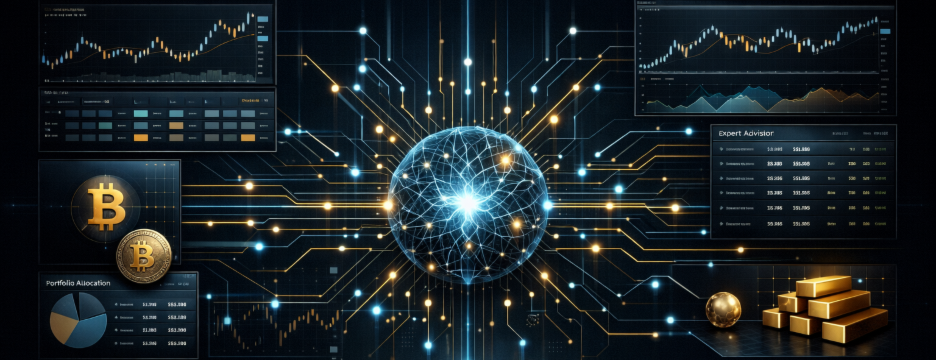
The ICONIC NEUROCORE AI+ framework includes the idea of multi-symbol trading, portfolio coordination, AI-supported decision-making, risk management, and trade lifecycle control. This matters because modern trading is not always one chart, one trade, one outcome. It can be an ecosystem of decisions that need to work together.
A trader may emotionally focus on the next setup.
A portfolio-aware system can evaluate the larger structure.
That is a major difference.
The future of automated trading will not only be about better entries. It will be about better coordination between entries, exits, risk, exposure, filters, regimes, and market-specific behavior.
That is where serious trading infrastructure begins.
BTC Expert Advisors And Gold Trading EAs Need Different Intelligence
A professional AI trading system should respect the instrument it trades.
Bitcoin and Gold are not the same market with different symbols. They behave differently, react differently, and punish different types of mistakes.
BTC often requires logic that respects speed, volatility, sentiment shifts, liquidity bursts, and structural breaks. It can create strong momentum, but it can also pull traders into emotional chasing. A BTC Expert Advisor needs to understand that fast movement is not automatically high-quality opportunity. It must filter volatility, control exposure, and avoid confusing urgency with edge.
Gold requires another kind of intelligence. Gold reacts heavily to macro context, economic releases, USD strength, interest-rate expectations, inflation narratives, and geopolitical risk. A Gold Trading EA needs to be aware of timing, news conditions, spread behavior, volatility expansion, and market structure around key sessions.
This is why specialized logic matters.
A generic automated trading system may look efficient, but efficiency is not the same as precision. If the system ignores the personality of the market, it may apply the wrong behavior at the wrong time. That is not discipline. It is automation without context.
The ICONIC ecosystem separates dedicated logic for BTC and Gold while connecting them through a broader AI and risk-management philosophy. That creates a more professional positioning: market-specific execution supported by shared structural principles.
Different instruments require different behavior.
But all serious trading systems require the same foundation: risk control, filtering, context, discipline, and structured execution.
When Discipline No Longer Has To Be Human
The phrase may sound provocative, but the meaning is practical.
Discipline no longer has to be human because discipline can be encoded into the system.
A trader no longer has to manually resist every weak setup if the system is designed to block low-quality conditions. He no longer has to rely on emotional strength after a loss if cooldown logic is built into the framework. He no longer has to manually watch every news event if the system includes news filtering. He no longer has to decide trailing behavior candle by candle if trade management rules are predefined. He no longer has to evaluate every signal from scratch if AI-supported confidence filtering is part of the decision layer.
This does not remove responsibility.
It changes the form of responsibility.
The trader becomes responsible for architecture, not impulse. He becomes responsible for selecting the system, understanding the logic, respecting the risk, monitoring performance, and evaluating evidence. The system becomes responsible for executing the operational rules without emotional distortion.
That is the future.
Not traders replaced by machines.
Traders protected by systems.
A serious AI trading system is not valuable because it is emotionless. It is valuable when its emotionless execution is connected to intelligent filtering, risk management, market awareness, and structured trade management.
Emotionless execution without structure is useless.
Emotionless execution with architecture is powerful.
The ICONIC Perspective: AI Trading As Infrastructure
The philosophy behind ICONIC is not to sell automation as a shortcut. That would weaken the entire message.
The stronger idea is this: modern trading should be treated as infrastructure.
Infrastructure means every layer matters. Signal logic matters. Risk management matters. AI-supported confidence matters. Market regime detection matters. News filtering matters. Multi-timeframe analysis matters. BTC and Gold specialization matter. Trade management matters. Portfolio coordination matters.
A trader does not need another random signal. He needs an operating framework.
ICONIC BTC AI+ is designed around the behavior of Bitcoin markets, where volatility, speed, sentiment, and liquidity shifts demand controlled execution. ICONIC GOLD AI+ is structured around Gold’s macro-sensitive behavior, where news awareness, session conditions, and volatility control are critical. ICONIC AI SIGNAL adds trend context, signal generation, multi-timeframe edge analysis, alerts, and dashboard visibility. ICONIC NEUROCORE AI+ connects AI-supported decision-making, multi-symbol coordination, portfolio awareness, risk management, and trade lifecycle control.Together, they represent one core belief:
Trading discipline should not depend entirely on the trader’s emotional state.
It should be built into the system.
That does not make trading effortless. It makes trading more structured. It allows the trader to move from emotional execution into strategic operation. It transforms discipline from a personal struggle into a repeatable process.
That is the difference between using a tool and operating an architecture.
Final Thought: The Future Of Trading Discipline Is System Design
The future of trading will not belong to the trader who feels the market the hardest.
It will belong to the trader who builds the strongest process.
Markets are faster, noisier, more reactive, and more data-driven than ever. BTC can punish emotional urgency within seconds. Gold can turn technical confidence into chaos around macro events. News, liquidity, volatility, and regime shifts can change the quality of a setup before the trader has fully processed what happened.
In that environment, discipline cannot remain only a personal promise.
It needs structure.
AI trading systems and professional Expert Advisors represent that structure when they are built correctly. They can filter decisions, enforce risk, validate market conditions, manage trades, respect news, analyze multiple timeframes, coordinate portfolio exposure, and execute without emotional interference.
That is not fantasy.
That is the serious version of automated trading.
Discipline does not disappear. It evolves. It moves from the trader’s nervous system into the architecture of the system. The trader still thinks, decides, monitors, and improves. But he no longer has to personally carry every execution decision through fear, greed, uncertainty, and pressure.
That is the real transformation.
From emotional discipline to system discipline.
From manual control to structured execution.
From trading as reaction to trading as infrastructure.
AI trading systems do not make discipline unnecessary. They make discipline operational.And for traders who understand that difference, the next era has already begun.
Move From Manual Discipline To AI-Supported Trading Infrastructure
If your trading process still depends entirely on your ability to stay calm, patient, disciplined, and objective under pressure, your system has a human bottleneck.
That does not mean you lack skill.
It means your skill needs architecture.
ICONIC was built for traders who want to move beyond fragile manual discipline and into structured, AI-supported trading infrastructure - with Expert Advisors for BTC and Gold, Neurocore AI logic, risk management frameworks, market regime awareness, news filtering, multi-timeframe analysis, trade management, and portfolio-level coordination.Not as hype.