My Trading Strategy: I Only Trade Where There's a Measurable Edge

My whole strategy today is built to fix exactly that. The rule is simple: before I risk a cent, I want proof that this symbol, this setup, has an edge — and I want that proof ranked honestly against every other symbol on my platform. This article is how I do it, and the tool I built the routine around: Edge Radar Pro.
The idea: rank opportunity, don't guess it
A trade only makes sense if the expectancy is positive — if, repeated many times, the wins outweigh the losses. That is measurable. So instead of staring at candles, I let the platform measure it for me across every symbol in the Market Watch at once.
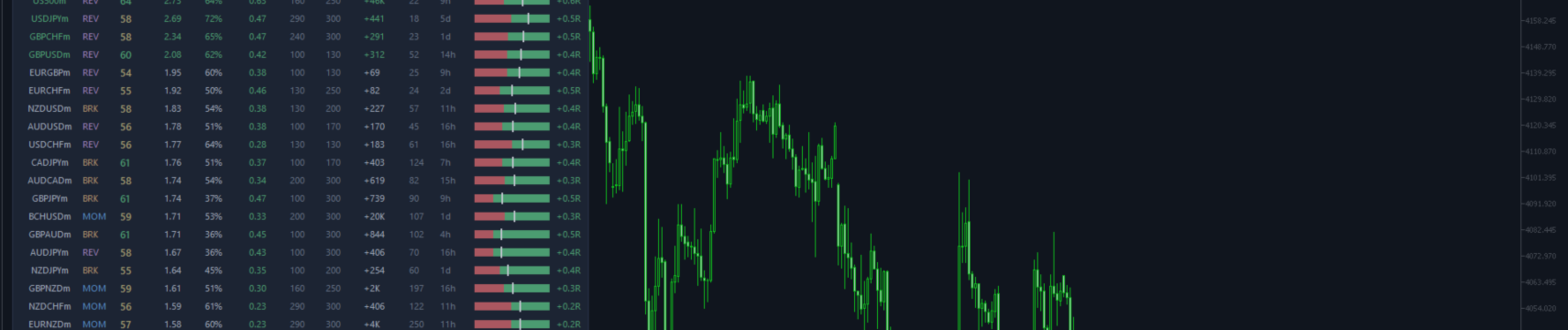
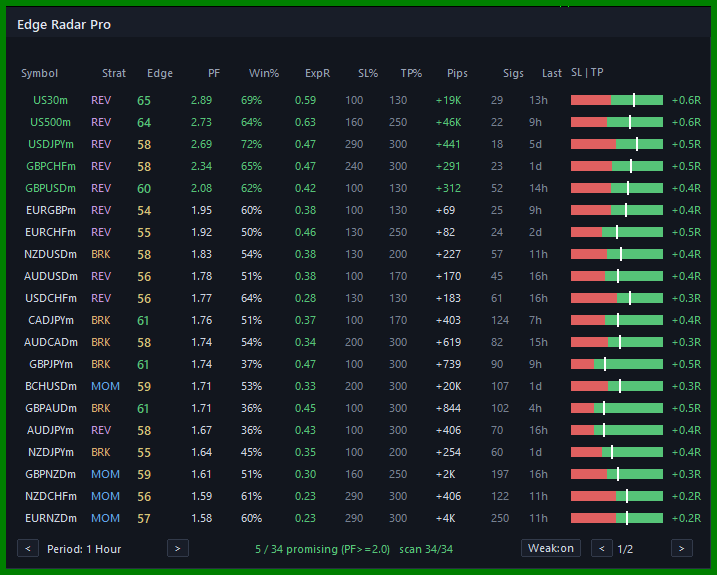
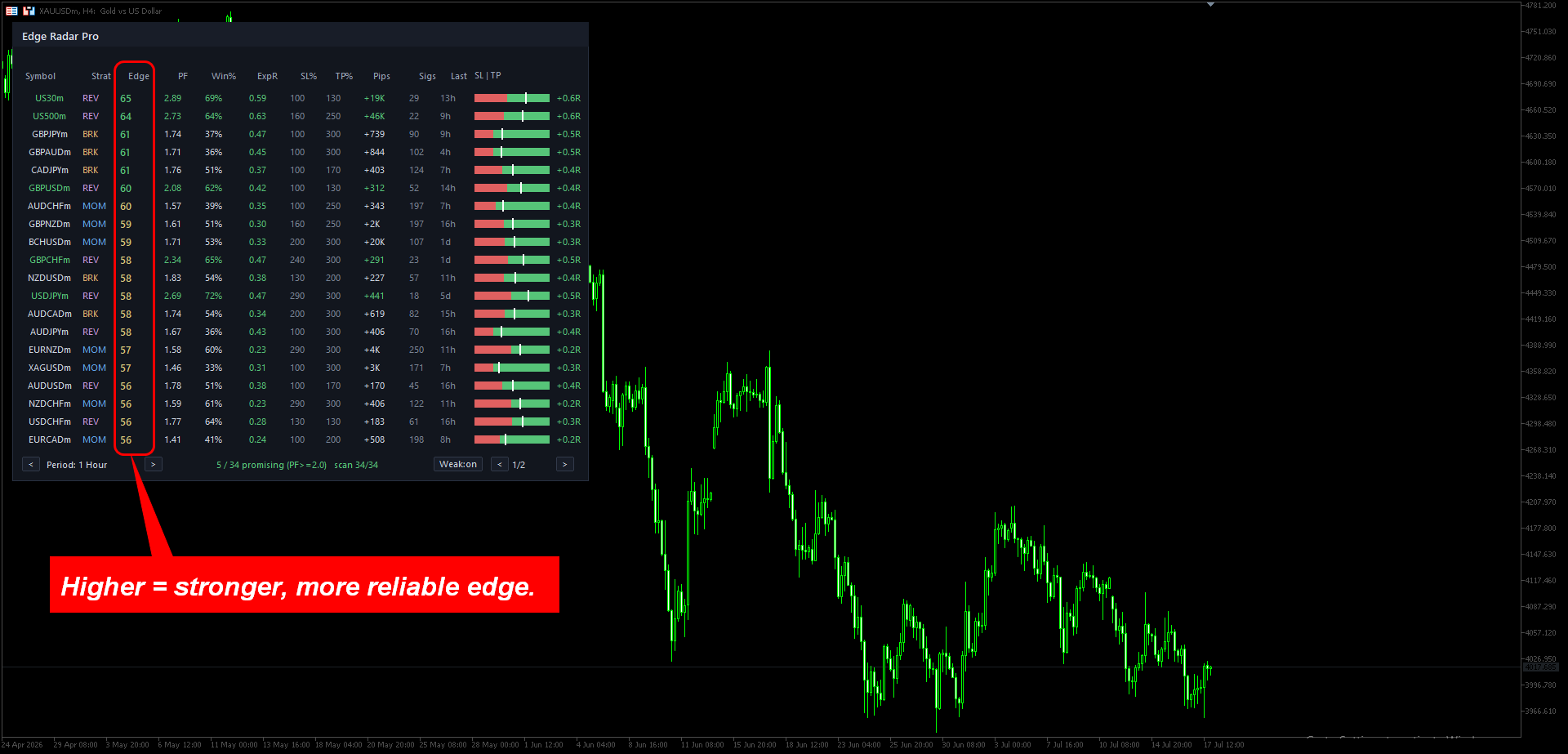
Edge Radar Pro takes each symbol and auto-optimizes three distinct price-action strategies over a grid of signal strengths and ATR-based stop/target pairs, backtesting every combination on closed bars only. For each symbol it keeps the single best configuration and shows me the numbers on one panel. My job shrinks from "analyze 50 charts" to "read one ranked list and pick from the top."
Why I stopped trusting Profit Factor alone
Here's the mistake that cost me the most, and the reason this tool exists in the form it does.
A symbol showing Profit Factor 4.3 looks irresistible. But when that number comes from only 12 trades, it is almost meaningless — a couple of lucky candles inflate it. I chased those "hot" symbols repeatedly and watched the edge evaporate the moment I traded it live.
So the panel's headline column is not raw Profit Factor. It's the Edge Score (0–100) — a confidence-adjusted expectancy. Under the hood it uses a Wilson statistical lower bound on the win rate, which penalizes small samples. In plain terms:
A setup with 120 trades and a 60% win rate scores higher than one with 15 trades and a 75% win rate — because the first one has earned my trust and the second hasn't yet.
That is exactly how a professional desk weighs an edge, and it changed my results more than any entry tweak ever did. What survives to the top of my list has already survived scrutiny.
My daily routine, step by step
- One glance, sorted by Edge. The list is ranked highest-edge first. I read the top rows and ignore everything below my threshold.
- Check the sample size (Sigs). I want the edge backed by data, so my personal filter is Edge ≥ 60 and Sigs ≥ 30. Anything thinner, I skip — no exceptions.
- Read the risk : reward bar. Every row draws a visual bar: red is risk, green is reward, and a white marker sits at the setup's expectancy in R. If the marker is comfortably inside the green zone, the math is on my side.
- Note the strategy tag. MOM (momentum), REV (reversal) or BRK (breakout) — the panel tells me which behavior is currently working on that symbol, so I know what kind of entry to look for.
- Click the symbol. One click switches my chart to it, and I execute using the optimized SL% / TP% (expressed as a percentage of ATR, so it adapts to each instrument's volatility automatically).
- Let the alerts do the watching. For the rest of the session I don't babysit charts — the scanner pings me when a new symbol becomes promising or when a fresh signal fires on one I'm already tracking.
That's the entire workflow. Discipline over drama.
Why three strategies instead of one
Markets don't all behave the same way at the same time. Ranging majors reward reversals; trending indices and metals reward momentum; breakouts fire on crypto and news-driven pairs. A single-strategy scanner forces one lens on everything and quietly misses half the opportunity.
Edge Radar Pro tests all three per symbol and reports the winner. So when the panel says GBPJPY is a BRK with a 3:1 reward-to-risk profile while EURUSD is a REV at 1.3:1, I'm not guessing the market regime — the data already told me.
What each column tells me
| Column | What I use it for |
|---|---|
| Edge | My primary ranking — confidence-adjusted strength (0–100). |
| Sigs | Sample size. My trust filter. |
| PF / Win% | Sanity check on the raw performance. |
| ExpR | Expectancy per trade in R — the honest bottom line. |
| SL% / TP% | The optimized stop and target, in ATR terms. |
| SL | TP bar | Instant visual read of risk vs reward and expectancy. |
| Last | How fresh the most recent signal is. |
Green rows are the ones that cleared my profit-factor threshold. Click any header to re-sort; hide the weak ones with one button.
The two things I refuse to compromise on
Non-repaint. Every statistic is computed on completed candles. Nothing on the panel repaints or "improves" after the fact, so what I backtest is what I traded. An honest tool is the only kind worth building a routine on.
Risk first. Because stops and targets are sized in ATR, my risk is consistent across a $0.9 forex pair and a 40,000-point index. I think in R, not in dollars, and the panel speaks that language natively.
Who this fits
This is a discovery and research layer, not a black box that trades for me. It works best if you:
- trade many symbols (Forex, Metals, Indices, Crypto) and are tired of chart-hopping;
- want opportunity ranked by evidence, not by which chart caught your eye;
- prefer H1–H4 swing/intraday rhythms (though M15–W1 all work);
- value a tool that tells you where the edge is and lets you decide how to trade it.
It pairs with disciplined execution and sound money management — it sharpens your focus; it doesn't replace your judgment.
Try it on your own charts
If your symbol selection has ever been a coin flip, put a number on it. Run the scanner over your Market Watch and see which pairs actually carry an edge right now — most traders are surprised by what's been hiding two rows down.
- MetaTrader 5: https://www.mql5.com/en/market/product/186324
- MetaTrader 4: https://www.mql5.com/en/market/product/186327
Download the demo, drop it on a chart, and let it score your market. Then trade the top of the list — with proof, not a hunch.
Trading involves risk. Edge Radar Pro is an analytical research tool that reports statistics computed from historical data; it does not predict future results or place trades. Past performance of any configuration is not a guarantee of future outcomes.