
Welcome to the official trading manual for the Key Levels Market indicator. This guide is designed to take you from understanding the basic interface to mastering advanced institutional supply/demand trading strategies.
SECTION 1: THE MECHANICS OF SUPPLY & DEMAND ZONES
To trade successfully with this tool, you must understand what these zones represent. They are not arbitrary lines on a chart; they are liquidity pools .
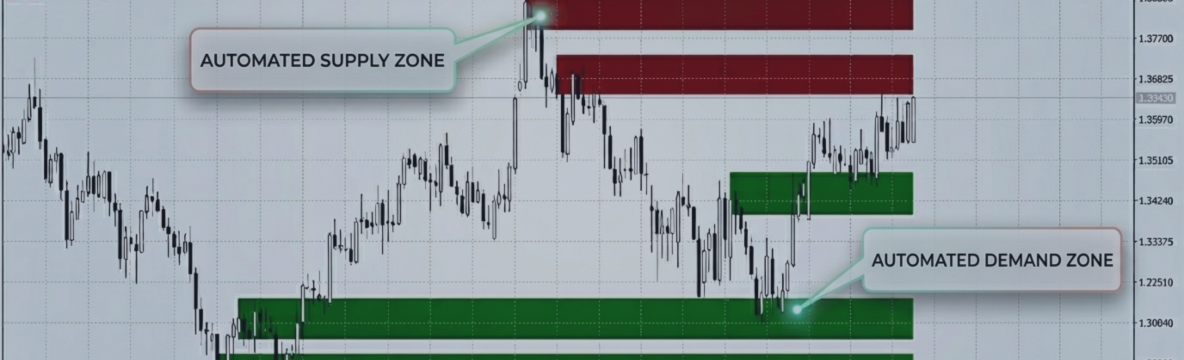
- 🟢 Demand Zones (Green): These represent areas where major institutional buyers (banks, hedge funds) previously filled massive buy orders, causing an aggressive upward move. When price returns here, unfilled buy orders (buy limits) often remain, leading to a price bounce.
- 🔴 Supply Zones (Red): These are areas where heavy institutional selling occurred. When price revisits this zone, sellers protect their positions, creating a strong probability of a downward drop.
SECTION 2: DEEP DIVE INTO INDICATOR SETTINGS
To maximize the indicator’s potential, customize it based on your trading style:
- Total Bars (Historical Depth):
- Scalpers (M1 to M15): Set to 500 - 1500 . This allows the indicator to look back far enough to catch intraday levels without cluttering your short-term view.
- Swing Traders (M30 to D1): Set to 300 - 500 . This focuses purely on major structural pivot points from recent months.
- Zone Inversion (True/False):
- When set to true , it activates the Support-becomes-Resistance (and vice-versa) rule. This is highly recommended for breakout traders.
SECTION 3: CORE TRADING STRATEGIES
Strategy A: The Institutional Mitigation (The Bounce)
This is the most reliable setup for trading ranging or mildly trending markets.
- Identify the Setup: Wait for a strong, clean historical zone to form (Green or Red).
- The Approach: Let the price return to the zone. Never market-order immediately upon touch.
- The Trigger (Lower Timeframe Confirmation): Drop down 1 or 2 timeframes (e.g., if the zone is on H1, look at M5 or M15). Wait for a Change of Character (ChoCh) or a classic Price Action pattern:
- Bullish Reversal: Pin Bar, Bullish Engulfing, or a Double Bottom inside the Green Zone.
- Bearish Reversal: Shooting Star, Bearish Engulfing, or a Double Top inside the Red Zone.
- Execution: Enter at the close of the confirmation candle.
- Stop Loss (SL): Place your SL 3–5 pips outside the outer edge of the zone.
- Take Profit (TP): Target the nearest opposite zone plotted by the indicator.
Strategy B: The S&D Flip (Zone Inversion Breakout)
When markets are highly trending (e.g., during major news releases), zones will get broken. This strategy capitalizes on those breaks.
- The Breakout: Watch for a candle to close completely outside a zone. For example, a strong bearish candle closes below a Green Demand Zone.
- The Flip: The indicator will automatically invert the zone's color to Red, signaling it is now a Supply Zone.
- The Retest: Wait for a corrective, low-momentum pullback back up into the newly flipped Red zone.
- Execution: Enter a SELL order on a bearish rejection candle inside the zone.
- Stop Loss: 5 pips above the high of the breakout candle or the top of the zone.
SECTION 4: ADVANCED RULES FOR MAXIMUM PRECISION
To avoid false signals ("fakeouts"), implement these institutional trading filters:
- Rule of Freshness (Zone Freshness): A zone is strongest on its first test (First Time Back / FTB). Every subsequent time the price touches a zone, it consumes the unfilled orders resting there. Avoid trading zones that have been tested 3 or more times.
- The Confluence Factor: Your win rate will skyrocket if you align your trades with higher timeframe structures. If the Daily trend is Bullish, only take BUY trades from H1 Green Zones. Ignore the H1 Red Zones or use them purely as profit targets.
- Beware of High-Impact News: During FOMC, NFP, or CPI releases, liquidity dries up, and price can easily slice through strong zones. Turn off your trading or widen your stops during these periods.
SECTION 5: RISK MANAGEMENT TEMPLATE
No indicator has a 100% win rate. Protect your capital with this mathematical framework:
| Risk Per Trade | Maximum 1% to 2% of total account balance. |
| Minimum Risk-to-Reward (RR) | 1:2 (If you risk $50, your target must be at least $100). |
| Trade Management | Move SL to Break Even (BE) once price covers 50% of the distance to TP. |
💡 Utilize Alerts: Enable Push or Email notifications in the settings. This allows you to step away from the monitor and only open charts when a high-probability setup occurs.