Gold House: Recent Performance, Backtesting Differences, and Trade Management Notes

Recently, several questions about Gold House have been raised repeatedly.
They mainly focus on two points:
First, why live trading and backtesting do not always look exactly the same.
Second, why the current version does not lock in profits earlier, allowing part of the floating profit to retrace and, in some cases, turn into a loss.
These are both valid questions and deserve a proper explanation. Rather than responding in scattered comments, it is better to organize everything clearly in one place for reference.
-
Why live trading and backtesting will never be 100% identical
The conclusion first:
No EA can have live trading and backtesting results that are 100% identical.
The reason is not complicated. In live trading, besides price itself, execution is also affected by spread changes, slippage, liquidity, and order fill details. Especially during fast-moving markets, frequent breakouts, or periods of wider spreads, these differences become more noticeable.
For Gold House, if you want a backtest mode that is closer to recent live performance and therefore more meaningful for comparison, the more suitable option is:
Every tick based on real ticks
Compared with the normal real ticks mode, this mode uses a much larger amount of data. It is slower to backtest, and downloading the historical data also takes more time. However, under certain market conditions, it is usually closer to the real trading environment.
Even so, one point still needs to be made very clear:
Historical data itself cannot fully record every detail of live trading.
So backtesting can try to get closer to live trading, but it can never perfectly reproduce live trading.
This is not a problem unique to Gold House. It is simply a reality that every automated trading system must face.
-
Why profits are not locked in earlier
Another question that has been raised frequently is:
Why not move to break-even earlier, or lock in part of the profit earlier?
Wouldn’t that reduce drawdown and also prevent many floating profits from eventually turning into losses?
This question itself is reasonable.
So rather than discussing it only in theory, I directly ran a comparison test.
The test conditions were kept the same:
The same symbol
The same time period
The same backtest mode: Every tick based on real ticks
Then I compared two different trade management approaches.
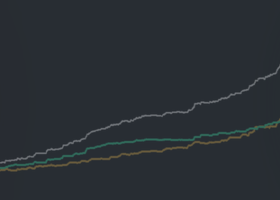
Figure 1: Profit lock-in version
Lower drawdown, but total profit dropped significantly

Figure 2: Current version, similar to our live performance
Higher profit potential, but larger drawdown during certain phases

The comparison result is actually very clear.
-
What the comparison shows
From the result, it can be seen that:
After adding profit lock-in, the drawdown during the current market phase was indeed reduced significantly, and the curve became smoother.
But at the same time, total net profit also dropped noticeably, because the later continuation profits were reduced.
In other words, locking in profit earlier is not a change that only brings benefits.
It can improve the short-term experience, but the cost is that some trades that still had room to develop further will be exited earlier.
This is a very typical trade-off in trade management:
Protect profit earlier, and the short-term experience usually feels better.
Leave more room for the position, and there is a better chance to capture the true breakout continuation.
Many times, watching floating profit retrace feels very uncomfortable.
But if every trade exits too early, then over the long run the profit structure of the strategy is weakened.
-
Why lot size can make the same strategy feel completely different
At this point, some people may think further:
If the profit lock-in version has lower drawdown, then why not increase the lot size and scale the profit back up?
In theory, larger lot size can of course increase profit.
But the problem is that it also increases drawdown and risk at the same time.
This is not free.
If you try to recover the lost profit potential caused by earlier profit locking simply by using larger position size, then you also have to accept:
Larger account fluctuations
Higher drawdown in dollar terms
Greater pressure on account stability
Higher risk of triggering risk-control limits
And more noticeable margin limitations on lower-leverage accounts
So this is not a perfect solution where you make the strategy more conservative first and then compensate for the lost profit by increasing size.
Another important point is position size itself.
For a strategy like Gold House, which relies more on reward-to-risk structure than on a very high win rate, lot size has a very direct impact on how drawdown feels in real trading.
The strategy logic may remain exactly the same, but if the lot size is too aggressive relative to the account balance, a normal drawdown phase can quickly become psychologically and financially difficult to handle. In other words, the same strategy can feel completely different under different risk settings.
That is why drawdown should not be judged only by the amount in isolation, without also considering account size and position size.
In essence, the problem has not been solved. The risk has simply been moved to another place.
-
Why we will not rush to modify the core logic only because of recent market conditions
One of the biggest mistakes in system development is drawing final conclusions only from the most recent market phase.
Breakout strategies naturally go through different market conditions:
In some phases, breakout continuation is stronger, and leaving more room for the position has more advantage.
In other phases, false breakouts are more frequent, and protecting profit earlier looks more comfortable.
The problem is that in hindsight, it is always easy to think:
If we had reversed the logic at that time,
or if we had taken profit earlier,
the result would have been better.
But the real difficulty is never hindsight. The real difficulty is that in live trading, you cannot reliably know whether:
this is the end of a false breakout,
or the beginning of a true breakout trend.
If the core trade management logic is changed quickly just because the recent phase has been difficult, the result may simply be a version that fits the current phase better, but fits the long term worse.
That is why we will not rush to modify the core logic only because of short-term pressure.
-
How we view user feedback
We welcome feedback.
Especially feedback with logic, data, and actual observation behind it. Less purely emotional noise is better for everyone. Only when a product can continue to survive and improve over time can users ultimately benefit from a better product.
But feedback and immediate modification are not the same thing.
Whether a suggestion deserves to be added cannot be judged only by whether it feels better over the last few days. It has to be judged by whether it can truly improve the overall stability of the strategy structure over a longer cycle.
For some functions that may improve short-term user experience, we are willing to evaluate them seriously.
But for the core management logic, we will not change it immediately just because the short-term experience has not been good.
Because in trading, a more comfortable experience does not always mean a better long-term outcome.
-
One final point
Gold House was never designed to produce a perfectly smooth upward curve.
Its design is built around reward-to-risk structure.
That means there will be phases where it performs more smoothly, and phases where drawdown pressure becomes more obvious.
The profitable phases are real, and the drawdown phases are real as well.
A strategy is better judged over a full cycle, rather than by isolating only one part of it.
We will continue to observe live performance, and we will continue to compare it with more suitable backtesting methods.
If an improvement is truly worth adding, we will not reject it. But a change that only feels better in the short term is not necessarily something that should be kept in the long term.
Trade management is never a one-way optimization. It is always a balance between profit potential, drawdown control, and long-term adaptability.
That is also why, in the current version, we are handling the core logic with caution.