Market Footprint Indicator MT5
- Göstergeler
-
Mohamed Samsudeen
 Hem canlı işlem hem algoritmik strateji geliştirme alanlarında 15 yılı aşkın uygulamalı deneyimle, MetaTrader 4 ve MetaTrader 5 için en gelişmiş, en stabil ve performans odaklı Uzman Danışmanları (EA’leri) sunmaya kendimizi adadık. Yolculuğumuz, piyasa davranışını anlamaya yönelik derin bir tutkuyla
 - Sürüm: 1.0
- Etkinleştirmeler: 10
Market Footprint Indicator
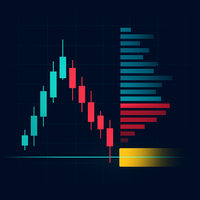
Market Footprint turns plain candles into a clear picture of where volume is happening and who is pushing price. It plots colored volume "bubbles" on every bar and a volume-by-price histogram on the right edge of the chart, so you can see at a glance where activity is concentrated and which side is in control. A small draggable panel with a built-in User Guide is included on the chart.
This is an indicator for MetaTrader 5. It works on any symbol and any timeframe.
Price information:
- Current price: $49
- Planned regular price: $499
For user guide CLICK HERE
What does it draw on the chart?
Three things: a thin price line following the close, a colored bubble on each bar, and a horizontal volume profile (histogram) anchored to the right side of the chart.
Why bubbles?
Each bar gets one bubble placed on its close. The bubble answers a simple question for every bar: did buyers or sellers win it, and how much volume was behind it? Instead of reading raw volume in a separate window, you see it directly on price.
What do the bubble colors mean?
Green means the bar closed up (buyers were in control on that bar). Maroon means the bar closed down (sellers were in control). Both colors are fully configurable in the inputs.
Why does bubble size matter?
Size encodes volume. Each bar's volume is compared with the busiest bar in a recent lookback window and sorted into five size tiers. A large bubble means heavy volume and strong participation; a small bubble means thin volume and a weaker, less convincing move. Size lets you separate moves that have real activity behind them from moves that do not.
How does the right-side volume profile work?
The indicator scans a configurable number of recent bars, splits the price range into rows, and adds up the volume traded inside each price row. Each row is drawn as a horizontal bar pointing into the right margin. The length of the bar is scaled to the busiest row, so the longest bars mark the prices where the most volume changed hands.
What is the right-side volume telling me?
A long bar marks a price level where a lot of business was done — a high-activity area that price often reacts to. A short bar marks a price that was passed through quickly with little interest. This helps you spot the levels that matter and the empty zones in between.
How do I read the market with it?
Combine the two views. Large green bubbles forming around a long profile bar show buyers defending a busy level. Large maroon bubbles around a long profile bar show sellers capping a busy level. When price moves through a thin, short-bar zone, there is little activity to slow it down. The built-in User Guide panel on the chart explains all of this with examples.
What is the floating panel?
A compact panel you can drag anywhere on the chart. It contains a USER GUIDE button that opens an on-chart guide explaining the bubbles, the sizing and the volume profile, so the explanation travels with the indicator.
Does it use real volume or tick volume?
You choose. By default it uses tick volume, which is available on every symbol. If your symbol provides exchange (real) volume, you can switch to it in the inputs.
What can I configure?
Buy and sell bubble colors, the lookback used to scale bubble size, real-volume vs tick-volume, the price line on/off and its color, the volume profile (number of bars included, number of price rows/resolution, maximum bar length, right-edge offset, and color), an optional clean chart template (white background, green/red candles, no grid), and the floating panel position and button text.