The XAUUSD Trap: Fatal Psychological and Technical Mistakes Destroying Your Account

Hello, fellow traders.
Trading financial markets—especially a volatile instrument such as Gold (XAUUSD)—requires more than identifying an entry signal. A technically valid setup can still become a losing trade when position sizing, risk management, or emotional decision-making are poorly controlled. Many retail traders struggle not because they lack access to indicators or strategies, but because losses can trigger behavioral responses such as fear, FOMO, revenge trading, and the reluctance to close a losing position.
XAUUSD can amplify these problems because relatively short-term price movements can generate significant changes in profit and loss, particularly when leverage is involved. The objective of a robust trading process, therefore, is not to eliminate losing trades—an unrealistic goal—but to ensure that individual losses remain defined, controlled, and survivable.
The following sections examine four closely related aspects of this problem: psychological bias, Martingale and Grid strategies, market structure, and systematic risk management.
1. The Psychological Sabotage: Why Your Brain Works Against You
Before analyzing indicators or price patterns, it is important to understand the behavioral factors that influence trading decisions. Financial markets create an environment in which uncertainty, rapid price movements, and real-time financial consequences can amplify normal human cognitive biases. Three behaviors are particularly relevant to retail trading: loss aversion, revenge trading, and FOMO (Fear of Missing Out).
Loss aversion refers to the tendency for losses to have a greater psychological impact than comparable gains. In trading, this can lead to an unwillingness to close a losing position because doing so makes the loss definitive. The trader may instead wait for the market to return to the entry price, even when the original trading thesis is no longer valid. The opposite behavior can occur with profitable trades: a trader may close a winning position prematurely because of the fear that an unrealized gain will disappear. The result can be an unfavorable asymmetry in which losing positions are allowed to remain open while winning positions are closed too quickly.
Revenge trading represents another common behavioral pattern. After a losing trade, the trader may attempt to recover the loss immediately by entering another position, increasing position size, or abandoning the original trading plan. The new trade is then driven less by a predefined setup and more by the desire to recover previous losses. This can create a cycle in which one controlled loss becomes several uncontrolled trades.
FOMO, or the fear of missing out, occurs when a trader enters a position primarily because a price movement appears to be accelerating. On a short timeframe such as M5, a sequence of large bullish candles can create the impression that the market will continue rising indefinitely. Entering after an extended movement, however, may expose the trader to unfavorable risk-to-reward conditions and a normal pullback immediately after entry. The problem is therefore not simply entering late; it is entering without considering whether the current price still provides a rational relationship between potential reward and predefined risk.
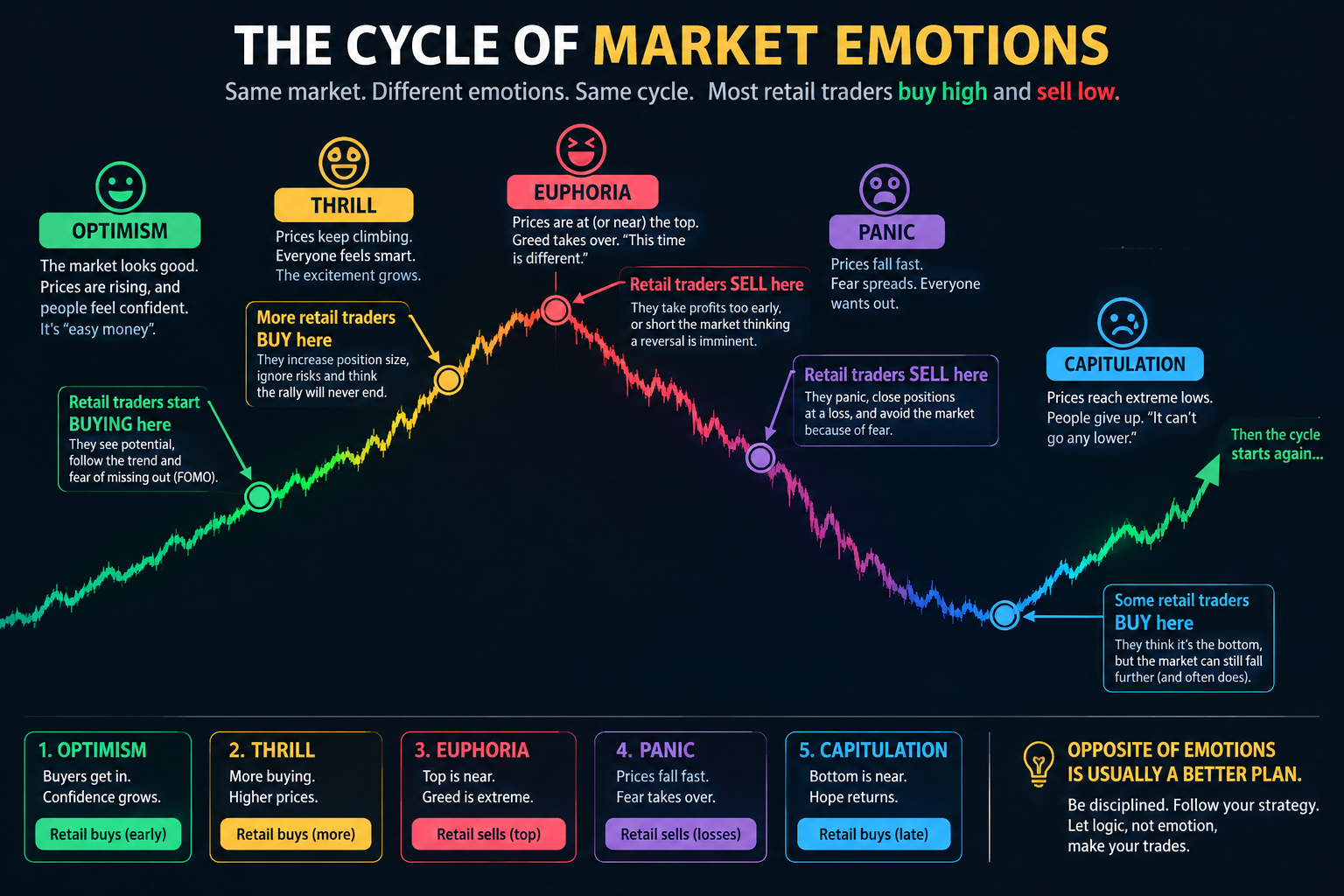
Figure 1. Examples of psychological factors that can influence retail trading decisions.
2. The "Cost Averaging" Illusion: The Danger of Martingale and Grid
When a losing position becomes psychologically difficult to accept, traders may attempt to improve the average entry price instead of closing the trade. Two approaches frequently associated with this behavior are Martingale and Grid-based position accumulation. Although these approaches are not identical, both can increase exposure when the market moves against the initial position, depending on how they are implemented.
A Martingale strategy traditionally increases position size after a losing trade, with the objective of recovering previous losses when a subsequent winning trade occurs. A Grid strategy, by contrast, places multiple orders at predefined price intervals. A grid can be implemented in different ways, but when additional positions are accumulated as price moves against the original position, the total market exposure can increase substantially. In both cases, an improved average entry price can create the impression that the position has become safer. However, a better average price does not reduce the market's ability to continue moving against the combined position.
The central problem is exposure. If price continues moving in one direction, additional positions increase the amount of capital exposed to the adverse movement. With Martingale sizing, the increase can become particularly rapid because position sizes may grow after successive losses. With an adverse Grid, the number of open positions can continue increasing as additional price levels are reached. The trader may therefore face rising margin requirements, increasing drawdown, accumulated spread and transaction costs, and greater sensitivity to slippage during volatile conditions. In leveraged trading, a sufficiently persistent movement can ultimately result in forced liquidation or a margin call before the expected reversal occurs.
Another important limitation is the assumption of mean reversion. Both approaches can appear effective during periods in which price repeatedly returns toward an average or remains within a relatively contained range. Their behavior can change dramatically when the market enters a sustained directional movement. There is no guarantee that price will return to the trader's average entry price within the trader's available capital or margin capacity. Consequently, averaging down can transform a relatively small initial mistake into a substantially larger position.
The psychological effect can reinforce the problem. Once several positions have been accumulated, closing the entire basket may mean realizing a significant loss. The trader may therefore continue waiting, adding positions, or moving the original risk limits in the hope of avoiding the realization of the loss. What initially appears to be a strategy for improving the entry price can consequently become a mechanism for increasing exposure and postponing the decision to exit.
The key distinction is therefore between improving the average entry price and reducing risk. They are not the same thing. A lower average price may reduce the distance to break-even, but the total position size and capital at risk may simultaneously increase.
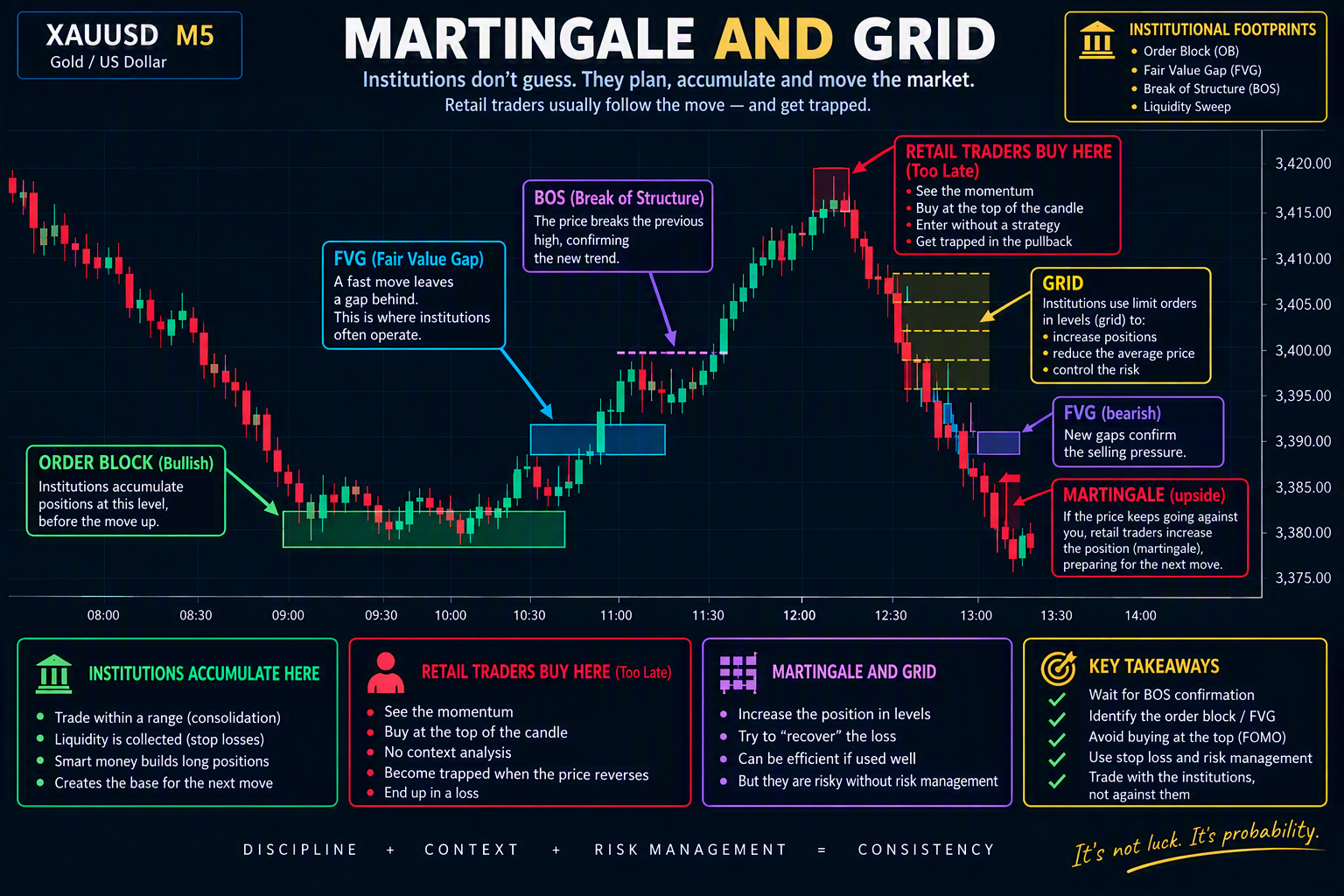
Figure 2. Illustration Grid and Martingale positions

3. Trading "In the Dark": The Importance of Market Structure
Another common problem occurs when traders treat individual indicators as complete trading systems. A moving-average crossover, oscillator signal, or isolated candlestick pattern may provide useful information, but the same signal can have very different implications depending on the broader market environment.
For example, a market in consolidation may generate repeated bullish and bearish signals as price oscillates within a relatively narrow range. A trader who interprets every crossover as an independent directional opportunity can consequently experience a sequence of false or low-quality entries. Conversely, a strong directional movement may continue for an extended period, making countertrend entries particularly vulnerable when they are based solely on short-term indicators.
This is where market structure becomes relevant. Concepts such as Break of Structure (BOS), Fair Value Gaps (FVG), Order Blocks, swing highs and lows, and areas of concentrated liquidity are commonly used by traders to place individual price movements into a broader context. These concepts should not be treated as guarantees of future price direction. Rather, they can provide additional information for evaluating whether a potential entry is occurring near a meaningful structural area or after an already extended movement.
The concept of liquidity is also important. Financial markets contain orders associated with stop losses, limit orders, entries, and exits. When price approaches areas containing concentrated orders, volatility can increase as those orders are triggered or absorbed. A sudden movement through a previous high or low should therefore not automatically be interpreted as confirmation of a sustained breakout. The trader needs to evaluate whether the movement is accompanied by broader structural confirmation.
This distinction is particularly important for XAUUSD on lower timeframes. A trader who sees a strong bullish candle on M5 may interpret it as a reason to buy immediately. However, if the movement has already traveled a significant distance from the preceding consolidation or structural level, the entry may occur after much of the movement has already taken place. Waiting for structural confirmation and evaluating the location of the entry can provide a more systematic framework than reacting to the latest candle alone.
The objective is therefore not to predict what institutions are "going to do" or to assume that every price movement represents an intentional liquidity trap. Instead, the objective is to read observable price structure and liquidity conditions and incorporate them into the trading decision.
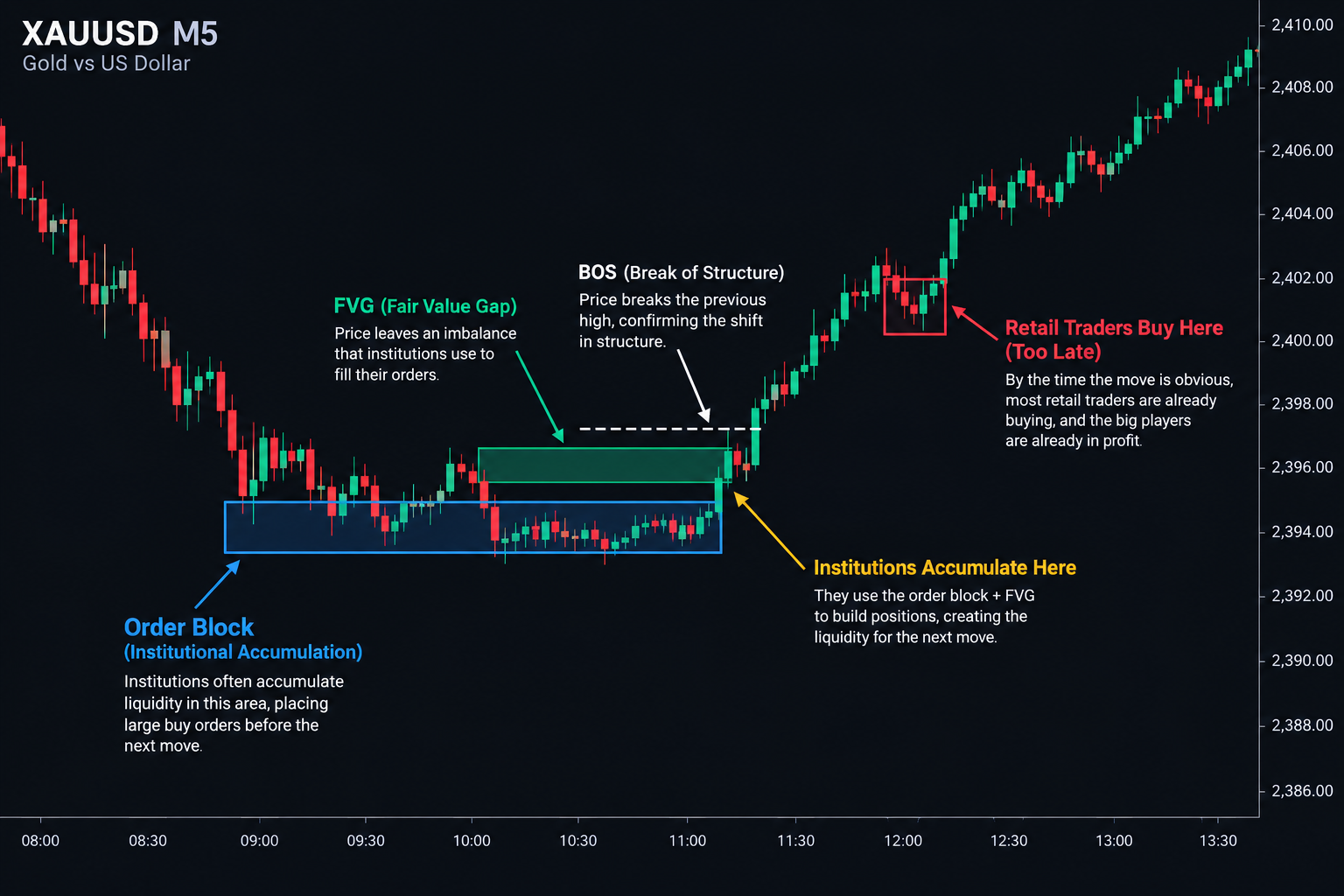
Figure 3. Example of market structure, liquidity areas, Break of Structure (BOS), Fair Value Gaps (FVG), and potential entry locations.
4. The Practical Solution: Automating Your Discipline
The previous sections lead to a fundamental principle: a trading strategy should define not only when to enter, but also how much to risk and when to exit. A disciplined framework can include several complementary rules.
- Accept small losses mechanically.
A Stop Loss should be defined before entering the trade and should reflect the characteristics of the setup and the instrument's current volatility. A volatility-based approach, such as using the Average True Range (ATR), can help adapt the stop distance to changing market conditions. The stop should not simply be moved farther away because the position is losing. - Control position size.
Position size should be determined by the amount of capital the trader is willing to risk and the distance to the Stop Loss. This is particularly important when trading leveraged instruments such as XAUUSD because the same price movement can produce very different monetary outcomes depending on position size. - Align multiple timeframes.
A short-term entry can be evaluated within the context of higher timeframes. For example, a setup on M5 can be compared with M15, H1, H4, or D1 structure. Multi-timeframe analysis does not guarantee a successful trade, but it can provide additional context and help distinguish isolated short-term movements from broader directional conditions. - Establish a maximum daily loss.
A predefined daily loss limit can prevent a sequence of losing trades from developing into uncontrolled risk-taking. Once the limit is reached, trading activity can be stopped until the next defined trading period. This is particularly relevant after a loss because it creates a mechanical barrier against revenge trading. - Do not increase exposure simply because a position is losing.
A losing trade should not automatically become a larger trade. If the original setup becomes invalid, the predefined exit should take precedence over the desire to recover the loss.
The challenge is that these rules are simple to describe but difficult to follow consistently when decisions are made manually under financial and emotional pressure. That’swhere automation can play an important role—not by eliminating market uncertainty, but by translating predefined rules into a more systematic execution process.
Look for an EA that follows this philosophy. The system should be designed with a focus on rule-based trade management, rather than accumulating positions based on Martingale or Grid strategies. Its risk management architecture uses a dynamic Stop Loss based on the ATR, allowing the stop distance to respond to the volatility conditions built into the system’s methodology.
The system also combines market-context information through multi-timeframe analysis and Smart Money Concepts (SMC) and presents these conditions through an interactive panel. Its setup-quality framework evaluates multiple criteria and classifies conditions using categories such as "GOOD" and "PERFECT" according to its internal scoring methodology. These classifications should be understood as system-defined setup-quality categories, not as a guarantee that a trade will be profitable.
For traders who prefer automated execution, the system can apply its predefined rules without requiring a discretionary decision for every individual trade. For traders who prefer manual execution, the technology can also be used as a trade-management tool, assisting with functions such as Break-Even and Trailing Stop management. In both cases, the objective is to transform a discretionary process into a more structured and repeatable workflow.
The fundamental principle remains the same: automation cannot eliminate market risk, but it can help enforce predefined rules and reduce the influence of emotional decision-making on trade execution.
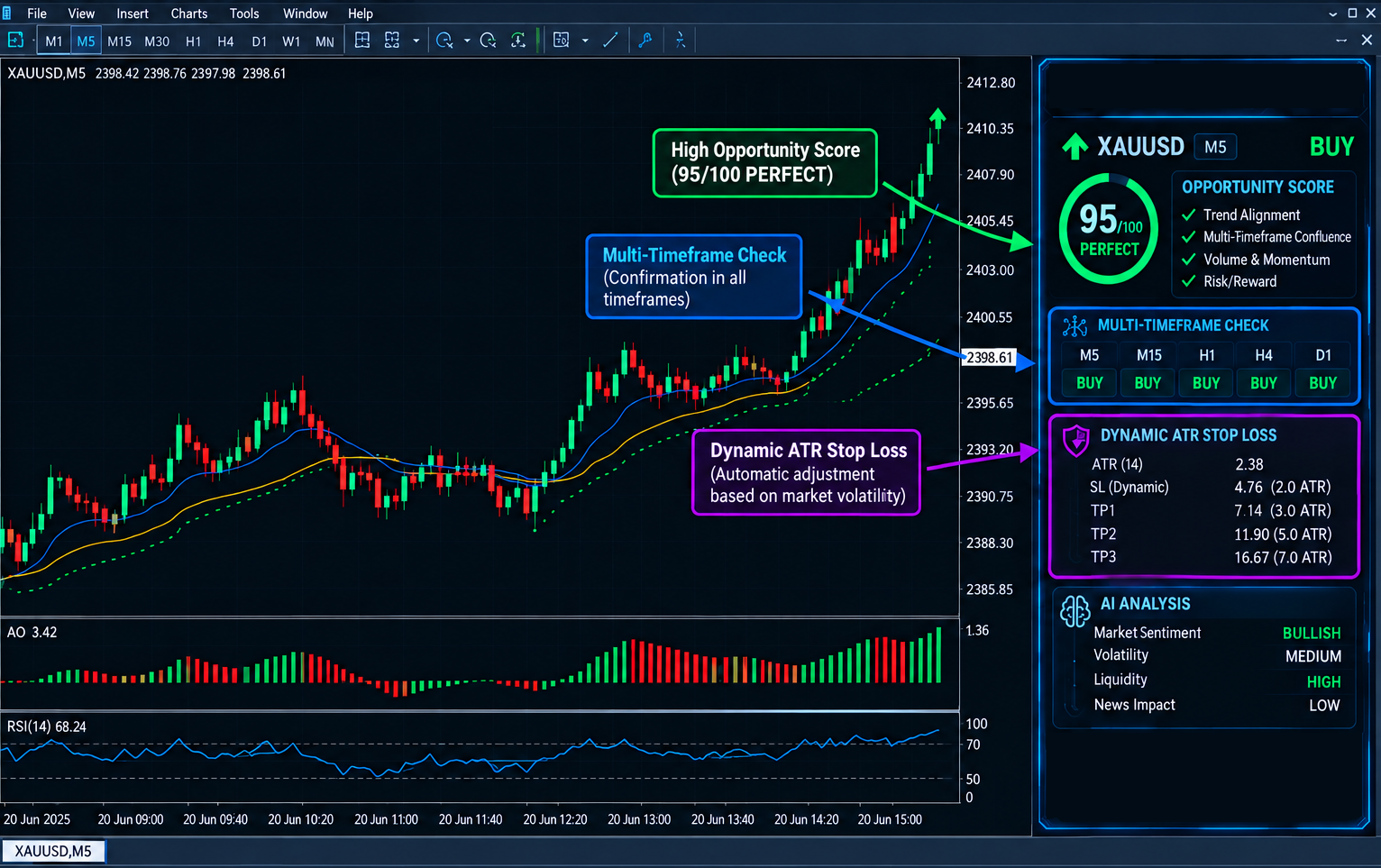
Figure 4. Example of the AURION EDGE PRO GOLD AI interface, showing XAUUSD analysis, multi-timeframe conditions, opportunity scoring, and dynamic ATR-based risk parameters.
Conclusion
The central lesson of XAUUSD trading is not that losses can be eliminated. Losses are an inherent part of trading.The critical question is whether each loss is predefined and controlled or whether it triggers a sequence of increasingly risky decisions.
Loss aversion can make traders hold losing positions. FOMO can lead to late entries. Revenge trading can encourage excessive activity after a loss. Martingale and adverse Grid strategies can then increase exposure precisely when the original trade is moving in the wrong direction. At the same time, trading without sufficient market context can result in entries based on isolated indicators rather than the broader structure of the market.
A more robust framework combines market context, predefined risk, appropriate position sizing, volatility-aware Stop Losses, multi-timeframe analysis, and disciplined execution. Automation can support this process by applying predefined rules consistently, while the trader remains responsible for understanding the strategy, its assumptions, its limitations, and the risks associated with leveraged trading.
https://www.mql5.com/pt/market/product/185055?source=Site+Market+My+Products+Page