
CiSD MT4
- Indicatori
-
Thank-god Avwerosuoghene Odukudu
 "A speculator must concern himself with making money out of the market and not insisting that the tape must agree with him"
 - Versione: 1.14
- Aggiornato: 28 luglio 2026
- Attivazioni: 5
CiSD | Change in State Delivery
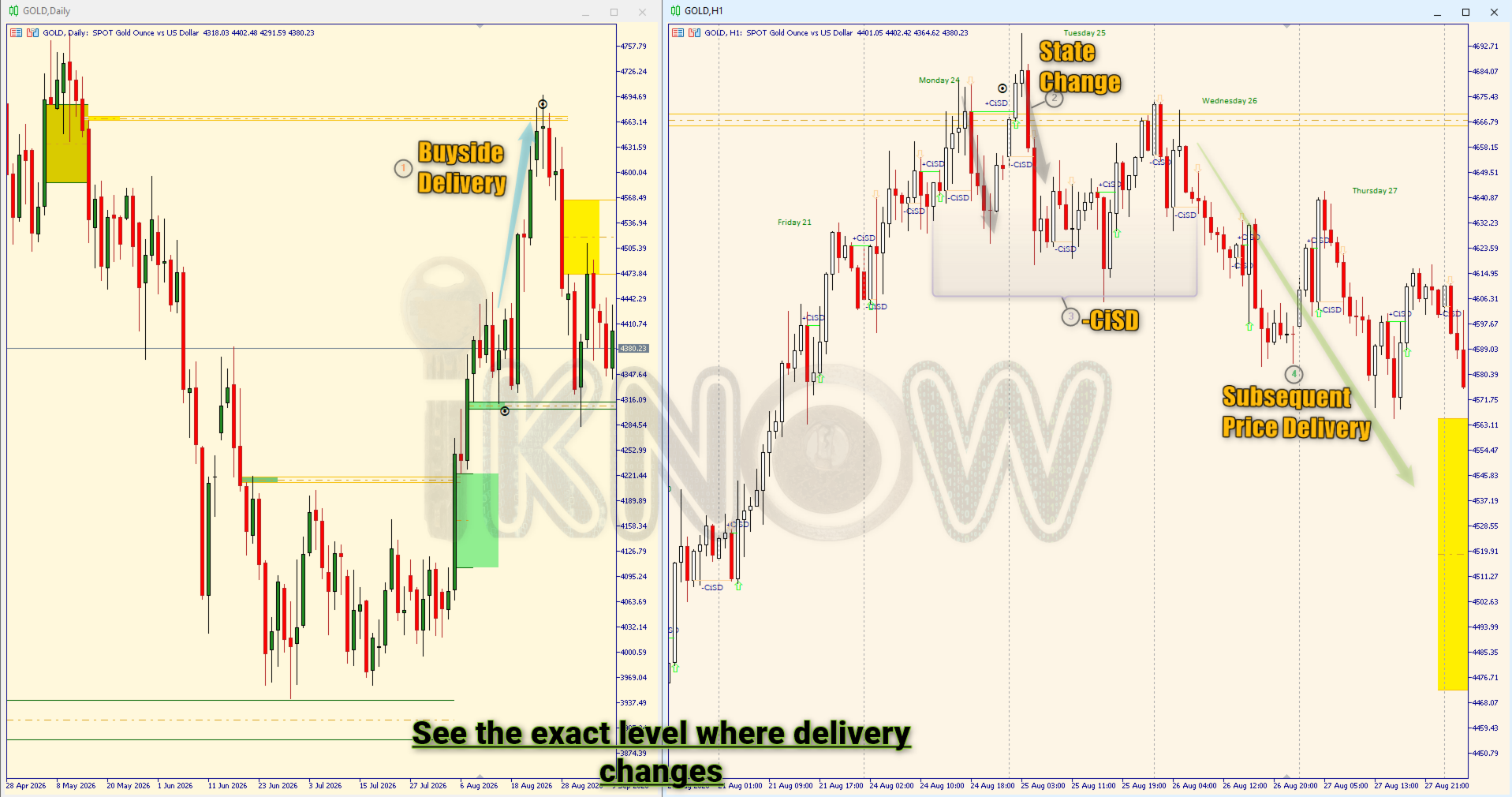
See exactly where price delivery changes direction.
CiSD automatically detects Change in State Delivery and plots the critical price associated with the shift - giving ICT/SMC traders a precise reference level without manually searching through candle sequences.
DETECT → MARK → CONFIRM → ANALYZE |
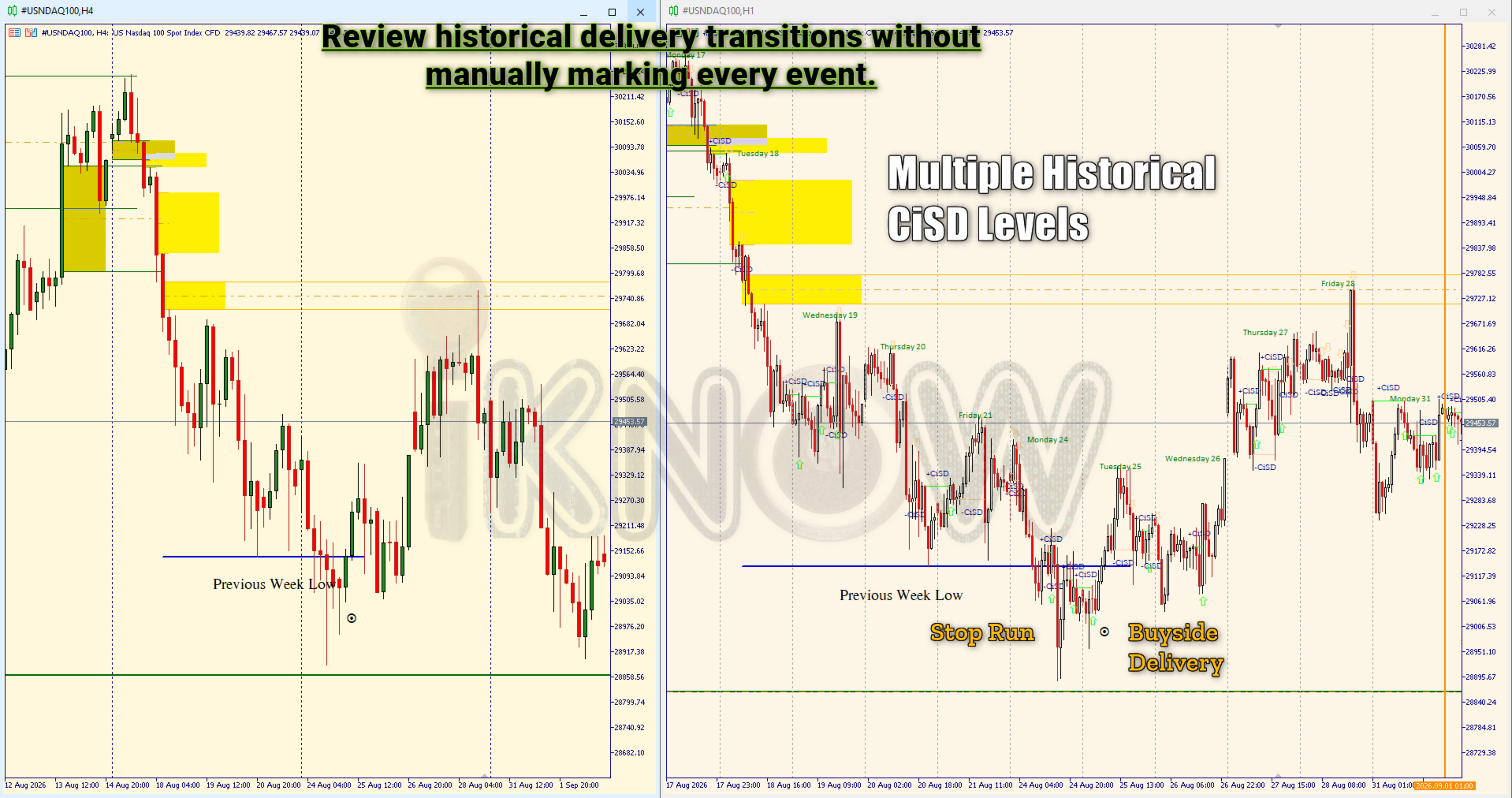
Figure 1: See the exact level where the delivery state changes.
CiSD is designed for traders who use liquidity, displacement, market structure, FVGs/Imbalances and premium/discount Arrays as part of their analysis.
Instead of manually identifying every delivery-state transition and marking the originating price, CiSD does the repetitive chart work for you.
The objective isn't to give you another buy/sell arrow. It's to show you the level where the delivery state changed.
What CiSD Gives You
🎯 Precise CiSD Levels
Automatically identifies and plots the relevant opening price associated with the Change in State Delivery.
↔ Bullish & Bearish State Changes.
Clearly distinguish transitions toward bullish or bearish delivery.
📍 Persistent Chart Reference
Keep the CiSD levels visible so you can study subsequent price action around the originating level.
📚 Historical Analysis
Review previous CiSD events directly on the chart instead of manually reconstructing historical examples.
🤖 Automated Detection
Continuously monitor price action for qualifying CiSD events while you focus on market interpretation.
⏱ Time-Saving Workflow
Reduce repetitive chart marking and focus your attention on context, confirmation and execution.
How It Works
01Price Delivers
Price is delivering toward liquidity or inefficiency in one direction.
02Delivery Changes
Price action satisfies the conditions defining a Change in State Delivery.
03CiSD Is Identified
The indicator identifies the corresponding delivery transition.
04Level Is Plotted.
The associated opening price is displayed directly on the chart
05You Analyze the Context
Evaluate Continuation, Retracement, Liquidity targets, FVG/Imbalance interaction, Structure and invalidation.
How It Works
Why Traders Use CiSD
Manual CiSD analysis can require repeatedly:
Watch candles → identify the transition → located the correct candle →find its opening price → monitor price → repeat.
CiSD automates that repetitive process.
Instead of asking:
"Where exactly did the delivery change?"
You can immediately see:
"This is the CiSD level. Now what is price doing around it?"
That makes the tool useful for both live analysis and historical chart study.
Manual analysis vs. CiSD Automation?
Spend less time maintaining your chart and more time interpreting price action — no more drawing lines and second-guessing whether a true state change occurred.
Manual Process
| The CiSD Workflow
|
How to Trade with CiSD Levels
- Price Delivers: Price moves toward liquidity in a single direction.
- State Shifts: Candle conditions satisfy a CiSD transition.
- Level Plotted: The exact opening price level is locked onto the chart.
- Execution Analysis: Evaluate price action around the level for continuation setups, retracement entries, or invalidation.
Built for Traders who Already Understand the Framework
CiSD is intended for traders already familiar with concepts such as:
Already familiar with CiSD?
Go directly to the demo and verify the indicator's output on your own charts.
New to CiSD?
Learn the underlying ICT concept first. The indicator is an analysis tool, not a substitute for understanding the methodology.
CiSD does not replace your model - it adds the missing timing trigger.
Understanding Change in State Delivery
The Change in State delivery (CiSD) is a microstructure indicator that identifies critical pivotal points where the market (Price delivery Algorithm) shifts its directional focus from seeking liquidity on one side of the market to the other. Specifically, it signals a transition from buyside-driven liquidity to sellside-driven liquidity. CiSD marks the precise opening price that signals a fundamental change in market structure and delivery direction.
What is State Delivery?
State delivery refers to the Market algorithm's active pursuit of liquidity pools and price inefficiencies. The market operates in two distinct delivery states:
- Bullish State Delivery: Actively seeking Buyside liquidity (buystops, sell limits above highs) and premium inefficiencies.
- Bearish State Delivery: Actively seeking Sellside Liquidity (sellstops, buy limits below lows) and discount inefficiencies.
What is a Change in State Delivery (CiSD)?
A CiSD occurs when price transitions from one delivery directive to the opposite:
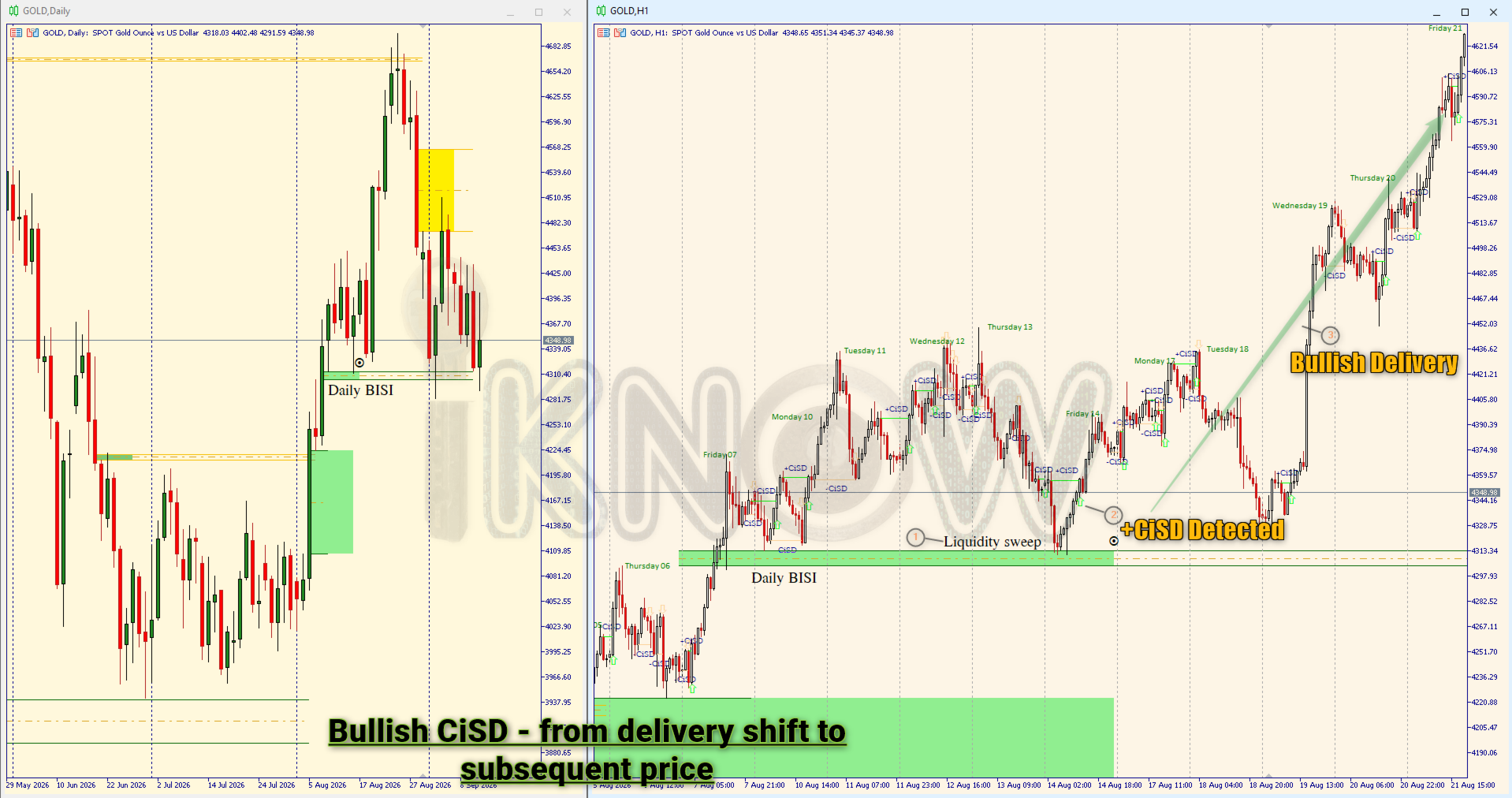
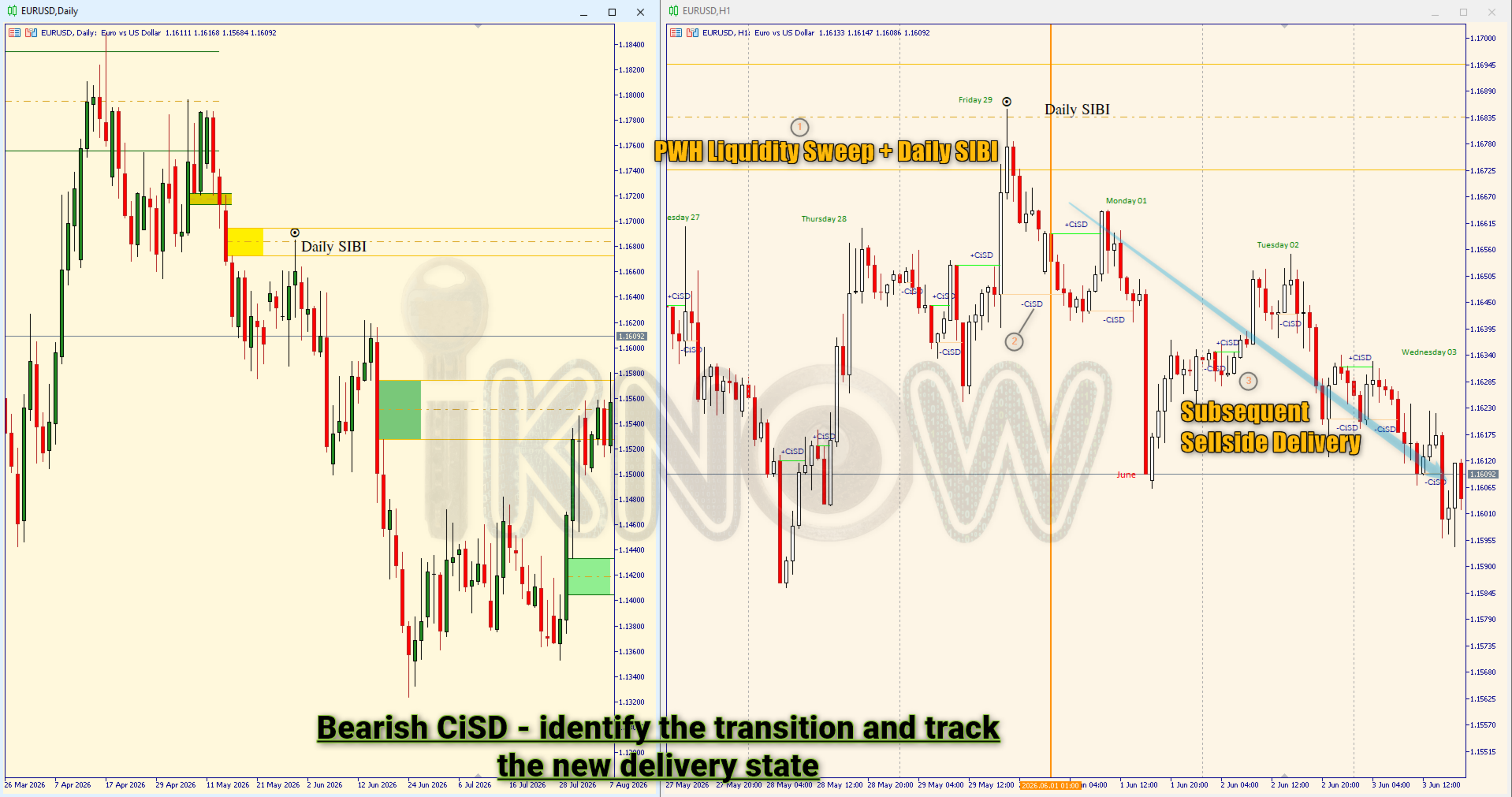
- Bullish to Bearish: Price stops seeking buyside liquidity and pivots to target sellside liquidity.
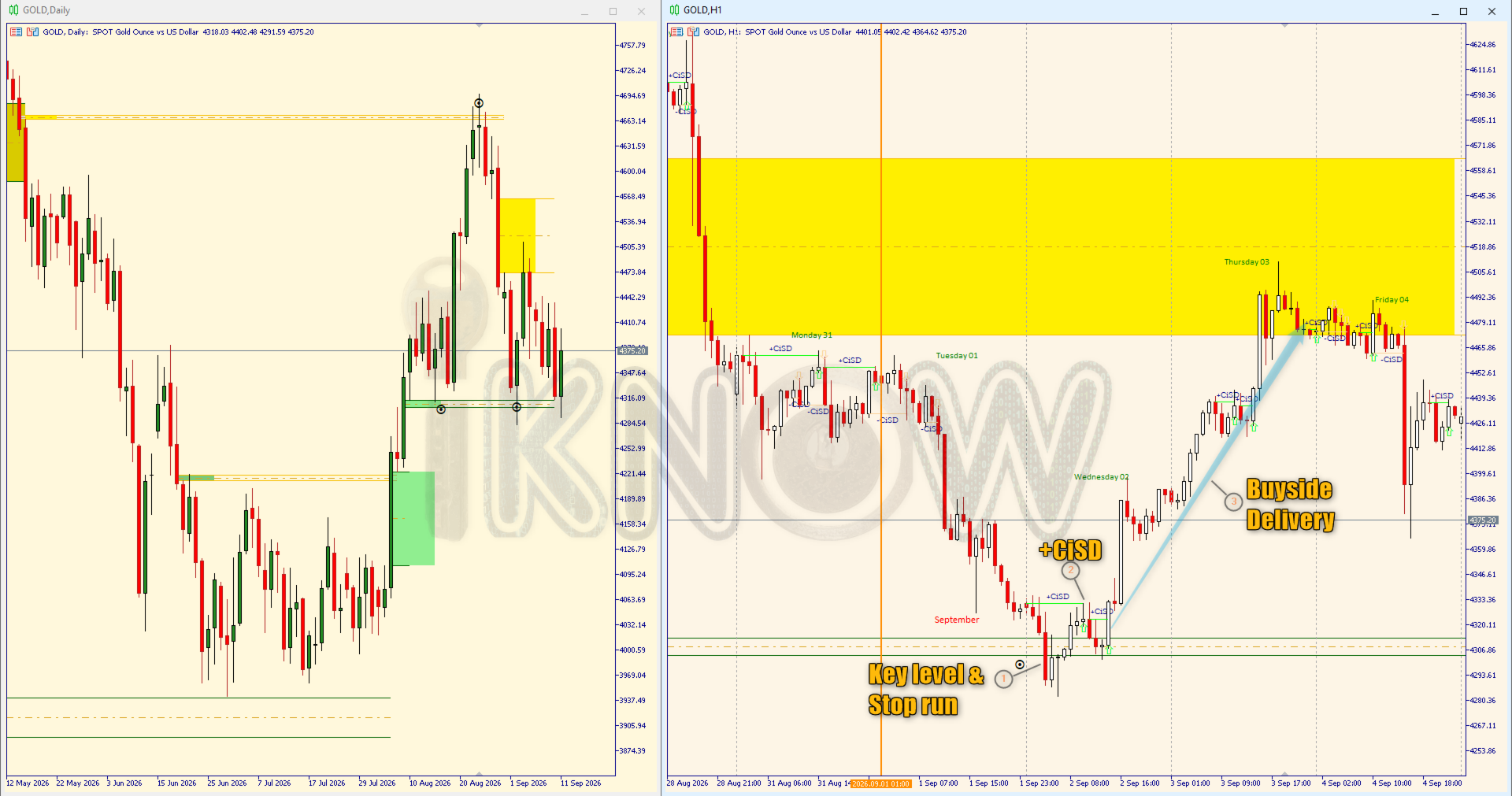
- Bearish to Bullish: Price stops seeking sellside liquidity and pivots to target buyside liquidity.
The CiSD opening price is the specific candle open that initiates this directional shift. This level becomes a critical reference point as it marks where the market's intent changed, establishing a new delivery bias.
Key Components/Features
- CiSD Opening Price
- A pivot point for the new directional bias
- A potential invalidation level for the current delivery state
- A reference for measuring premium/discount zones
- Delivery Direction
- Bullish CiSD: Market now seeks premium inefficiencies and/or Buyside liquidity
- Bearish CiSD: Market now seeks discount inefficiencies and/or Sellside liquidity
- Target Zones
- Premium Inefficiencies: Fair Value Gaps (FVG), imbalances, and unfilled orders above current price
- Discount Inefficiencies: Fair Value Gaps (FVG), imbalances, and unfilled orders below current price
- Liquidity Pools: Buyside (above) or Sellside (below) concentrations
- Combination Targets: Both inefficiencies and liquidity on the same side
The opening price of the candle that triggers the change in state delivery. This price level acts as:
Once a CiSD is identified, the indicator determines the new market directive:
Based on the CiSD, the market will now pursue:
Features
The indicator displays:
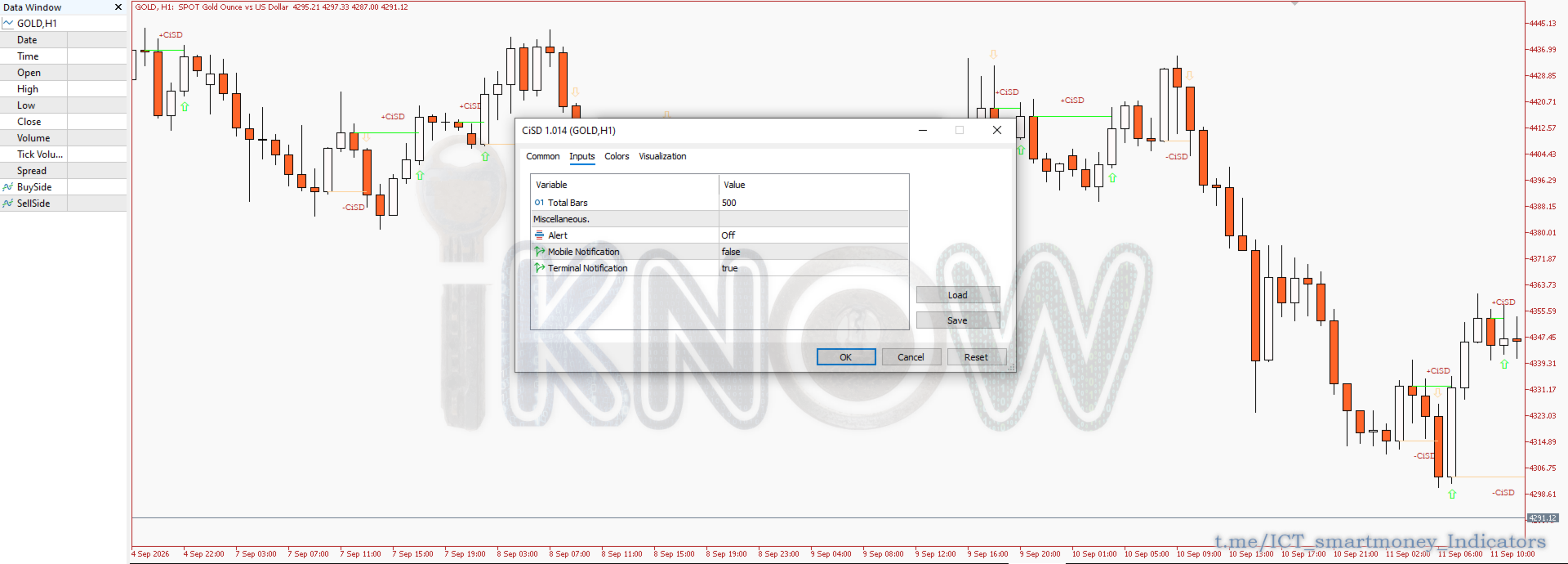
- CiSD Level Line: Horizontal line at the opening price where state change occurred.
- Directional Arrow: Visual indicator showing new delivery direction.
- Color Coding:
- -Bullish CiSD: Blue/Green tones
- -Bearish CiSD: Red/Orange tones
- Label: Text showing "CiSD" with timestamp and price level
Pricing
Rent it to try CiSD in live market conditions, or buy once and keep it.
Monthly
Lower initial commitment for traders who want to test the product over a shorter period.
Best valueLifetime
Own the current product permanently instead of paying a recurring monthly fee.
A free demo is available so you can verify the indicator's behaviour on your charts before purchasing.
Frequently Asked Questions
CiSD monitors price action for a change in delivery state. When the conditions are met, it marks the opening price of the candle that initiated the transition and indicates the new delivery direction.
- Chart screenshot
- Symbol
- Timeframe
- Date/Time
- Relevant candles
- Expected result
- Methodology/Reference used
This allows the result to be investigated properly.
Glossary of Terms
- Liquidity: Areas where large numbers of pending orders are concentrated (typically above/below key price levels).
- Buyside Liquidity: Concentration of buy-stop orders above current price (targets for bearish moves).
- Sellside Liquidity: Concentration of sell-stop orders below current price (targets for bullish moves).
- State Delivery: The market's current directional focus in seeking liquidity pools.
- Premium Zone: Price area above a reference level (generally considered "expensive").
- Discount Zone: Price area below a reference level (generally considered "cheap").
- Inefficiency: Price imbalances or gaps where one-directional order flow dominated, leaving unfilled orders.
⚠️ Risk Disclaimer
This indicator is a tool for market analysis and does not guarantee trading profits. Past performance does not indicate future results. Trading forex, stocks, and other financial instruments involves significant risk of loss and is not suitable for all investors. Always use proper risk management and never risk more than you can afford to lose. You should carefully consider your investment objectives, level of experience, and risk appetite before making any trading decisions.










































L'utente non ha lasciato alcun commento sulla valutazione.