MyFxDesk
- Indicators
-
Truong Nguyen
 I am an independent algorithmic/discretionary trader.
I am a certified Elliott Wave technician with a deep knowledge and understanding of market structure. - Version: 1.20
- Updated: 17 September 2026
- Activations: 10
MyFxDesk is a powerful reversal-continuation analysis indicator designed to uncover developing shifts in market direction before they become obvious.
MyFxDesk was developed by combining next-generation AI-driven quantitative research and market intelligence with analysis shaped by years of real-world trading experience.
Chart structure. Multiple timeframes. Entry timing. Risk. As discretionary traders, we already invest considerable focus in planning a trade. Reading a currency-strength dashboard should not become another analysis task.
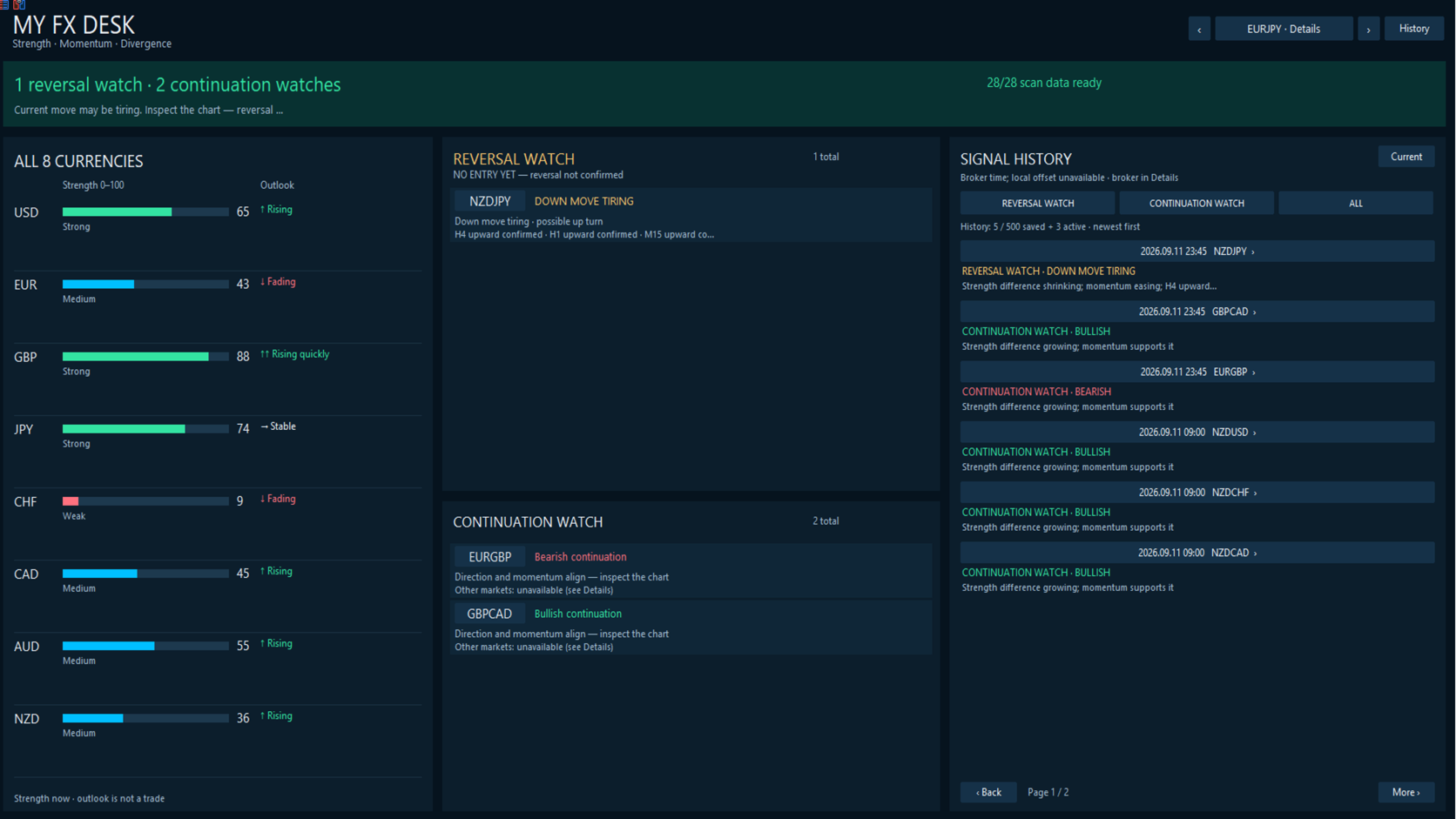
MyFxDesk brings eight major currencies and their 28 Forex pair combinations into one workspace. See which currencies are strong or weak, whether that strength is building or fading, which pairs deserve closer inspection, and where a move may be losing support.
Not just strength now. A clearer view of how strength is changing.
Designed for a ten-second overview
The design goal is simple: understand the main market picture within your first ten seconds, then spend your time on the charts that matter to your trading plan.
Research on working-memory limits and cognitive load provides a reason to reduce unnecessary mental processing, rather than asking users to hold and combine more information. My FX Desk applies that principle through grouped information, readable strength bars, clear outlook labels and separate lists for continuation opportunities and possible turning points. This is a design application of the research.
The main screen puts three questions first:
Which currencies are improving or fading? Which pairs deserve attention? Is there a qualifying setup, or is it better to wait?
Strength is the starting point, not the whole story
A strong currency is not necessarily getting stronger. A weak currency is not necessarily continuing to weaken.
My FX Desk separates current relative strength from its calculated outlook. This helps distinguish a strong currency that is still improving from one whose advantage is fading, and a weak currency that is still falling from one showing signs of recovery.
For example, EUR may remain relatively strong while its outlook fades. JPY may still look weak while its outlook improves. EURJPY can therefore retain a positive strength difference even as that advantage narrows.
That is not automatically a sell signal. It is a reason to examine whether the move is still developing or beginning to mature.
How the Outlook meter works
The calculations work through three practical questions.
Where is the strength coming from?
My FX Desk combines price changes across the available Forex pair network to estimate each currency’s relative contribution. It accounts for differences in volatility and combines short-, medium- and longer-horizon momentum, rather than judging a currency from one chart alone.
How is that strength changing?
The Outlook examines the pace of change, whether it is accelerating or fading, whether the movement is broad across the currency’s pairs, and what the shorter timeframe contributes to the picture. Those readings are compared with their own earlier behaviour to provide context.
What does that mean for the pair?
The dashboard compares the two currencies to show whether their strength difference is widening or narrowing, alongside the pair’s own momentum and relationship evidence.
The result is a rule-based directional outlook intended to help you assess developing strength and weakness over the coming working-timeframe bars.
Reversal Watch: notice when a move may be losing support
Reversal Watch looks for combinations of exhaustion evidence, not merely an overbought or oversold reading.
It considers whether a previously large strength difference is narrowing, whether the pair’s momentum is slowing, whether divergence is developing or confirmed, and whether broader FX relationship evidence is beginning to weaken.
Price may still be pushing forward, but the evidence supporting that push may be deteriorating.
It shows whether divergence evidence agrees across timeframes or conflicts, rather than turning every warning into a buy or sell instruction. Its divergence model distinguishes developing, confirmed and expired conditions.
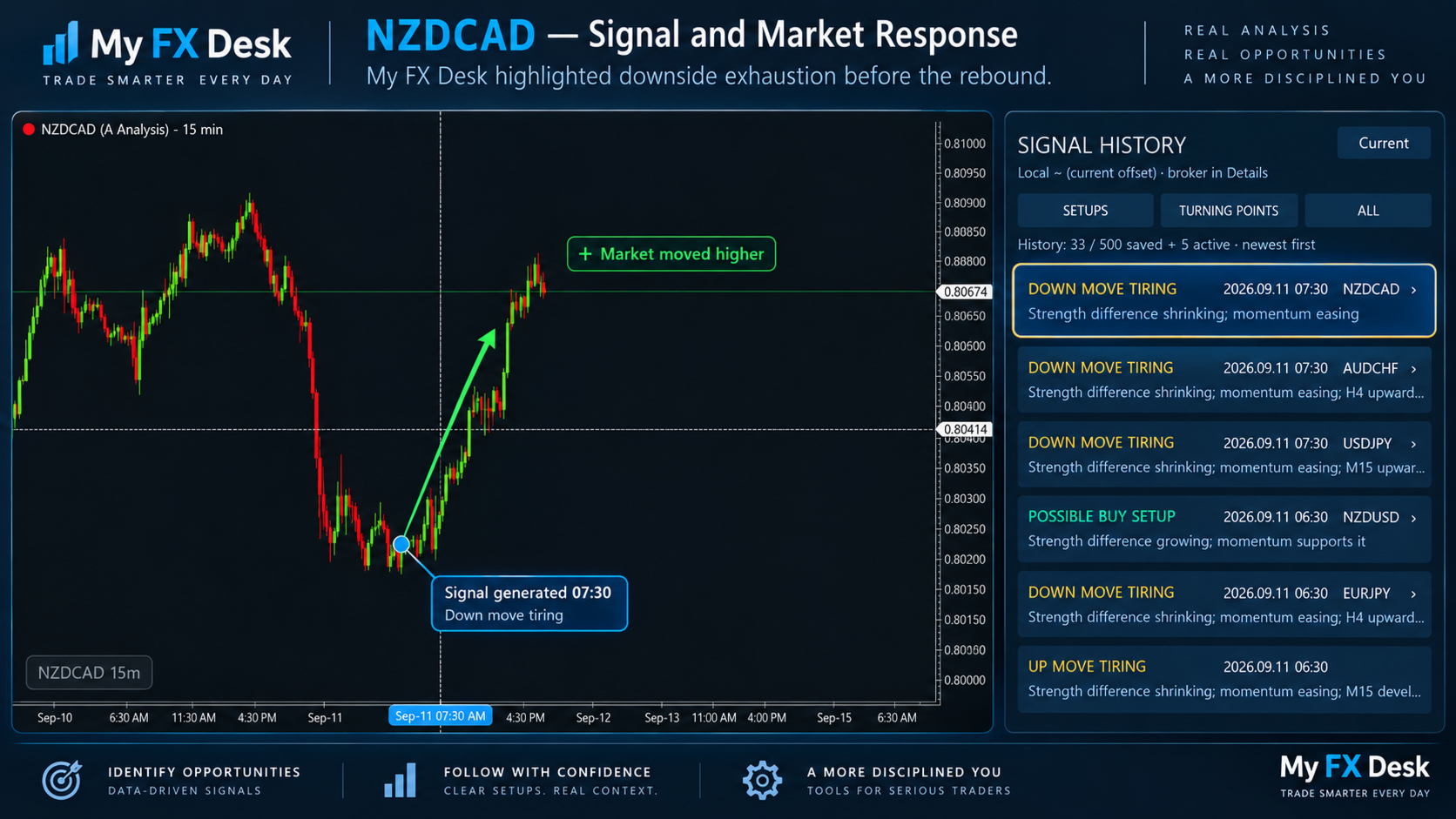
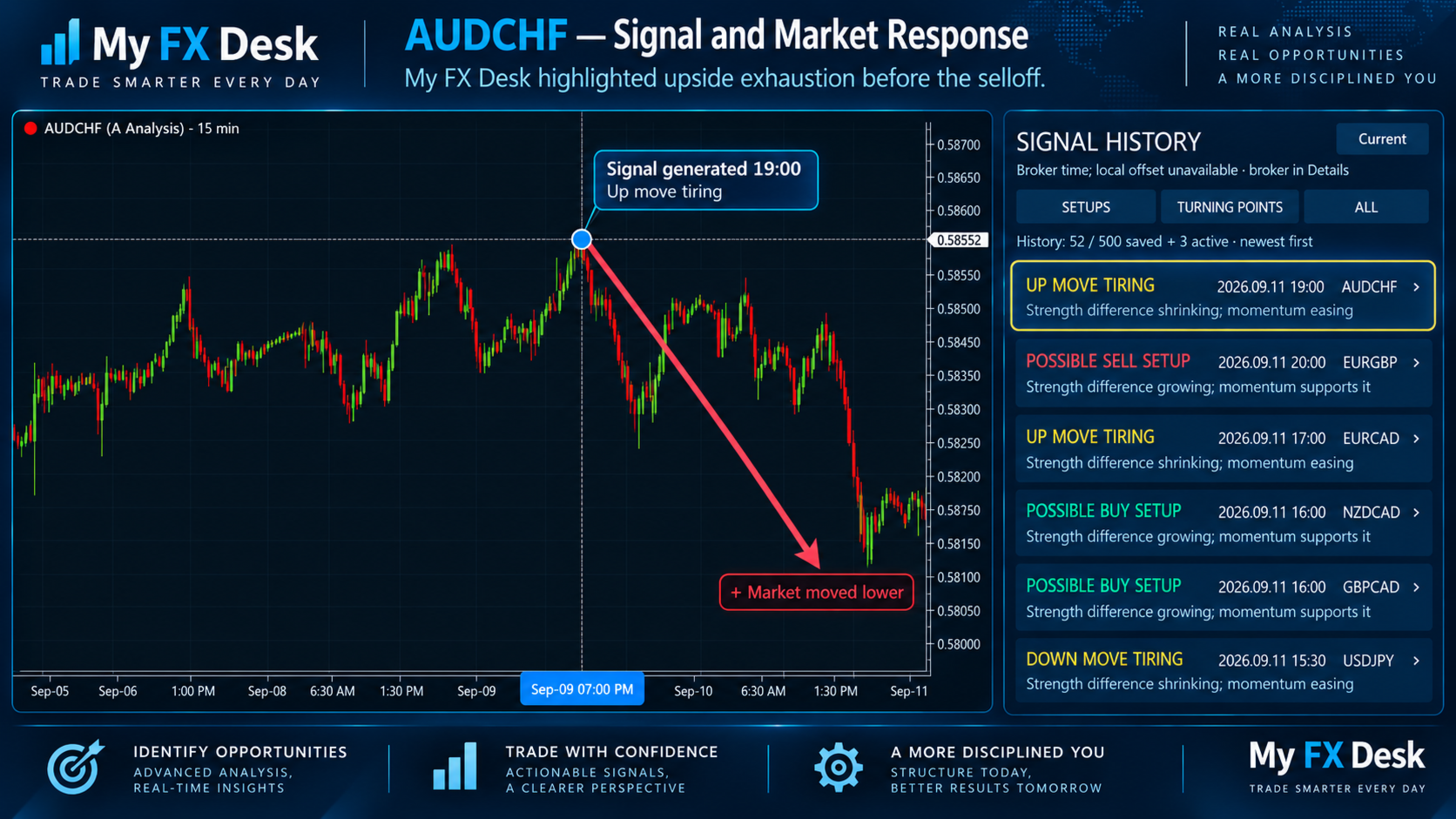
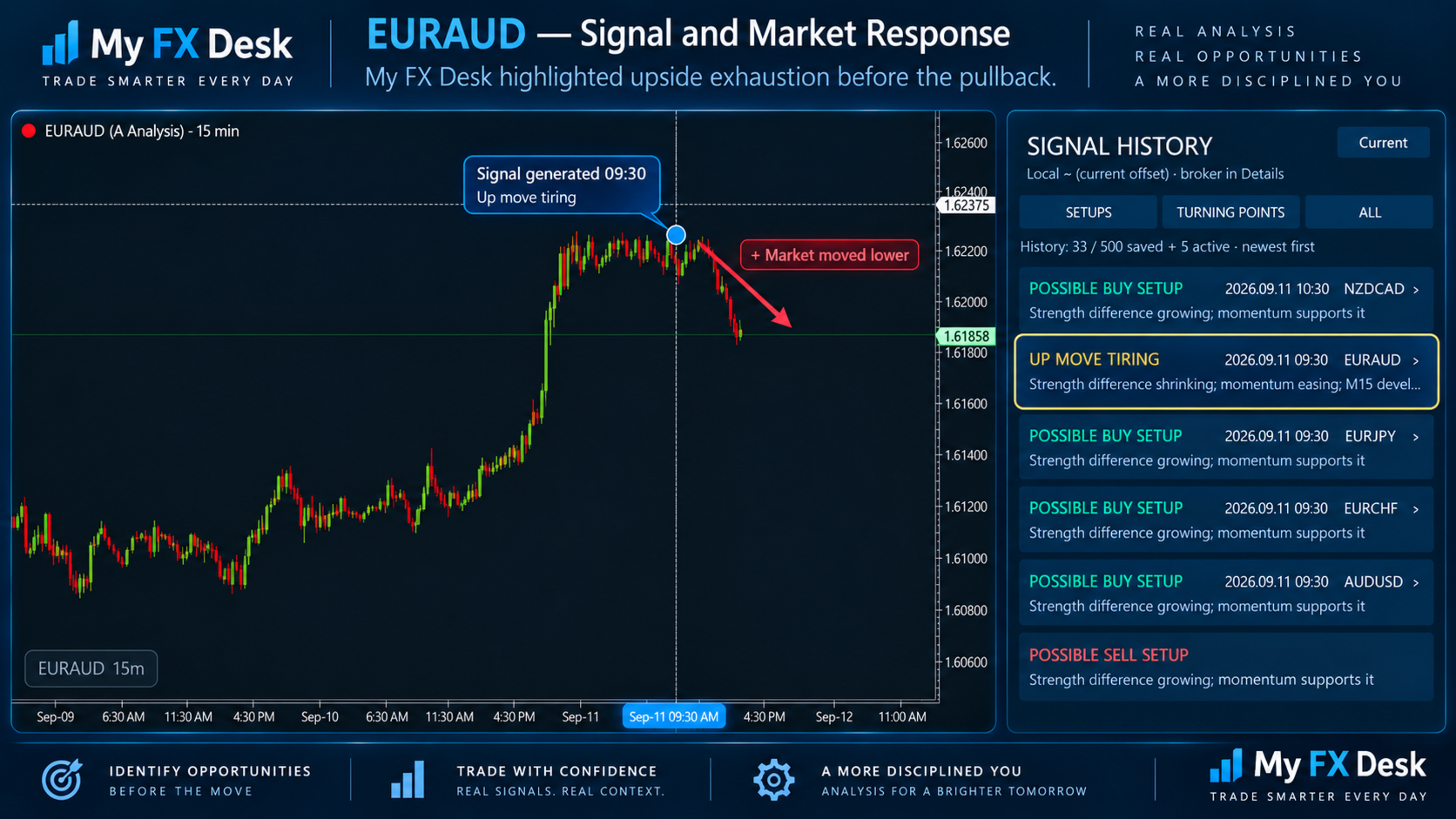
Reversal Watch means: inspect this chart for a possible turning point. It does not mean: a reversal is confirmed, or enter now.
Continuation Watch, Reversal Watch and the discipline to wait
Continuation Watch and Reversal Watch answer different questions.
Continuation Watch highlights pairs meeting the continuation scanner’s requirements. These are charts to inspect where the existing move may still have support.
Reversal Watch highlights conditions that may be maturing or losing support. These remain watch situations until your own entry criteria are met. The two lists are deliberately separate: a continuation opportunity and a possible exhaustion warning are not interchangeable.
Each qualifying signal is also accompanied by a Confidence reading. This provides a quick indication of how strongly the available evidence supports the conditions identified by the scanner, helping you distinguish stronger observations from more marginal ones without having to analyse every component individually.
Confidence is an evidence-strength reading, not a probability of success or a prediction that a trade will win. It is intended to help prioritise which signals may deserve your attention first while leaving the final trading decision to your own analysis.
When nothing qualifies, the dashboard says so. When some pairs cannot be assessed because required information is missing, it identifies the incomplete scan instead of presenting it as proof that no opportunity exists.
Confirmation beyond one chart
My FX Desk also evaluates relationships across the Forex pair network.
The aim is to determine whether the broader FX evidence that has recently accompanied a pair’s move is still supporting it or beginning to weaken. These relationships are treated as supporting observations rather than permanent assumptions about how individual pairs must behave.
This provides additional context without requiring you to manually compare every related currency pair yourself.
Review the evidence after the moment has passed
The timestamped Signal History lets you look back through recorded Continuation Watch and Reversal Watch events and compare them with subsequent price action.
The original Confidence reading is retained with the recorded signal where available, helping you review not only what the dashboard identified, but how strong the supporting evidence was at the time.
Use it to review how the dashboard’s observations fit your own trading method. The history is a review tool, not an automatic win-rate or profitability claim.
Recommended chart and Strategy Tester settings
For the clearest experience, use EURJPY on the H1 (1-hour) chart.
My FX Desk performs sophisticated multi-currency, multi-pair and multi-timeframe analysis in the background. When evaluating the indicator in the MetaTrader 5 Strategy Tester, the recommended modelling method is 1 Minute OHLC.
This provides the indicator with the intrabar progression needed for its calculations while offering a much more practical testing speed than tick-by-tick modelling.
Recommended Strategy Tester settings:
- Symbol: EURJPY
- Timeframe: H1
- Modelling: 1 Minute OHLC
My FX Desk performs its own internal multi-timeframe analysis, so the H1 chart is the recommended working chart rather than the only timeframe used by the indicator.
Built to support your judgement
My FX Desk is a non-trading MetaTrader 5 indicator. It does not place trades or manage positions. Its analytical signals use completed-bar evidence; developing conditions can change as new bars arrive. Required data availability affects which calculations and pairs can be assessed.
Outlook readings, continuation observations, Confidence readings and reversal warnings are analytical estimates, not promises. They should be considered alongside your price analysis, risk management and independent trading plan.
See the strength. Understand the change. Decide what deserves your attention.