The savings book of Drawdown Minimizer: where the money for each slice comes from

Out of drawdown #3 – part 2 looked at the problem: a stuck grid basket pays swap every night, blocks margin and is exposed for as long as it stays open. This part explains the first piece of the logic of Drawdown Minimizer: the savings book. It decides how much money is available to close old losers – and, just as important, which money never counts.
Three numbers: Saved, Spent, Available
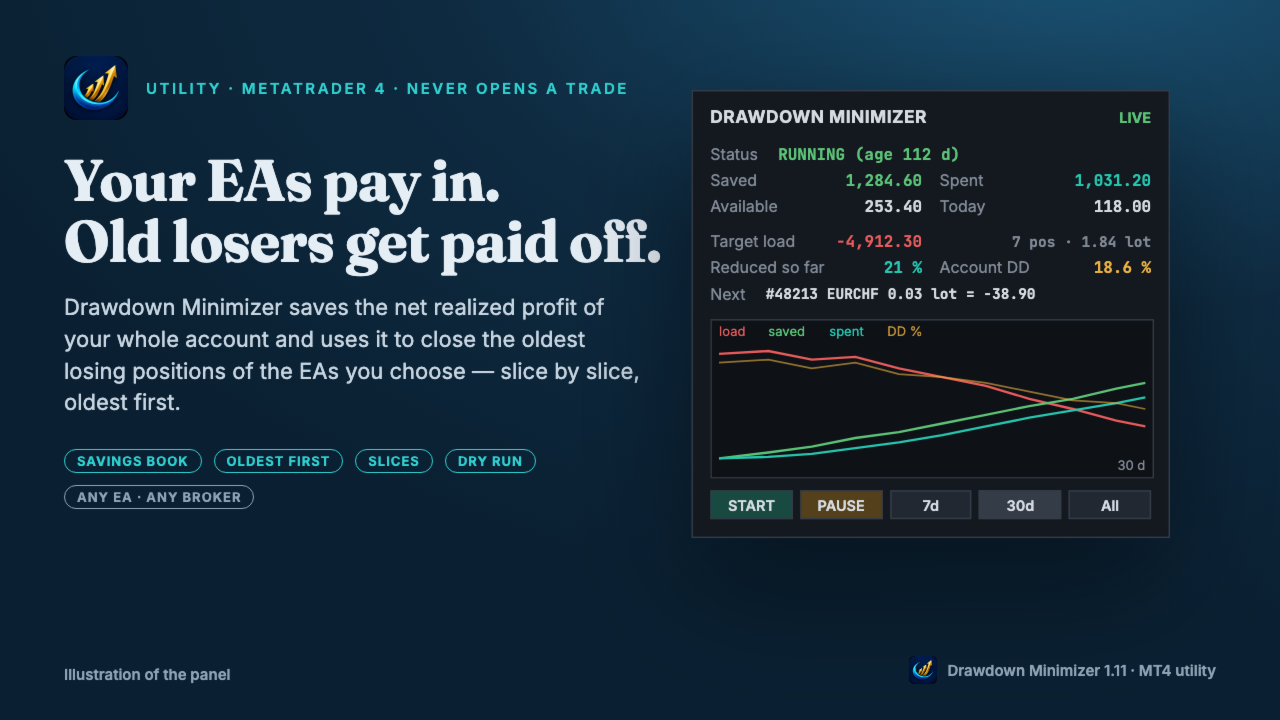
The whole book comes down to three lines on the panel:
| Line | What it is |
|---|---|
| Saved | Save % × net result of all trades closed in the account since the start |
| Spent | The realized loss of all closes made by Drawdown Minimizer |
| Available | Saved − Spent, optionally capped by Max spend per day |
Only Available is ever used for a slice. If Available is not enough to pay for the smallest lot step of the oldest losing position, nothing is closed – the panel shows how much is still missing.
What pays in
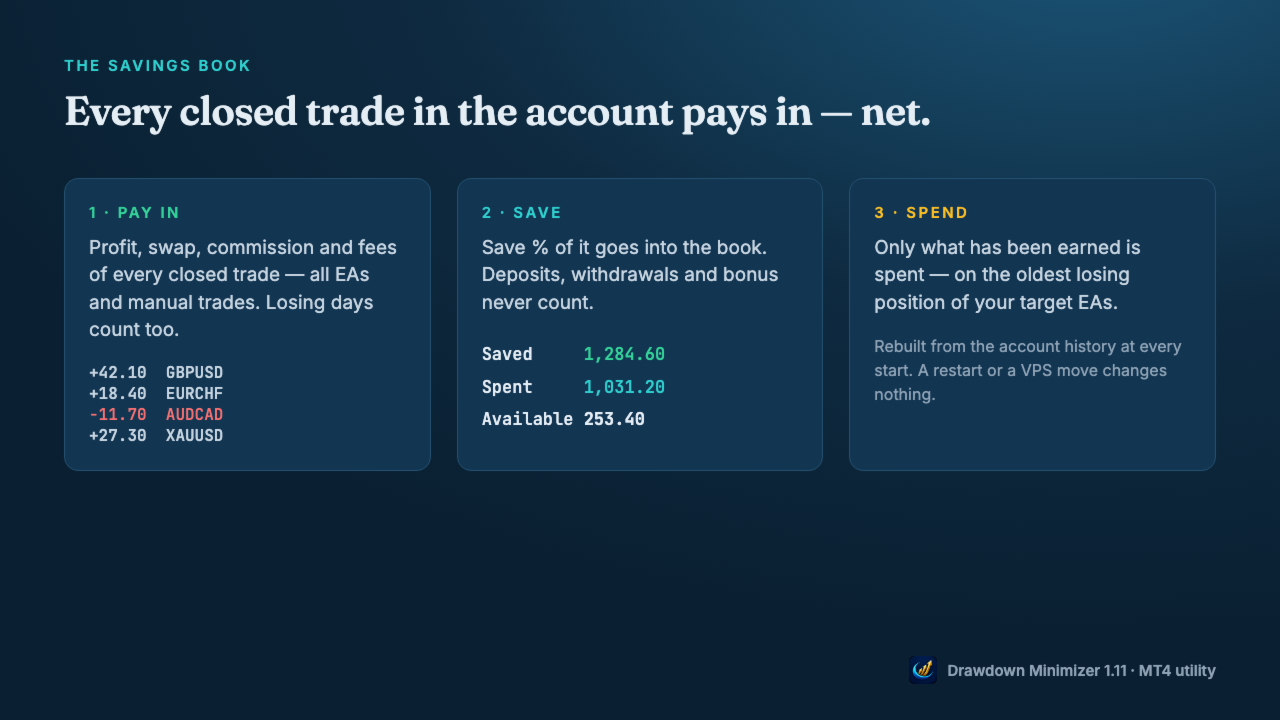
Every closed trade in the account pays in, net: profit minus loss, including swap, commission and fees. That means:
- All EAs count. Your breakout EA, your index EA, any other system on the account.
- Manual trades count. A trade you closed by hand is part of the net result.
- The target EA itself counts. When the grid EA closes a newer basket in profit, that profit goes into the book too – and can later pay for a slice of its own oldest position.
- Losing days count too. A losing trade lowers the book. Saved is a net figure, not a sum of winners.
Save % decides how much of that net result goes into the book. The default is 100 %. With a lower value, only that share of the net profit is used for reduction.
What never counts
This is the part that keeps the book honest:
- Deposits and withdrawals do not count. Putting money into the account does not create "savings" for the tool, and taking money out does not lower the book.
- Bonus and credit do not count. A broker bonus is not earned profit.
- The tool's own closes do not count as savings. They are booked under Spent, not as a loss under Saved.
The rule behind it is simple: only what the account has earned is spent. If the book drops below what was already spent – for example after a few losing trades – the reduction waits until money has been earned again.
A worked example (illustration only, not a result)
To make the arithmetic visible, here are simple example numbers:
| Step | Saved | Spent | Available |
|---|---|---|---|
| Start, Save % = 100 | 0.00 | 0.00 | 0.00 |
| Other EAs close trades for a net +120.00 | 120.00 | 0.00 | 120.00 |
| A slice of the oldest loser is closed for −38.90 | 120.00 | 38.90 | 81.10 |
| A losing trade elsewhere closes at −25.00 | 95.00 | 38.90 | 56.10 |
| You deposit 1,000.00 | 95.00 | 38.90 | 56.10 |
The deposit changes the balance, but not the book. The losing trade lowers Saved. The slice moves money from Available into Spent.
A counter, not a separate account
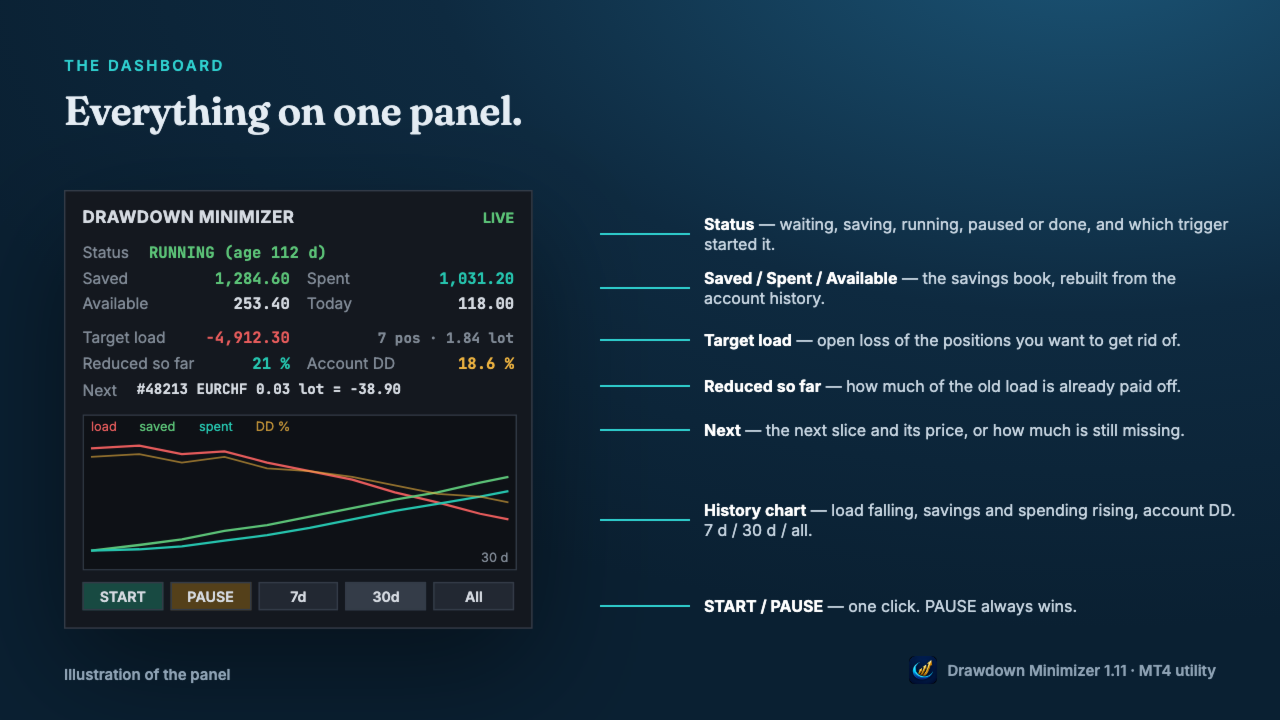
This is easy to misunderstand, so it is worth saying clearly: the savings book is a counter, not a separate account. No money is moved anywhere. The profit stays on your balance and stays at risk, like any other money in the account. The book only tracks how much of that profit the tool is allowed to use for closing old losers.
That is also why the book is always rebuilt from the account history. A restart, an update or a crash changes nothing; only the start time is stored. On MetaTrader 4 there are two practical points:
- Set the Account History tab to All History. Otherwise the book counts only the part of the history the tab shows.
- The tool recognises its own closes by a ticket list in the terminal's MQL4\Files folder. Copy the DDMin_* files from there when you move to another terminal or VPS – without them the book starts again from zero.
When counting starts
Counting starts when you attach the tool. Profits made before that are not in the book. If you want older profits to count, set Start counting from to a date (for example 2026.06.01) and limit Max spend per day (0 = no limit). The daily limit slows the reduction down, so a large backdated book is not spent in one go. Part 9 of this series goes deeper into that option.
Saving always runs. Spending only starts when a trigger fires or you press START – and in Dry run, which is on by default, the journal only shows what would be closed. Watch it for one or two weeks before you switch to live. When the first real slice is closed, check that the closing deal appears under Spent, not as a loss under Saved.
What the book does not do
The book does not create money. Closing a loser with saved profit does not change your equity, apart from slippage: a floating loss becomes a realized one, and the balance grows more slowly. What changes is the load – less open volume, less margin, no more swap on the closed volume. The price: if the market would have come back, that way back is gone for the closed slices.
The next part explains how the book is spent: oldest loser first, slice by slice, and when a small rest is closed in full.
Complete guide: https://www.mql5.com/en/blogs/post/778023
Drawdown Minimizer MT5: https://www.mql5.com/en/market/product/201728