A trader opens MetaTrader 5, reviews several positions, and sees that the combined estimated risk is only 0.75% of account equity.
At first glance, that might seem reassuring.
But what if one of those positions has no stop-loss?
The account's actual exposure could be substantially greater than the displayed estimate.
Understanding this distinction is an important part of trading risk management.
1. What Happens When a Position Has No Stop-Loss?
A stop-loss defines a price at which a position is instructed to close if the market moves against the trade.
Without a stop-loss, there is no predetermined exit price established through that type of order.
The trader may intend to close the position manually, follow an automated exit signal, or use another exit strategy.
However, these approaches can introduce additional risks, including delayed execution, platform interruptions, connectivity problems, and unexpected market movements.
A position without a stop-loss is not necessarily part of an undisciplined trading strategy, but its exposure requires careful monitoring.
2. Why Missing Stop-Losses Complicate Risk Calculations
Suppose a trader has a $20,000 account with four open positions.
Three positions have defined stop-losses:
-
EURUSD: Estimated loss of $40
-
GBPUSD: Estimated loss of $50
-
USDJPY: Estimated loss of $30
Their combined estimated stop-loss exposure is:
$40 + $50 + $30 = $120
Expressed as a percentage of account equity:
$120 ÷ $20,000 × 100 = 0.60%
Now suppose the fourth position is a EURJPY trade without a stop-loss.
The trader knows the estimated stop-loss exposure of the first three positions, but the fourth position does not have a defined stop-loss price from which its potential loss can be calculated.
Therefore, the 0.60% figure represents only the known stop-loss exposure.
It does not represent the account's complete risk.
Known stop-loss risk and total account exposure are not necessarily the same thing.
3. Why a Risk Dashboard Must Distinguish Unknown Exposure
Consider a dashboard displaying:
-
Positions: 4
-
Positions without stop-loss: 1
-
Known risk: 0.60%
If the trader looks only at the known-risk percentage, the missing-stop position could be overlooked.
An effective monitoring tool should clearly identify the unprotected position instead of silently treating it as having zero risk.
This distinction becomes especially important for traders managing multiple positions or using more than one trading system.
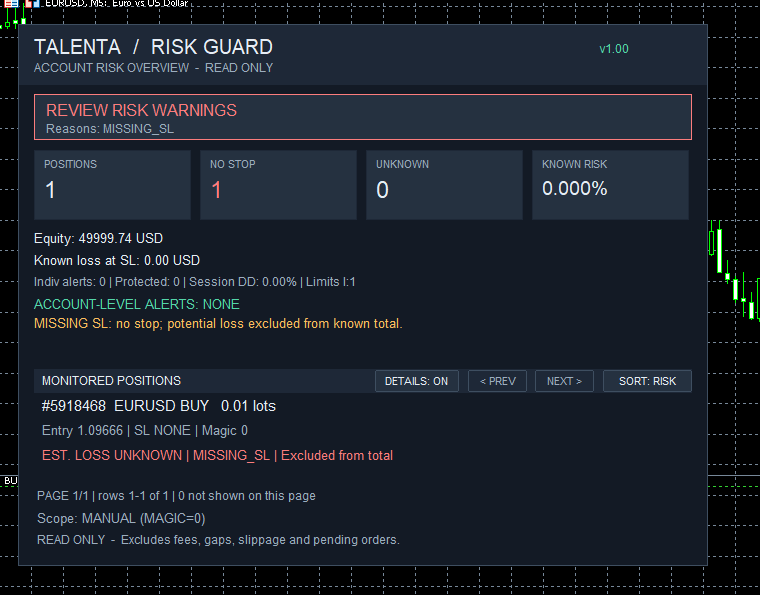
For example, Talenta Risk Guard for MT5 is a read-only utility that identifies monitored positions without stop-losses.
When a missing stop-loss is detected, its dashboard displays a warning such as:
REVIEW RISK WARNINGS
Reason: MISSING_SL
The affected position is identified separately, and its potential loss is excluded from the known stop-loss loss total.
This helps traders recognize when the calculated exposure does not account for every monitored position.
4. A Stop-Loss Is Not a Guaranteed Maximum Loss
Even when every position has a stop-loss, actual losses can differ from the original estimates.
A stop-loss order does not guarantee that the position will close at the requested price.
Potential differences can arise from:
-
Market gaps
-
Slippage
-
Limited liquidity
-
Execution delays
-
Commissions and other trading costs
For this reason, stop-loss-based risk calculations should be treated as estimates rather than guaranteed loss limits.
5. The Importance of Position Size
A position's risk also depends on its size.
For example, consider two EURUSD positions with the same 30-pip adverse price movement.
Using approximate pip values for a USD-denominated account:
-
0.01 lots: approximately $3 loss
-
0.10 lots: approximately $30 loss
-
1.00 lot: approximately $300 loss
The price movement is identical, but the financial exposure differs substantially.
Without a stop-loss, traders should be particularly aware of how changes in market price interact with position size and leverage.
6. Practical Steps for Monitoring Missing Stop-Losses
A useful daily risk review can include the following questions:
-
How many positions are currently open?
-
Which positions have defined stop-losses?
-
Are any positions relying on manual or automated exits instead?
-
What is the estimated loss at the stop-loss prices of protected positions?
-
Which positions are excluded from that calculation?
-
Are position sizes and combined exposures appropriate for the trading plan?
These questions help identify potential exposure before it becomes an unexpected problem.
7. Using Talenta Risk Guard for MT5
Talenta Risk Guard provides a dashboard for reviewing monitored positions, estimated stop-loss exposure, and risk warnings.
Its features include:
-
Monitoring open positions within a selected scope.
-
Identifying positions without stop-losses.
-
Calculating estimated known losses at stop-loss levels.
-
Displaying known risk as a percentage of account equity.
-
Showing individual position information.
-
Highlighting missing-stop warnings.
The utility operates in read-only mode.
It does not open, close, modify, or block trades. It does not automatically add stop-losses or prevent losses.
Traders remain responsible for all trading decisions and position management.
Conclusion
One of the most important questions in trading risk management is not simply how much risk has been calculated, but whether that calculation includes every relevant position.
A displayed risk percentage can be useful, but it may not tell the entire story when some positions lack defined stop-losses.
Recognizing that distinction can help traders make more informed decisions about their existing exposure.
Additional resource:
Talenta Risk Guard for MT5 — Installation and User Guide
https://www.mql5.com/en/blogs/post/781264
Educational information only. Forex and leveraged trading involve substantial risk of loss.