Why Every MetaTrader 5 Trader Should Monitor Account-Level Risk

A trader can carefully manage the risk of each individual position and still overlook the total exposure across an account.
This is particularly relevant for traders who operate several currency pairs, manage multiple strategies, or combine manual trading with automated Expert Advisors.
Understanding account-level risk requires looking beyond individual trades.
1. Individual Trade Risk Is Only Part of the Picture
Suppose a trader has three open positions with estimated stop-loss losses of:
-
EURUSD: 0.40% of account equity
-
GBPUSD: 0.30% of account equity
-
USDCHF: 0.50% of account equity
Each position might appear relatively small when evaluated separately.
However, their combined estimated stop-loss losses equal:
0.40% + 0.30% + 0.50% = 1.20% of account equity.
On a $20,000 account, that represents approximately $240 of estimated loss if all three positions close at their specified stop-loss prices.
The calculation is straightforward, but it becomes easier to overlook when positions are spread across several charts or strategies.
The sum represents combined exposure at the defined stop-loss levels, not a guaranteed maximum loss.
2. Multiple Positions Can Share the Same Market Risk
Different currency pairs do not necessarily represent independent trading opportunities.
For example, a long EURUSD position and a long GBPUSD position may both be sensitive to movements in the US dollar.
Although the positions involve different currency pairs, the same market development could affect both.
A trader therefore needs to consider two aspects of exposure:
-
Quantitative exposure: How much is estimated to be lost at the positions' stop-loss levels?
-
Shared market exposure: Could the same price movement or economic event affect several positions simultaneously?
Adding estimated stop-loss losses helps quantify the first issue. It does not fully measure the second.
3. Missing Stop-Losses Create an Important Information Gap
Consider a trader who has four open positions.
Three have stop-losses, and their combined estimated risk is 0.80% of account equity.
The fourth position has no stop-loss.
Is the account's total risk 0.80%?
No.
The trader knows the estimated stop-loss exposure of three positions, but the potential loss associated with the fourth is not defined by a stop-loss price.
A monitoring dashboard might correctly display 0.80% as known stop-loss risk while separately warning that another position has no stop-loss.
This distinction matters.
Known risk is not necessarily total risk.
An unprotected position should not be treated as having zero risk simply because its potential loss cannot be calculated from a stop-loss level.
4. How Stop-Loss Risk Is Estimated
For a straightforward USD-denominated EURUSD position, estimated risk can be calculated using:
Estimated loss = Stop distance in pips × Pip value
For example:
-
Position size: 0.10 lots
-
Stop-loss distance: 25 pips
-
Approximate pip value: $1 per pip
The estimated loss at stop-loss is:
25 × $1 = $25
If account equity is $5,000, the estimated percentage risk is:
$25 ÷ $5,000 × 100 = 0.50%
For other instruments and account currencies, calculations must account for the broker's contract specifications and relevant currency conversions.
These estimates are useful for monitoring exposure, but they are not guaranteed loss limits.
5. Why Actual Losses May Differ
Even when every position has a stop-loss, realized losses can differ from the original estimates.
Factors include:
-
Market gaps
-
Slippage
-
Execution conditions
-
Commissions and other trading costs
-
Changes in account equity
A stop-loss is an important risk-management mechanism, but it does not guarantee execution at the requested price.
Traders should also consider pending orders and other exposures not included in calculations based solely on open positions.
6. Using a Risk Dashboard
A dedicated risk-monitoring dashboard can help consolidate information that would otherwise require reviewing several positions individually.
Useful information includes:
-
Number of monitored positions
-
Positions without stop-losses
-
Estimated losses at stop-loss prices
-
Known stop-loss risk as a percentage of equity
-
Individual position details
-
Visible warnings for risk conditions
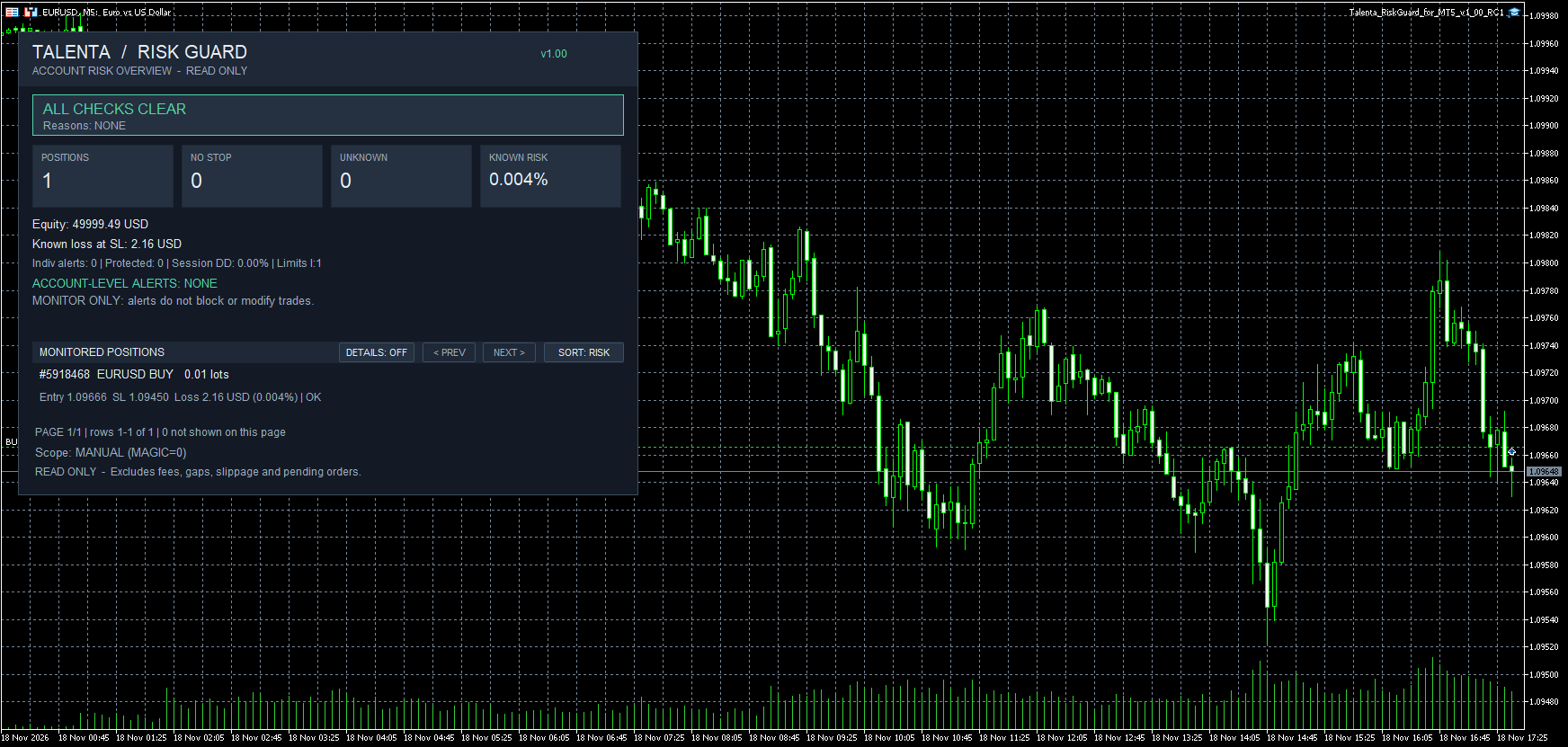
For example, Talenta Risk Guard for MT5 is a read-only monitoring utility that displays position information and warns when a monitored position has no stop-loss.
Its dashboard distinguishes calculable stop-loss exposure from positions that cannot be evaluated using a defined stop-loss level.
The utility does not open, close, block, or modify trades. All trading decisions remain with the account owner.
7. A Practical Daily Risk Review
Before opening another position, a trader can ask:
-
How many positions are currently open?
-
What is the combined estimated loss at their stop-loss levels?
-
Are any positions missing stop-losses?
-
Are several positions exposed to the same market movement?
-
How would another position affect total account exposure?
These questions can help traders maintain awareness of their existing commitments before adding new trades.
Conclusion
Risk management involves more than choosing a stop-loss for each individual position.
It also requires understanding the combined exposure of an account, recognizing overlapping market risks, and identifying positions where potential losses cannot be quantified from a defined stop-loss level.
Whether traders calculate these values manually or use a monitoring utility, the goal is the same: make trading exposure visible so decisions can be made with better information.
Additional resource:
Talenta Risk Guard for MT5 — Installation and User Guide
https://www.mql5.com/en/blogs/post/781264
Educational information only. Trading foreign exchange and leveraged products involves substantial risk of loss.