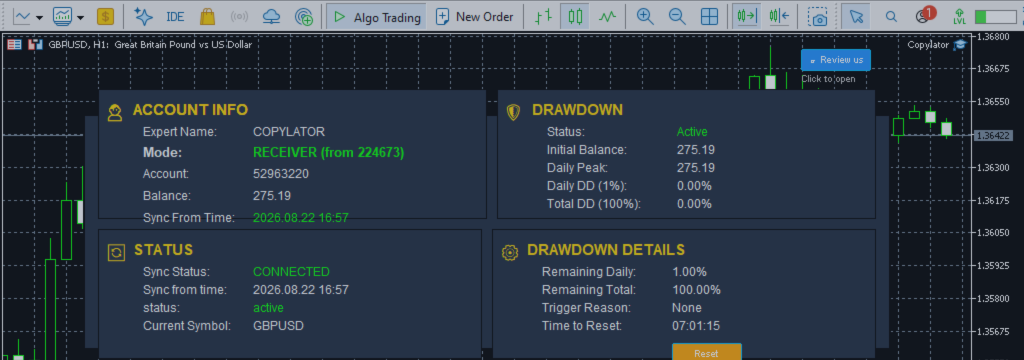
Reverse Mode: Should You Change Your Lot Size When You Switch? — COPYLATOR – MT5 Trade Copier

Product link:
https://www.mql5.com/en/ market/product/191385
There is a question many traders overlook when enabling reverse mode: if the trade direction changes, should the position size change as well?
Some traders switch on reverse mode, see positions opening in the opposite direction, and assume that the original risk profile has been mirrored too. Because the lot-sizing settings remain unchanged, they expect the risk to remain unchanged.
That assumption is not always correct. Reversing direction does not automatically preserve the receiver's actual risk, trading costs, or drawdown behavior.
Before deciding whether to keep or reduce the lot size, it is important to understand three factors: stop-loss behavior, the reversed strategy's performance distribution, and trading costs.
1. Risk Per Trade Is Not Determined by Volume Alone
The volume of a position is only one component of its risk. The monetary amount at risk also depends on the stop-loss distance, the instrument's tick or pip value, the account currency, and the actual execution conditions.
For example, a position of 0.10 lots with a 50-pip stop can have a different monetary risk from another 0.10-lot position with a 100-pip stop. Even when the lot size remains unchanged, a wider stop can increase the amount at risk.
In reverse mode, the trade direction changes. Depending on how the copier applies the reversal to the entry and protective levels, the resulting stop-loss distance must be checked on the receiver rather than assumed to be identical to the original.
Broker restrictions can also affect the result. Minimum stop distances, freeze levels, price changes, and execution conditions may prevent a protective level from being placed exactly where intended. The receiver's actual stop distance may therefore differ from the sender's.
What to check: Compare the actual receiver stop-loss distance with the intended distance, and calculate monetary risk using the receiver instrument's specifications. If the receiver's risk per lot is higher, the volume may need to be reduced.
2. The Reversed Strategy Has a Different Performance Distribution
Reversing trade direction changes the outcomes of the original strategy, but it does not guarantee a perfectly symmetrical performance record.
In a simplified model with identical entry and exit prices, equal transaction costs, and exactly opposite trade outcomes, a strategy with a 60% win rate would become a strategy with a 40% win rate after reversal.
Real trading is more complicated. Bid/ask prices, spread, slippage, swap, execution differences, and stop-loss behavior can make the reversed results differ from a simple mathematical inversion.
Even if the average loss and gain per trade appear similar, the sequence of winning and losing trades can change the account's drawdown profile. A longer losing streak or a different concentration of losses can make a previously acceptable lot size unsuitable.
What to check: Evaluate the reversed strategy over a meaningful sample of trades. Review maximum drawdown, losing streaks, average win and loss, and the distribution of results—not just the win rate.
3. Trading Costs Are Not Necessarily Symmetrical
Changing direction does not eliminate trading costs or guarantee that the costs will be equal in both directions.
Spread: Every market order is subject to the bid/ask spread. The effective entry and exit costs depend on the instrument, market conditions, execution, and the prices available when the order is placed and closed.
Commission: Commission is determined by the broker's pricing model and account conditions. It generally remains a cost of trading regardless of whether the position is Buy or Sell, although the exact charging structure can vary.
Swap: Overnight financing can differ between Buy and Sell positions. A position that receives a credit in one direction may incur a charge in the other. The difference depends on the broker, instrument, and applicable financing rates. Triple-swap days and other broker-specific rules may also affect the result.
A strategy that holds positions overnight may therefore have a materially different cost profile after reversal.
What to check: Compare actual spread, commission, and overnight swap costs on the receiver. Evaluate their combined effect on the reversed strategy rather than assuming that costs simply change sign.
So, Should You Change the Lot Size?
There is no universal rule that says traders must always reduce the lot size or always keep it unchanged. The decision should be based on the receiver's actual risk and performance.
Three measurements are particularly useful:
- Actual stop-loss risk: Compare the monetary risk per trade after reversal with the original configuration.
- Drawdown behavior: Compare maximum drawdown, losing streaks, and the frequency of adverse periods.
- Trading costs: Compare the actual spread, commission, and swap impact under the reversed configuration.
If the reversed configuration creates greater risk per trade or a deeper drawdown profile, reducing the lot size may be appropriate. If the measured risk and costs remain comparable, keeping the original size may be reasonable.
However, a short period of favorable results is not sufficient evidence that the reversed strategy has the same risk characteristics. Testing should cover different market conditions and a sufficiently large sample.
A Conservative Starting Point
When there is not enough reliable data to assess the reversed strategy, starting with a smaller position size is a prudent risk-management approach.
For example, a trader might initially use half of the intended final volume on a demo account or a suitably small live configuration. This is an illustrative starting point, not a mathematically guaranteed safe ratio.
The purpose is to limit exposure while observing:
- Whether reversed positions open with the intended direction and protective levels.
- Whether actual stop-loss distances match expectations.
- Whether spread, commission, and swap materially affect performance.
- How the reversed strategy behaves during losing streaks.
- Whether the resulting drawdown remains within the account's risk budget.
Only after reviewing sufficient evidence should the trader consider increasing the volume.
When Keeping the Same Lot Size May Be Reasonable
There are situations where keeping the original lot size can be justified.
If the receiver's actual monetary risk per trade is comparable to the original, the stop-loss distances are appropriate, trading costs are not materially worse, and testing shows that the reversed strategy's drawdown remains within the intended limits, there may be no need to change the volume.
Using the same broker and instrument can make some comparisons easier, but it does not guarantee symmetrical execution or identical results. The actual receiver trades and costs remain the relevant evidence.
The decision should be based on measured risk, not on the assumption that identical settings automatically produce identical risk.
The Maximum Lot Cap Also Needs Reviewing
If the receiver uses a maximum lot cap, review it when enabling reverse mode.
A maximum lot cap limits position volume. It does not guarantee a fixed maximum monetary loss because the loss per lot also depends on stop distance, instrument specifications, and execution.
If the reversed configuration has a wider effective stop or a different monetary risk per lot, the previous cap may no longer provide the same level of risk control.
Recalculate the potential loss at the capped volume using the receiver's actual instrument specifications and stop distance. Adjust the cap if necessary.
Review the Drawdown Limits Too
Drawdown limits should also be reviewed after a strategy configuration changes.
A daily or total drawdown threshold calibrated using the original strategy's historical behavior may not be appropriate for the reversed strategy. The new configuration can have different losing streaks, transaction costs, and drawdown characteristics.
Review the reversed strategy's results and decide whether the existing limits still fit the account's risk budget. Do not assume that a threshold suitable for the original strategy automatically provides the same protection after reversal.
Remember that drawdown protection is a risk-control mechanism, not a guarantee that the final realized loss cannot exceed the configured threshold. Slippage, gaps, execution delays, and other market conditions can affect the outcome.
A Practical Sequence for Enabling Reverse Mode
- Review the existing configuration: Record the original lot size, stop-loss distance, maximum lot cap, and drawdown limits.
- Start with reduced exposure if uncertain: Use a smaller volume while gathering evidence about the reversed configuration.
- Enable reverse mode: Confirm that the receiver opens the intended opposite direction.
- Check protective levels: Verify the actual stop-loss and take-profit behavior on the receiver.
- Measure trading costs: Review spread, commission, and swap under the new direction.
- Evaluate performance: Compare drawdown, losing streaks, and other relevant statistics over a meaningful sample.
- Reassess risk settings: Adjust lot size, maximum lot cap, and drawdown limits if the evidence indicates that the original settings are no longer suitable.
The Main Question, Restated
Should the lot size change when the trade direction changes?
The correct answer is that the lot size should reflect the risk of the configuration actually being traded. Reverse mode changes direction, but it does not guarantee identical stop-loss execution, performance distribution, or trading costs.
If those factors materially change the monetary risk or drawdown behavior, the lot size should be reviewed. If they remain comparable and testing supports the original risk assumptions, keeping the same volume may be reasonable.
Summary
Reverse mode changes trade direction, but it does not automatically preserve the original strategy's risk profile.
- Actual stop-loss distances and monetary risk per lot may differ.
- The reversed strategy can have a different distribution of wins, losses, and drawdowns.
- Spread, commission, and swap costs must be evaluated under the reversed configuration.
- The maximum lot cap and drawdown limits should be reviewed rather than automatically inherited from the original strategy.
Start with controlled exposure when the reversed configuration is untested. Measure actual receiver behavior, evaluate the results over a meaningful sample, and adjust the lot size according to the risk you observe.
Reverse mode changes the direction. Your risk settings should reflect what happens after that change—not what happened before it.
Product link:
https://www.mql5.com/en/ market/product/191385