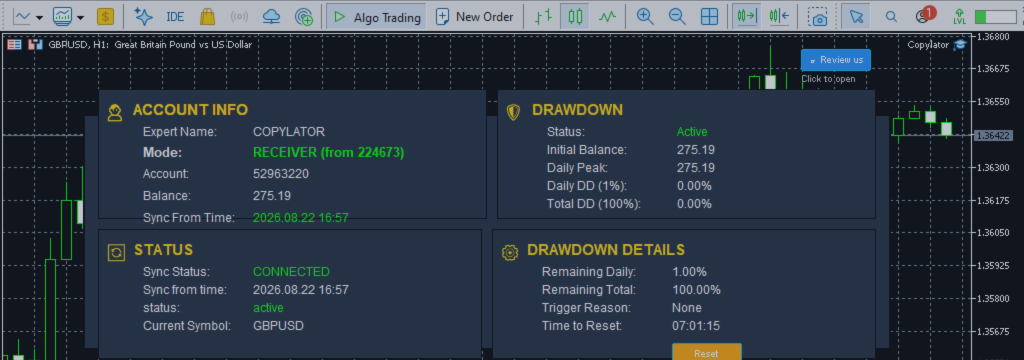

Product link:
https://www.mql5.com/en/ market/product/191385
Reverse mode works cleanly when the sender trades one position at a time. A Buy becomes a Sell, the geometry is mirrored, and the trade behaves as expected. The picture changes when the sender trades a basket of correlated positions simultaneously. Reversing each trade individually does not necessarily produce an exact mirror image of the basket. The resulting exposure can differ from what the trader expects.
This is a practical look at what happens when reverse mode meets correlation, and how to configure around the problem.
What a Correlated Basket Actually Is
A basket is simply multiple positions opened around the same time on instruments that may move together. A sender might open long EURUSD, long GBPUSD, and short USDCHF in a single signal. All three positions may express the same underlying view: dollar weakness.
The sender is not necessarily taking three independent risks. Instead, the positions may represent one broader market view expressed in three ways. Because the instruments can be correlated, their gains and losses may occur together under certain market conditions.
This distinction may be obvious to the sender. However, it can be less apparent to the receiver, because the copier sees three separate trades and processes each one individually.
What Reversing the Basket Produces
When reverse mode is enabled, each trade in the basket is flipped. Long EURUSD becomes short EURUSD. Long GBPUSD becomes short GBPUSD. Short USDCHF becomes long USDCHF.
At first glance, this looks like a reversal of the original view. If the sender was betting on dollar weakness, the receiver is now positioned for dollar strength. The direction of each position has been reversed.
However, reversing each trade individually does not guarantee that the resulting basket will have the same risk characteristics as the original. The instruments may continue to be correlated, but their relationships and price behavior can vary with market conditions. The resulting exposure and risk therefore need to be evaluated separately.
The Spread Cost Multiplies
Every position in the basket incurs trading costs, including spread. The sender pays the applicable spreads to open the original basket. The receiver also pays the applicable spreads when opening the reversed basket.
The receiver's spreads may differ from the sender's because of differences in brokers, account conditions, liquidity, and execution. Trading costs can also vary by instrument and market conditions.
When three positions are opened, the combined spread costs can be significant. These costs affect the basket's initial profitability and should be considered before assuming that reversing the trades will produce an equivalent result in the opposite direction.
Correlation Does Not Reverse Perfectly
Correlation is not necessarily constant. Two instruments that move closely together under one set of market conditions may behave differently when market direction, volatility, or other factors change. Their relationship is not guaranteed to be a perfect mirror in rising and falling markets.
When a basket is reversed, its individual trades remain exposed to the actual market relationships between the instruments. Those relationships may be weaker or stronger than expected, producing a different risk profile.
The practical consequence is that the reversed basket may not behave like a single coherent position. Its individual positions may move differently, potentially producing an aggregate exposure that does not match the trader's expectations.
The Net Exposure Trap
A correlated basket has an aggregate exposure that depends on its instruments, position sizes, and contract specifications. The sender may understand and manage this exposure. The receiver's reversed positions will point in the opposite direction at the individual-trade level, but the overall risk will not necessarily be identical in magnitude.
Consider the dollar-weakness basket: long EURUSD, long GBPUSD, and short USDCHF. If the sender uses equal position sizes, the trades may collectively express a substantial short-dollar view. However, the actual net exposure depends on the instruments' contract specifications, exchange rates, and position sizes.
Reversing the basket produces short EURUSD, short GBPUSD, and long USDCHF. The individual directions are opposite, but equal lot sizes do not automatically mean that the original and reversed baskets have perfectly matched exposure in absolute terms.
If the sender sized the positions unequally—for example, using a larger position in EURUSD and a smaller one in USDCHF—the reversal preserves those size differences. The reversed basket may therefore concentrate risk in a particular instrument.
This is not always obvious from examining individual trades. Evaluating the basket requires considering the combined exposure rather than simply counting Buy and Sell positions.
When the Basket Partially Fills
A further complication arises when the basket does not copy completely. The sender opens three positions, but the receiver copies only two because the third encounters a spread filter, a symbol-mapping issue, or a broker restriction.
The receiver now holds a partial basket. Its net exposure is no longer the direct reversal of the sender's complete basket. Instead, it is based on a subset of the original positions, with a potentially different risk profile.
This problem can also occur during normal copying, but it deserves particular attention when reverse mode is enabled. The missing position may have played an important role in balancing the original basket.
The practical check is to verify that all intended positions have been copied before assuming that the receiver's exposure represents the complete reversed basket. If any position is missing, reassess the aggregate exposure.
The Timing Problem
A correlated basket may be opened within seconds, but its positions do not always execute at the same time. If the sender opens three positions over ten seconds, the receiver may copy them over a similar interval, depending on execution and platform conditions.
During that interval, market prices can change. The first reversed position may open at one price, the second at another, and the third at a third price. As a result, the receiver's average entry prices and overall execution may differ from those of the sender.
This is a normal possibility in trade execution. It means that the reversed basket may have a different aggregate entry price and initial trading cost. Over multiple baskets, execution differences can affect the overall results.
Why Reversing a Basket Can Increase Risk
Reversing a correlated basket can produce a different level of risk from the original basket, and in some circumstances that risk may be greater.
The original basket may have been designed around a particular market view, with position sizes selected to account for the relationships between the instruments. Reversing the trades preserves the individual position sizes, but it does not automatically reproduce the original risk analysis in reverse.
If the instruments diverge or their correlations change, the reversed positions may experience losses in combinations the trader did not anticipate. The outcome depends on market conditions, position sizing, execution, and the actual relationships between the instruments.
Reversing the direction of each trade changes the direction of its price exposure, but it does not guarantee a simple, symmetrical reversal of the basket's overall profit and loss.
The Case for Disabling Reverse Mode on Baskets
If the sender frequently trades correlated baskets, disabling reverse mode may be the more straightforward approach.
If the trader wants to take the opposite view of the sender, an alternative is to construct the opposite basket deliberately. Instead of reversing three positions individually, the trader can open positions that express the opposite market view, with position sizes calibrated to the intended exposure.
This approach allows the trader to assess the resulting basket as a whole rather than assuming that an automatic reversal will preserve the original risk structure.
If Reverse Mode Must Be Used on Baskets
If reverse mode must be used on a basket—whether for automation or because the sender's trades are not always correlated—several precautions are worth considering.
- Verify that all positions are copied. A partial reversed basket can have a substantially different exposure from the intended basket.
- Use symbol mapping carefully. If an instrument maps to a different broker symbol with different contract specifications, recalculate the resulting exposure rather than assuming that the positions are equivalent.
- Review position sizes. Consider reducing lot sizes if the resulting basket's risk has not been fully evaluated. Smaller positions do not eliminate correlation or execution risks, but they can reduce the amount of capital exposed.
- Monitor net exposure directly. Do not assume that the receiver's aggregate exposure is an exact mirror of the sender's. Calculate and verify it.
- Test basket reversal on a demo account. Copy several representative baskets and observe how the reversed positions behave under different market conditions before relying on the configuration in live trading.
How to Identify a Correlated Basket
The sender does not always label a group of trades as a basket. The receiver may need to identify patterns in the trading history.
Look for clusters of positions opened within a short time window. Three or more positions opened within the same minute may indicate a basket, although timing alone does not prove that the positions are correlated.
Review how the instruments have historically moved in relation to one another, while remembering that correlation can change over time. Also examine the sender's history over several weeks. Repeated patterns involving the same instruments, directions, and timing may reveal a systematic basket strategy.
Once the pattern is identified, the trader can decide whether individual-trade reversal is appropriate or whether the basket requires a different approach.
The Alternative: Basket-Level Reversal
Some trade copiers or trading systems may support basket-level reversal rather than reversing every trade independently. In principle, this approach evaluates the basket's combined exposure before constructing the opposite position or recalculated basket.
Basket-level reversal can make it easier to target a defined opposite exposure, but its effectiveness depends on the implementation. It does not automatically eliminate execution differences, transaction costs, changing correlations, or the risks associated with missing positions.
If a copier supports basket-level reversal, review how it calculates exposure, sizes positions, and handles partial execution before relying on it for correlated groups.
A Practical Decision Framework
Before enabling reverse mode for a sender, review the sender's trading pattern.
- Single trades or uncorrelated instruments: Trade-level reversal may be straightforward, provided position sizing, execution, and broker conditions are suitable.
- Correlated baskets: Trade-level reversal requires additional risk analysis. Consider a basket-level approach if supported, or disable reverse mode and construct the opposite exposure deliberately.
- Mixed trading patterns: If the sender sometimes opens individual positions and sometimes trades baskets, assess whether the copier's reversal behavior is appropriate for both patterns. If it cannot distinguish between them, disabling reverse mode may be the more conservative choice.
Summary
Reverse mode is easiest to evaluate when applied to individual trades. When it is applied to correlated baskets, the resulting exposure and risk become more complex.
The reversed basket is not guaranteed to be an exact mirror of the original. It incurs its own transaction costs, remains subject to changing correlations, and may have a different exposure if one or more positions fail to copy.
If the sender trades baskets, identify the pattern before enabling reverse mode. Verify that all positions are copied, assess the combined exposure, and test the configuration on a demo account. Consider reducing position sizes when the resulting risk has not been fully evaluated.
Basket-level reversal may be an alternative when supported and properly implemented. Otherwise, disabling reverse mode and deliberately constructing the opposite exposure may provide a clearer basis for managing risk.
Reverse mode is easiest to understand when the trades are simple. Correlated baskets require a broader view of the positions, their relationships, and their combined exposure.
Product link:
https://www.mql5.com/en/ market/product/191385