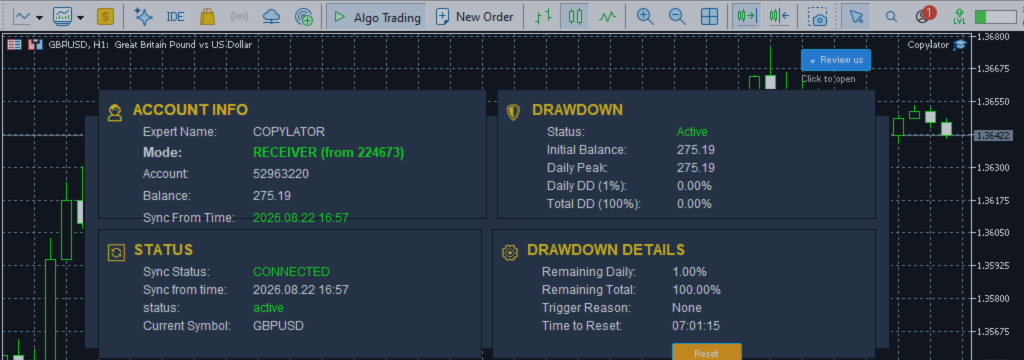
COPYLATOR – MT5 Trade Copier: Reverse Mode and Partial Closes — What Happens When the Sender Scales Out

Product link:
https://www.mql5.com/en/ market/product/191385
Reverse mode is usually evaluated on simple trades: one entry, one exit, one direction flip. The mechanics are straightforward, and the behavior can be predictable. But many trading strategies use more complex trade management. They scale in, scale out, take partial profits, and adjust stops as positions develop. When reverse mode is applied to a strategy that uses partial closes, the interaction requires additional attention.
The difficulty is not the direction flip itself. It is ensuring that a partial close on the sender is correctly reflected in the receiver's reversed position. Although both positions may reduce their volume by the same proportion, differences in position sizing, broker restrictions, and execution can affect the result.
This is a practical look at what happens when reverse mode meets partial closes, and what to verify before relying on it.
What a Partial Close Actually Does on the Sender
A partial close reduces the volume of an open position by a specified amount. For example, the sender might close half of a one-lot position, leaving half a lot open.
The remaining position continues to represent the original trade, although its volume has been reduced. Depending on the account type and platform behavior, position identifiers and ticket details may remain the same or behave differently.
From the sender's perspective, the strategy has reduced its exposure while maintaining the remaining position.
What the Receiver Must Do in Normal Mode
In normal copying, the receiver holds a position in the same direction as the sender. When the sender partially closes a position, the copier should apply the corresponding volume reduction to the receiver's position.
For example, if both accounts hold one lot and the sender closes 0.50 lots, the receiver should normally reduce its corresponding position by 0.50 lots, subject to the copier's volume rules and the broker's permitted volume increments.
The remaining positions should continue to correspond to one another. However, the exact result depends on the copier's implementation, account type, and execution conditions.
What Changes When Reverse Mode Is Enabled
With reverse mode enabled, the receiver holds a position in the opposite direction. When the sender partially closes its position, the copier must identify the corresponding reversed position and reduce its volume appropriately.
The direction of the position being reduced is different, but the intended volume relationship remains similar. If the sender reduces a one-lot position to 0.50 lots, the receiver should generally reduce its corresponding reversed position from one lot to 0.50 lots as well, assuming equal initial sizing and compatible volume rules.
The remaining receiver position should continue to represent the opposite direction of the sender's remaining position. Whether this happens correctly depends on the copier's partial-close handling and the broker's execution rules.
The Netting Account Complication
On a Netting account, multiple deals in the same instrument are combined into a single net position. This differs from a Hedging account, where multiple positions in the same instrument can be held separately.
Consequently, partial-close behavior and position identification can differ between account types. A copier must correctly recognize the relevant net position and calculate the appropriate volume reduction.
With reverse mode enabled, the receiver's net position is in the opposite direction of the sender's corresponding position. The copier must still apply the partial close correctly, even though the two positions have opposite directions.
The practical check is to test a partial close on a Netting receiver with reverse mode enabled. Confirm that the receiver's remaining volume matches the intended reversed counterpart of the sender's remaining volume, allowing for the copier's sizing rules and the broker's volume restrictions.
The Ticket Mapping Question
An important requirement for partial closes in reverse mode is correctly identifying the receiver's corresponding position when the partial-close event arrives.
If a copier relies on matching position direction alone, it may fail to identify the reversed counterpart because that position has the opposite direction. A robust implementation must account for reverse mode when locating the corresponding receiver position.
Depending on the copier's architecture and the account type, this may involve position identifiers, ticket mappings, internal trade references, or other tracking mechanisms.
The key principle is that the copier must identify the correct corresponding position independently of a simple same-direction assumption. Otherwise, a partial close may be skipped, applied incorrectly, or handled in an unintended way.
The SL and TP After a Partial Close
After a partial close, the remaining position should retain the intended stop-loss and take-profit settings, subject to the copier's synchronization behavior and broker rules.
On the receiver, reverse mode may require the SL and TP to be adjusted to reflect the opposite trade direction. After a partial close, those levels should still be valid for the remaining reversed position.
However, the levels are not guaranteed to remain unchanged in every implementation. Some systems may modify or resynchronize protective levels, and brokers can impose restrictions on minimum distances or valid price levels.
Another possible complication is minimum volume enforcement. If a partial close would leave a remaining position below the broker's minimum permitted volume, the requested operation may be rejected or may need to be adjusted. The receiver could then end up with a different remaining volume from the sender.
The Cascade of Partial Closes
Some strategies scale out in multiple stages: closing 25% at one target, another 25% at a second target, another 25% at a third, and allowing the final portion to run.
Each partial close must be processed correctly on the receiver. With reverse mode enabled, the copier must identify the corresponding reversed position and calculate the reduction using the intended volume relationship.
If a stage fails because of volume rounding, broker restrictions, a communication problem, or an execution error, the receiver's remaining volume may diverge from the sender's. That discrepancy can persist through the rest of the trade unless it is detected and corrected.
This is why partial closes and reverse mode should be tested together before live use. A single failed stage can leave the receiver with a position that no longer corresponds to the sender's intended remaining exposure.
What to Test on Demo
Before relying on reverse mode with a strategy that uses partial closes, verify the behavior on a demo account using the intended broker and account type.
- Open a position on the sender with a known volume.
- Enable reverse mode on the receiver and confirm that the opposite position opens with the expected volume.
- Partially close the sender's position by 25%. Confirm that the receiver's corresponding position is reduced by the intended proportion, subject to volume-step restrictions.
- Repeat with additional partial closes, such as 50% and 75%, using a clear test sequence. Check the remaining volume after every operation.
- Confirm that the receiver's SL and TP remain valid and correctly positioned for the reversed trade.
- Check that the copier continues to identify the correct receiver position throughout the sequence.
- If the strategy uses multiple scale-out stages, test the entire sequence rather than only one partial close.
- Repeat the test on the relevant account type, especially if the live setup uses a Netting account.
Common Failures and How to Recognize Them
Several issues can arise when partial closes are combined with reverse mode.
1. A partial close affects the wrong position.
This can happen if the copier fails to identify the correct corresponding position. The symptom is that an unintended receiver position is reduced while the intended reversed counterpart remains unchanged.
2. A partial close becomes a full close or is rejected.
This may occur when the requested reduction or remaining volume violates the broker's minimum-volume or volume-step requirements. The receiver may close more volume than intended, or the operation may fail.
3. A partial close is skipped.
This can happen if the copier cannot identify the corresponding receiver position or cannot execute the requested reduction. The receiver may remain at its original volume while the sender's position has been reduced.
4. Repeated partial closes cause volume divergence.
Even if the first reduction succeeds, rounding or execution differences can accumulate over several stages. Comparing the sender's and receiver's remaining volumes after each partial close helps identify such discrepancies early.
When to Avoid Reverse Mode with Partial Closes
There are situations in which combining reverse mode with partial closes requires particular caution.
- Frequent partial closes on small positions: Volume rounding can make exact correspondence difficult when the position is close to the broker's minimum volume.
- Strict Netting-account requirements: If the copier's partial-close handling has not been verified for the relevant Netting configuration, do not assume the behavior will match a Hedging account.
- Strategies that depend on exact remaining volume: If subsequent risk calculations or trade-management decisions depend on precise position sizes, differences in rounding or execution may cause the receiver's behavior to diverge.
- Unverified copier behavior: If partial closes have not been tested with reverse mode enabled, validate the complete process on demo before relying on it with live funds.
Summary
Reverse mode and partial closes can work together, but their interaction requires careful verification.
The copier must reduce the correct reversed position by the intended amount. It must correctly identify the corresponding trade, respect the broker's minimum volume and volume-step requirements, and handle the relevant account type properly.
Before relying on this combination, test it on a demo account using the same account type and a representative sequence of partial closes. Verify the remaining volume after every stage, confirm that SL and TP levels remain valid, and check that the copier continues to track the correct position.
The important principle is simple: do not assume that partial-close behavior is correct merely because reverse mode successfully opens the initial trade. Verify the complete trade-management sequence before relying on it.
Product link:
https://www.mql5.com/en/ market/product/191385


