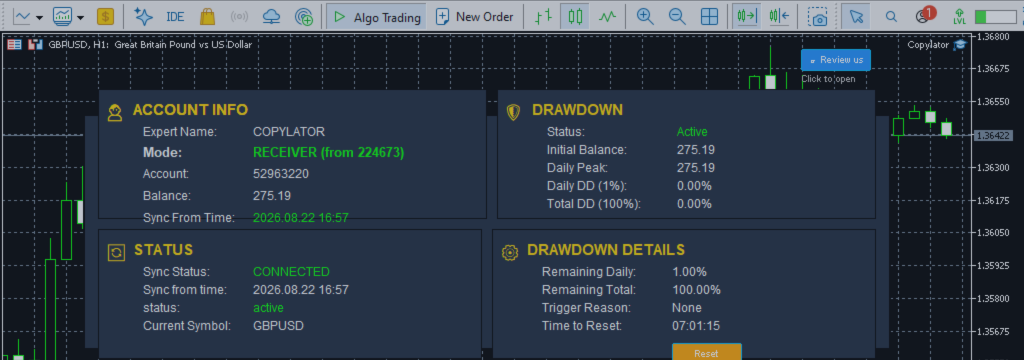
COPYLATOR – MT5 Trade Copier: A Practical Framework for Deciding When to Enable Reverse Mode

Product link:
https://www.mql5.com/en/ market/product/191385
Reverse mode is one of the most emotionally attractive features in a trade copier. When a strategy is losing, the idea of simply flipping every trade and turning those losses into gains is seductive. It promises a solution without requiring any change to the underlying strategy, the market, or the trader.
In practice, reverse mode may work well in some situations and fail in others. The difference is rarely obvious, and it cannot reliably be determined by intuition alone. It depends on measurable characteristics of the sender's strategy, trading costs, execution conditions, and the market environment in which it operates.
This is a practical framework for deciding when to enable reverse mode, based on observable evidence rather than hope.
The First Question: Is the Loss Directional or Structural?
The most important diagnostic question is whether the sender's losses come primarily from directional decisions or from structural weaknesses in the strategy.
Directional losses occur when a strategy repeatedly takes positions against subsequent price movements. It may buy during downtrends, sell during uptrends, or hold positions through adverse moves because of its entry logic. Under certain circumstances, reverse mode may benefit from such a directional bias.
Structural losses occur when a strategy loses because of execution costs, poor timing, wide spreads, inadequate stop placement, or market conditions that are unfavorable to its approach. Reversing the trades does not automatically eliminate these problems. The reversed strategy remains exposed to trading costs and execution limitations, and its results may be equally poor or worse.
A practical diagnostic method is to review a meaningful sample of the sender's trades. For each losing trade, examine the entry, exit, market movement, and trading costs. Consider whether the loss resulted primarily from directional exposure or from other factors.
If the evidence suggests a persistent directional weakness, reverse mode may be worth testing. If structural problems dominate, reversing the trades is unlikely to provide a reliable solution.
The Second Question: Is the Bias Persistent or Temporary?
Even when losses appear directional, the underlying bias may not persist. A strategy can struggle during a particular market regime, such as a strong trend, a central bank policy cycle, or a period of unusual volatility, and behave differently when conditions change.
Reverse mode is useful only if the observed directional weakness continues long enough for the reversal to benefit from it. If the weakness occurred during a temporary market phase and has since disappeared, continuing to reverse the strategy may produce a different outcome.
A practical method is to divide the sender's historical results into separate periods and examine the performance of the original trades and their hypothetical reversals in each period.
If the pattern remains consistent across multiple periods and different market conditions, it deserves further investigation. If it appears only during one period, it may reflect temporary conditions rather than a persistent characteristic of the strategy.
The Third Question: Is the Spread Cost Tolerable?
Reverse mode does not eliminate spread. The receiving account still incurs transaction costs when opening and closing positions. Actual costs may differ from those of the sender because of broker conditions, liquidity, execution, and the direction of the trade.
For a strategy targeting relatively large price movements, spread may represent a smaller proportion of the expected move. For a strategy targeting small profits, spread and commissions can consume a much larger proportion of potential gains.
A practical diagnostic method is to calculate the average round-trip trading cost per trade and compare it with the strategy's average gross profit per winning trade or typical profit target.
For example, if the average round-trip cost is 1.5 pips and the typical profit target is 10 pips, the cost represents 15% of that target. If the target is 50 pips, the same cost represents 3%.
These figures are illustrative, not universal thresholds for deciding whether reverse mode is suitable. The relevant ratios depend on the strategy's trade distribution, losing trades, commissions, slippage, and execution quality. The key is to determine whether trading costs leave enough room for the reversed strategy to produce a positive result.
The Fourth Question: Does the Strategy Depend on Swap or Financing?
Some strategies derive a meaningful portion of their returns from overnight financing rather than from directional price movements alone.
For example, a carry-trade strategy may hold positions in a currency pair to benefit from a favorable swap rate. Reversing the position changes its directional exposure and may also change the financing received or paid, depending on the instrument and broker.
A strategy that earns a substantial portion of its returns from positive swap may lose that benefit when reversed. In some cases, the reversed position may incur negative swap instead.
A practical diagnostic method is to separate the strategy's historical results into price-related profit and loss, swap, commissions, and other costs wherever the account records make that possible.
If financing contributes substantially to the strategy's profitability, its effect must be included in any reverse-mode evaluation. If returns are primarily driven by directional price movements, the financing issue may be less significant, but it should still be checked.
The Fifth Question: How Does the Strategy Behave in Both Directions?
One of the most useful ways to evaluate reverse mode is to compare the original strategy with a reversed version using the same underlying signals and a consistent testing period.
Where the copier's capabilities permit, the trader can run the original copying configuration on one demo account and the reversed configuration on another. Both accounts should follow the same sender over the same period, with comparable initial balances, position-sizing rules, and account conditions wherever possible.
After collecting a meaningful sample, compare the two accounts' results. Examine not only profitability, but also maximum drawdown, trade frequency, average trade outcome, transaction costs, and behavior under different market conditions.
This comparison can reveal whether the reversed configuration performs differently from the original. However, demo execution may not reproduce all live trading conditions, and the results of a limited sample cannot guarantee future performance.
The objective is to replace speculation with evidence and to understand the trade-offs before committing real capital.
The Framework in Practice
With the five questions answered, the decision becomes more structured.
If the losses appear directional, the bias persists across multiple periods, trading costs are manageable, financing does not undermine the reversal, and comparative testing produces encouraging results, reverse mode may be a candidate for further evaluation.
If one or more conditions fail—especially the directional analysis or the financing assessment—reverse mode may not help, regardless of how attractive it appears after a losing streak.
This framework does not guarantee success. It reduces the likelihood of making an impulsive decision by breaking the problem into smaller questions that can be investigated with data.
When to Disable Reverse Mode
The same framework can help determine when to disable reverse mode after it has been enabled. The conditions that originally justified the reversal can change.
If the sender adjusts the strategy, the market environment changes, or the previously observed directional weakness disappears, the original reason for reversing the trades may no longer apply.
The evaluation should therefore be repeated periodically using recent data, while retaining enough historical context to distinguish a genuine change from ordinary variation. A reversal that performed well six months ago is not guaranteed to perform well today.
Changes should be based on a predefined review process rather than on reacting to every short-term fluctuation in performance.
The Discipline of Data
A common mistake with reverse mode is enabling it after observing a short sequence of losses. A trader sees five losing trades in a row, switches on reverse mode, and then assumes the decision was correct when the next few trades are profitable.
A short sequence cannot establish whether a strategy has a persistent directional weakness. A small sample may be strongly influenced by random variation or a temporary market condition.
There is no universal number of trades that guarantees a reliable conclusion. The required sample depends on the strategy's trade frequency, variability, holding period, and market exposure. The trader should evaluate the quality and consistency of the evidence rather than relying on a fixed number of trades.
The discipline of reverse mode is the discipline of data. It requires patience, measurement, and a willingness to accept that the results may not support the original intuition.
The Role of Patience
A structured evaluation also encourages the trader to wait before acting. Someone who follows a defined method is less likely to enable reverse mode impulsively after a losing streak.
This remains valuable even when the eventual decision is to enable reverse mode. The decision is deliberate, documented, and based on evidence. If the outcome is disappointing, the trader can review the assumptions, costs, and market conditions that influenced the decision.
An impulsive change provides much less information about why the result occurred. A documented process makes it easier to learn from the outcome and refine future decisions.
Summary
Reverse mode is not a general solution for losing strategies. It is a configuration that may be worth testing when evidence suggests a persistent directional weakness and the strategy's costs, financing, and execution characteristics support the reversal.
Before enabling it, ask five questions:
- Are the losses primarily directional or structural?
- Is the observed directional bias persistent or temporary?
- Are spread, commissions, and other trading costs tolerable?
- Does the strategy depend significantly on swap or financing?
- How does the reversed configuration perform when tested against the original?
The framework replaces intuition with evidence, but it cannot guarantee that reversing a strategy will be profitable. Its purpose is to reduce the risk of reversing for the wrong reasons or mistaking a temporary recovery for proof that the decision was correct.
The right time to enable reverse mode is when the available evidence supports testing it—not simply when the trader wants it to work.
Product link:
https://www.mql5.com/en/ market/product/191385


