
A stop loss is one of the most important tools in forex risk management. It helps define how much you're willing to lose when a trade doesn't go as planned.
But there's a problem many traders overlook, a stop loss can be technically correct and still be too large for your account. The key isn't simply where you place your stop. It's how much capital you're putting at risk to reach your trading target.
1. A Wider Stop Means More Risk Per Lot
Imagine two traders entering the same currency pair. One uses a 20-pip stop loss, while the other uses a 60-pip stop. If both trade the same lot size, the second trader risks approximately three times as much, assuming the same pip value and ignoring costs.
A wider stop isn't automatically wrong. Some strategies require more room for price fluctuations. The problem arises when the position size doesn't account for that distance. Your lot size should reflect your stop-loss distance, not the other way around.
2. The Hidden Cost of Oversized Risk
Large stop losses can affect your account in several ways:
- Greater financial exposure: Each losing trade removes more capital.
- Slower recovery: Larger percentage losses require disproportionately larger gains to recover.
- Reduced flexibility: A series of losses can leave less capital available for future opportunities.
- Emotional pressure: Larger losses can encourage revenge trading or impulsive decisions.
- Account rule violations: For prop firm traders, excessive losses can breach daily drawdown or maximum loss limits.
Risk management isn't just about surviving one losing trade. It's about remaining in the game over a series of trades.
3. Calculate Your Position Size Before Entering
Instead of choosing a lot size first and accepting whatever risk follows, start with the amount you're prepared to lose. For example, consider a $10,000 account with a planned risk of 1%, or $100. If your stop loss is 20 pips and each pip is worth $10 per standard lot, your position size would be approximately 0.50 lots. With a 50-pip stop under the same assumptions, the position size would fall to approximately 0.20 lots. The risk remains around $100 in both cases, before commissions, slippage, and other trading costs.
This illustrates an important principle, a wider stop doesn't necessarily mean greater account risk if your position size is adjusted correctly.
4. Don't Tighten Your Stop Just to Reduce Risk
There's another mistake worth avoiding. Some traders place an unnecessarily tight stop simply to increase their lot size or reduce the apparent risk. If the stop is inside normal market fluctuations, the trade may close before the strategy has a reasonable chance to work.
Your stop loss should be based on your strategy, market structure, volatility, and trade invalidation point. Once that level is established, calculate the appropriate position size. If the resulting position is too small, or the required stop makes the trade unattractive, sometimes the best decision is to skip the trade.
5. Make Risk Management Part of Your Trading System
Whether you trade manually or use an Expert Advisor, your system should evaluate stop-loss distance alongside position sizing. Before placing a trade, consider:
- Is the stop at a logical level?
- Does the position size match the intended risk?
- Does the trade leave sufficient free margin?
- Could the position breach daily or overall drawdown limits?
- Have commissions, spread, and possible slippage been considered?
A well-designed trading system should help prevent position sizes that exceed predefined risk limits, even when market conditions or stop distances change.
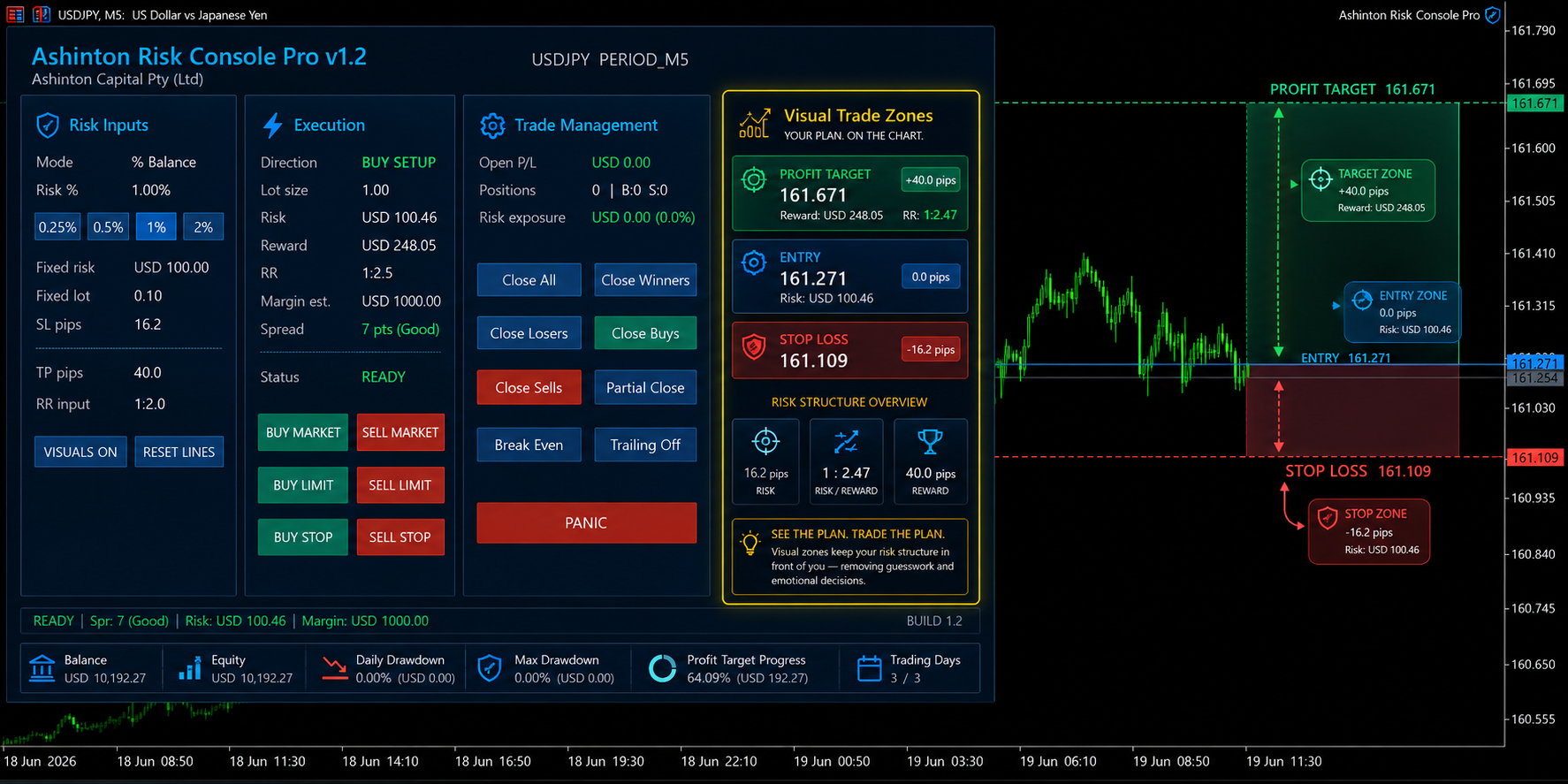
A large stop loss isn't necessarily a bad stop loss. An oversized position is often the real problem. The objective is to give a valid trade enough room to develop without exposing your account to more risk than you can afford.
Define your risk. Calculate your position size. Protect your capital. Because in trading, staying in the game matters just as much as finding the next opportunity.
https://www.mql5.com/en/market/product/176092