
Two hotter-than-expected inflation reports hit gold within 24 hours last week — September CPI on Wednesday, September PPI on Thursday. By Friday's close, spot gold was down only about 0.7% on the week, near $4,165. On Monday it is still parked between $4,150 and $4,200.
Read only the headlines and it looks like gold ignored the news. It didn't. It reacted hard, twice, in opposite directions. What it didn't do is leave the box it has been trading in for roughly three weeks. That box is the more useful thing to look at.
What actually happened
Wednesday, 14 October — CPI. Headline inflation rose 0.6% in September and 3.7% year on year, up from 3.4%. Gasoline alone jumped 9.1% in the month. All of that was expected. The surprise was core: +0.3% m/m against 0.2% expected, and 2.6% y/y against 2.5% — the first rise in the core rate since May. Short-dated yields jumped, futures briefly priced an October hike at above 40%, and gold fell to around $4,073 intraday, closing near $4,093, down roughly 1.5%.
Thursday, 15 October — PPI. On paper this was worse. Producer prices rose 1.3% in a month where about 0.5% was expected, taking the annual rate to 6.3%, the highest in more than four years. Retail sales printed a strong +0.8% headline, but the control group — the part that feeds GDP — managed only +0.1%; gasoline did most of the work. Gold went up, recovering more than $60 toward $4,170. Several Fed speakers had already been leaning against an October move, and the market took the hint.
Friday, 16 October — Warsh. Speaking at the IMF meetings in Bangkok, Fed Chair Kevin Warsh refused to say what he would do at the remaining 2026 meetings, called October and December the decision points, and said the economy had behaved broadly as the Fed expected since the September hike. The dollar index slipped about 0.7%. Gold climbed back toward $4,180. October hike odds settled around 16%, December around 89%.
Net result: two hot prints, one deliberate non-answer from the Fed chair, and gold finished the week a few dollars from where it started.
The headline is not the trade
The lesson here is not "inflation doesn't matter for gold". It is that gold doesn't trade the number — it trades the change in what the market expects the Fed to do.
CPI moved an October hike from "unlikely" to "possible". Gold fell. PPI was hotter still, but it did not push October any further, and the soft spending detail plus Fed commentary pulled it back. Gold rose on what was, by any reasonable reading, bad inflation news. Warsh then confirmed that December, not October, is the live date, and the dollar eased.
Same category of release on two consecutive days, opposite reactions. Anyone trading the first seconds after a release is trading the headline while the market is still working out the repricing. On Wednesday the first move turned out to be right. On Thursday it turned out to be wrong. There was no way to know which from the number alone.
Why ranges are expensive for breakout traders
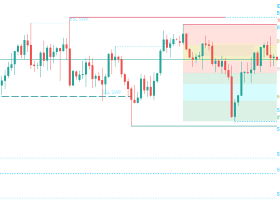
Here is the box. The floor sits around $4,070–4,100: the October low, tested again on CPI day at $4,073. The ceiling sits at $4,200–4,220: rejected on 13 October and stalled under again on several attempts between 16 and 19 October. Roughly $150 from edge to edge.
Inside a range, every test of an edge looks like the start of a breakout. On Wednesday, gold sliding through $4,100 looked like a breakdown. There was no follow-through and it was bought back within a day. The same happened in reverse each time price pushed into $4,200.
Three things separate a real break from a range doing what ranges do:
- A close beyond the level, not a touch. Intraday pokes through an edge are the range's normal behaviour, not a signal.
- A retest from the other side that holds. A broken ceiling has to act as a floor when price comes back to it. If it doesn't, the "breakout" was just a wider swing.
- A reason that changes the balance. This range exists because two sets of forces offset each other. On one side: elevated yields, a Fed that is still hiking, a dollar that is firm whenever hike odds rise. On the other: steady central bank buying and a Middle East risk premium that never fully leaves. A range ends when one side of that balance shifts — not when price happens to wander to an edge.
Time is the fourth filter. A genuine break moves away from the level. If price pierces an edge and is still sitting on it hours later, the odds favour it ending up back inside.
Levels for the week
- $4,200–4,220 — the ceiling. A daily close above it opens the way to $4,300–4,330, the zone gold lost in late September. That would be the first real retest of the breakdown from below.
- $4,140–4,150 — the first shelf inside the range; Thursday's rebound held here on the pullback.
- $4,070–4,100 — the October floor.
- $4,000 — the round number below, and the obvious target if the floor gives way.
The middle of the box, roughly $4,140–4,200, is where trading is least rewarding: a stop on either side sits close to normal noise, and the target is capped by the opposite edge.
What could break the box
The Fed is now in its quiet period ahead of the 27–28 October meeting, so no officials will be out steering expectations. Warsh has said, in effect, watch the data rather than him. With no guidance to lean on, individual releases carry more weight than usual, and reactions to them can be larger.
The meeting itself is the obvious catalyst. With an October hike priced at around one in six, a hold with language pointing firmly at December is the base case. A hike would be a genuine surprise. So would a statement that softens the December message. Either surprise is the kind of thing that changes the balance of forces rather than just testing an edge.
Oil remains the wild card. Energy is doing most of the work in headline inflation, and every Middle East headline cuts both ways for gold: higher crude means more pressure for hikes, which weighs on it, while the same headlines feed the safe-haven bid.
Looking ahead
No prediction and no target. The environment is a range waiting for a catalyst, and the calendar has one on 28 October. Until then, expect the edges to be tested and, more often than not, defended. After it, the market finds out whether December is a done deal — and the box either holds or gives way to something that moves.
You can follow AlphaEdge Smart with the full verified statistics on my profile. Questions about gold or the levels above? Ask in the comments — I answer everyone.
Past performance does not guarantee future results. Trading gold on margin involves substantial risk and is not suitable for every investor. Results when copying a signal may differ due to spreads, slippage and execution.