The same trades, two profit factors: why a pip is not a unit of money

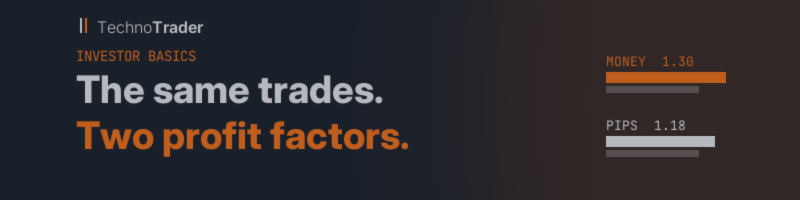
Open the statistics tab of any MQL5 signal and you will find gross profit and gross loss printed twice: once in the account's money, once in pips. Divide each pair and you get a profit factor. On our flagship account this morning the two are 1.30 and 1.18, from the same 4 684 closed trades. Nothing happened between the two numbers. Only the unit changed.
Where the two numbers come from
A profit factor is gross profit divided by gross loss. In money, the flagship's tab reads 10 631.03 EUR against 8 173.77 EUR, which is 1.30. In pips it reads 11 927 570 against 10 101 502, which is 1.18.

Why they disagree
A pip is a price step, not an amount of money. What one pip is worth depends on the instrument and on the size of the position. On this account a pip earned on Bitcoin was worth about a sixtieth of a pip earned on gold. Add the pips of five instruments together and you get a total that no account ever felt.
The distribution tab on the same page shows how far apart the two views are. In pips, Bitcoin earned 59 of every 100 of the account's gross profit. In money it earned 10. Gold goes the other way: 7 of every 100 pips, 69 of every 100 dollars. Counted in pips, this is mostly a Bitcoin account. Counted in money, it is mostly a gold account.
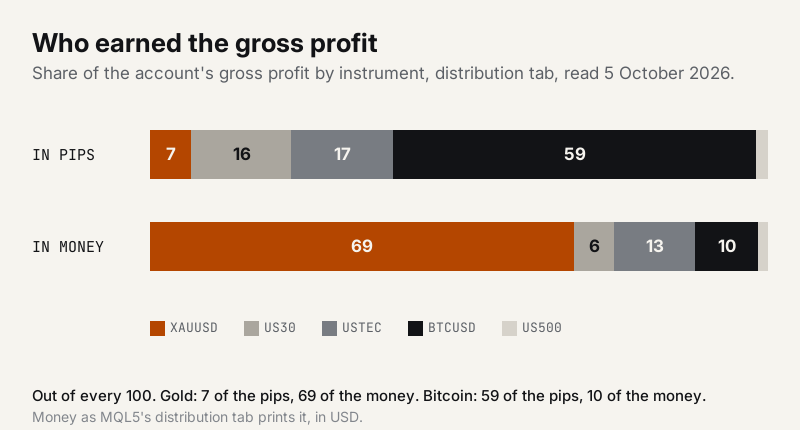
Inside one instrument the two views agree closely. On gold alone the profit factor is 1.44 in money and 1.47 in pips. The gap opens only when instruments with very different pip values are added together, and then the pip total leans towards whichever instrument has the most pips, not the most money.
Which one to read
The one in the account's currency. That is the number the balance actually moved by. The pip version means something for a single instrument traded at a steady size, and little else. On our account the money figure happens to be the higher one. On another account it can be the reverse, which is exactly why the unit has to be checked before the size of the number.
The check, on any signal page
1. On the statistics tab, divide gross profit by gross loss twice, once in money and once in pips.
2. If the two are close, the account trades one instrument, or instruments with similar pip values, and either number tells the same story.
3. If they are far apart, open the distribution tab and see which instrument carries the pips and which carries the money. Judge the account by the money.
4. If a result is shown to you only in pips, ask for it in money. Pips are the cheapest number in this industry to advertise, because they commit to nothing.
One caution
A profit factor, in either unit, says nothing about the order of the trades or the depth of the drawdown on the way. It is one ratio, not a verdict. And past results, ours included, do not predict future ones.
The figures in this post come from the public record of our flagship account on MQL5, where every closed trade is listed: Techno Long Term, signal 2307342.