Two Choke Points, One Market: Why the Next Oil Shock May Not Be What Gold Traders Expect

Something happened in Yemen this week that I think every Gold trader should understand.
Not because we suddenly need to become geopolitical experts.
And not because I'm going to predict another war-driven XAUUSD rally.
Actually, the opposite.
I think the obvious Gold trade may be the dangerous one.
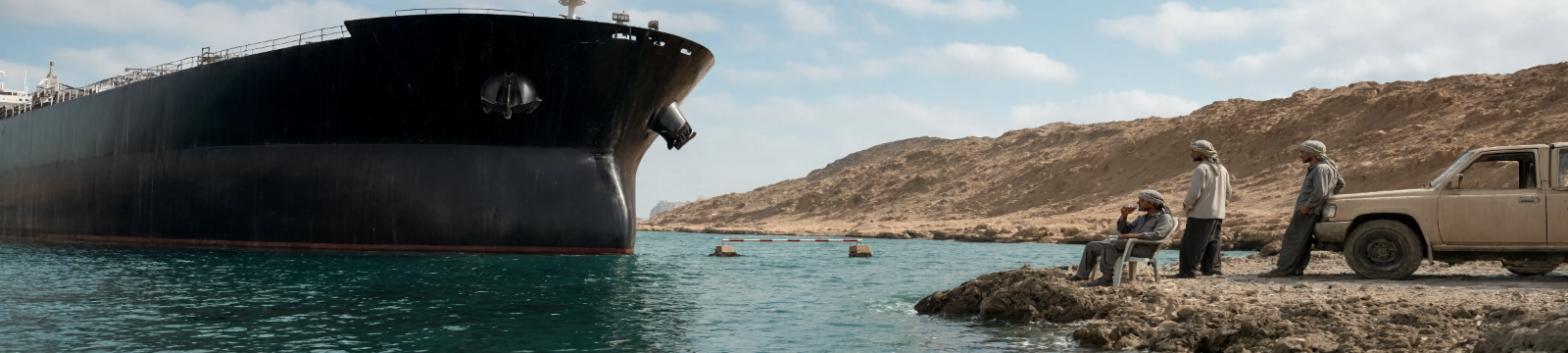
The Houthis have reached Perim, the small island sitting inside the Bab el-Mandeb Strait.
If you don't know where it is, look at a map.
That tiny piece of land suddenly matters.
A lot.
Because Bab el-Mandeb connects the Red Sea with the Gulf of Aden and the Indian Ocean. It is one of the arteries connecting Middle Eastern energy flows, the Suez route, Europe and Asia.
And this isn't happening in isolation.
Hormuz has already been severely disrupted.
Saudi Arabia's East-West oil pipeline — the alternative route that helped move millions of barrels per day away from Hormuz — has now been temporarily shut after a drone attack.
And now pressure is building around the southern exit from the Red Sea.
Three different pieces of infrastructure.
One uncomfortable question:
How does the oil get out?
This is where it becomes a Gold story
Brent moved above $100 this week.
My first instinct as someone who spends a lot of time around XAUUSD was simple:
oil up → inflation up → Gold up.
It sounds logical.
Unfortunately, markets don't owe us simple answers.
And the more I thought about it, the more interesting this became.
Because an oil shock can push Gold in two opposite directions.
Path #1: The obvious one
Shipping disruption
→ less available oil
→ higher energy prices
→ higher inflation
→ geopolitical fear
→ demand for protection
→ Gold higher
That's the trade everybody can see.
But there is another path.
Path #2: The uncomfortable one
Oil above $100
→ inflation becomes harder to kill
→ central banks stay hawkish
→ bond yields rise
→ holding non-yielding Gold becomes more expensive
→ USD strengthens
→ Gold comes under pressure
Same oil shock.
Completely different XAUUSD outcome.
That is what makes the current situation so interesting.
Oil doesn't simply “push Gold up”
This is something I think traders sometimes oversimplify.
Gold and oil are not married.
Sometimes they move together.
Sometimes they don't.
Oil affects Gold through several different channels: inflation, interest rates, the dollar, risk sentiment and expectations about what central banks will do next.
And those channels can fight each other.
Imagine Brent jumps another $15.
The first reaction might be:
BUY GOLD. WAR + INFLATION.
But if the bond market responds by aggressively pricing higher inflation and higher rates, Gold can initially fall.
That wouldn't mean the geopolitical thesis was wrong.
It would mean another force was stronger.
At least for that moment.
And this is exactly the kind of market that makes me nervous about beautifully optimized trading systems.
My EA doesn't understand Yemen
I've been thinking about this a lot while developing and testing my own XAUUSD systems.
An EA doesn't wake up in the morning, read the news and say:
"Hmm. Perim Island. Hormuz. Saudi pipeline. Perhaps today is unusual."
It sees numbers.
Price.
Spread.
Volatility.
Time.
Whatever inputs we've given it.
That's all.
And I think we developers sometimes forget this because after thousands of hours of testing, a system starts to feel smarter than it really is.
It isn't.
The intelligence is in the assumptions we put around it.
That thought has changed how I test my Gold systems.
I'm becoming less interested in:
“How much did it make?”
and more interested in:
“Does it know when the world has stopped behaving normally?”
Those are very different questions.
Imagine Bab el-Mandeb really does close
To be clear: that has not happened as I write this.
The Houthis have strengthened their position around the strait, but shipping has not been universally shut.
But as traders, we're allowed to ask what if?
So let's do it.
Imagine Hormuz remains disrupted.
The Saudi pipeline remains unavailable.
And Bab el-Mandeb becomes effectively unusable for another large part of tanker traffic.
Oil doesn't disappear.
It has to find another route.
Longer routes.
More expensive shipping.
Higher insurance.
More tanker capacity tied up for longer.
More uncertainty about delivery.
And suddenly the market isn't pricing only the physical barrel.
It is pricing the difficulty of moving that barrel from A to B.
That risk premium can spread much further than oil.
Into inflation expectations.
Bonds.
Currencies.
Equities.
And eventually Gold.
The part that worries me most isn't direction
It's speed.
This is probably the biggest lesson I've learned from trading automation.
Most strategies can deal with being wrong.
They have a stop.
What is much harder to deal with is a market that changes faster than the assumptions inside the strategy.
Spread expands.
Liquidity disappears.
Price jumps.
An entry that looked reasonable a second ago suddenly isn't.
Your EA can even predict the direction correctly and still lose the trade.
I've written about this before, and the current situation makes the problem very real.
When I test my own Gold automation now, I deliberately try to make life uncomfortable for it.
Worse spread.
Higher volatility.
Bad sequences.
Different market regimes.
Conditions I hope never happen.
I'm not trying to prove the system is invincible.
There is no such system.
I'm trying to discover where it becomes fragile before the market discovers it for me.
That distinction matters to me.
So what am I watching now?
Not just Gold.
I'm watching oil first.
Because right now oil may be telling us something about the next regime before XAUUSD does.
If Brent keeps rising while Treasury yields rise with it, I would be careful with the simplistic “war = Gold up” thesis.
If oil keeps rising but yields stop responding, while fear and safe-haven demand accelerate, that is a very different environment for Gold.
And if oil suddenly falls because the shipping situation de-escalates?
That matters too.
The point isn't to predict one outcome.
It's to understand the chain:
Bab el-Mandeb → Oil → Inflation → Rates → USD → Gold
Break one link and the final result can change.
One thing I've learned the hard way
The market usually doesn't punish us for not knowing the future.
It punishes us for being too certain that we do.
I don't know whether Gold goes higher next week.
I don't know whether the Houthis will attempt to restrict the strait further.
I don't know whether oil is heading to $120 or back below $90.
Anyone telling you they know probably has more confidence than information.
What I can do is prepare my trading systems for more than one answer.
And maybe that's the real edge.
Not predicting the next geopolitical headline.
Not predicting the next Gold candle.
But building a system that doesn't require the world to behave exactly as expected.
That's what I'm trying to build.
And if I'm wrong about something, I'd rather discover it in testing than with real money.
I'm curious how other algo traders are handling this.
Do you let your EA trade normally during geopolitical shocks — or do you reduce risk / stop trading when volatility moves outside its normal regime?
And an even harder question:
If oil goes to $120, what breaks first in your Gold strategy?
I'd genuinely like to hear the answers.
Because right now I think that question is more useful than another XAUUSD prediction.