Why Twenty Four Seven Markets Are Changing Investing Forever

Why Twenty Four Seven Markets Are Changing Investing Forever
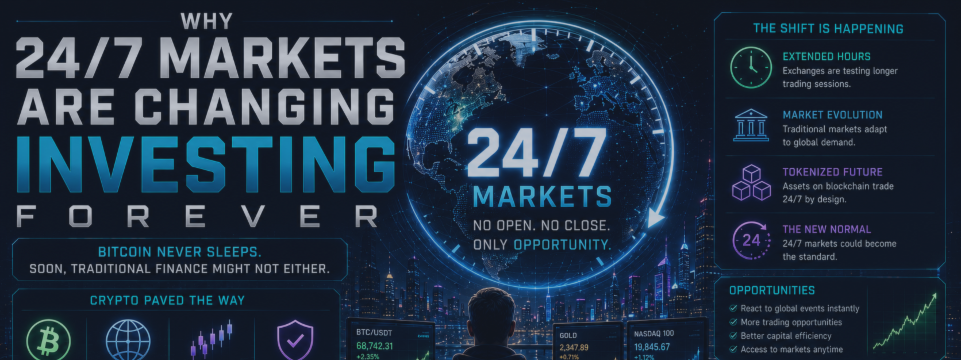
Bitcoin never sleeps. Soon, traditional finance might not either. The fact that markets are extending toward continuous, always on trading has already been documented in depth elsewhere. What deserves deeper, dedicated treatment is why crypto specifically became the pioneer of this structure in the first place, and, more practically, exactly what continuous trading changes about the genuine opportunities and genuine risks a trader actually faces once the closing bell stops meaning anything.
Part One: Why Crypto Specifically Became the Pioneer of Continuous Trading
This was never a deliberate feature bolted onto crypto for marketing appeal, it is a structural consequence of how the technology and its community were built from the ground up, and understanding that origin explains why the shift feels so natural for crypto and so genuinely difficult to retrofit onto legacy systems.
Crypto's decentralized, globally distributed infrastructure never required a central authority to declare specific market hours the way a traditional exchange historically did, there was no single trading floor whose local business hours needed defending as the default. Blockchain settlement is native and near instant by design, meaning crypto never inherited the multi day batch settlement cycle logic that historically justified defined trading sessions and overnight processing windows across traditional finance. And crypto emerged without centuries of institutional and cultural inertia built around a physical trading floor's natural human working hours, it was built from day one by a genuinely global community with no single home time zone to privilege over any other. Continuous trading was not something crypto added. It was something crypto never had a structural reason to restrict in the first place.
Part Two: Traditional Markets Are Following, Briefly Revisited
The specific regulatory and infrastructure developments pushing traditional exchanges toward longer, and in some cases genuinely continuous, trading hours have been covered in real detail elsewhere in this series, major exchanges extending sessions and building dedicated tokenized venues targeting around the clock operation, alongside real, currently unresolved friction points where markets that remain closed on traditional hours, such as certain hedging and government bond markets, create genuine structural gaps against assets now trading continuously. That ground will not be repeated here. What matters for this article is simply that the direction is real and already in motion.
Part Three: The Genuine Opportunities Continuous Markets Create
- Immediate reaction capability. Genuine news and events can be acted on the moment they occur rather than waiting through a closed session, valuable both for capturing opportunity and, arguably more importantly, for exiting a position immediately on adverse news rather than being structurally trapped until a market reopens.
- A different, and in one specific sense less severe, gap risk character. Traditional session bound markets can gap dramatically at the open once overnight news has accumulated into one concentrated shock. A continuously trading market processes that same information incrementally as it actually arrives, rather than compressing it into a single, sudden repricing event, a genuinely nuanced point worth understanding rather than assuming continuous trading simply means more risk in every dimension.
- Continuous liquidity access in principle. A trader is never structurally locked out of managing a position during closed hours, since no closed hours genuinely exist.
Part Four: The Genuine Risks Continuous Markets Create
- Behavioral fatigue risk. This is the most underdiscussed risk of continuous markets, and arguably the most important one for an individual trader specifically. Session bound markets impose a natural, forced break, the close. A market that never stops removes that structural boundary entirely, creating genuine risk of fatigue driven decisions, overtrading fueled by the simple fact that there is always another candle to react to, and a gradual erosion of any healthy boundary between trading and rest.
- Uneven liquidity within a nominally continuous market. A market being technically open at every hour does not mean every hour carries equal liquidity depth. Genuine thin, lower liquidity windows still exist even within crypto's continuous structure, meaning the market being open is not the same claim as the market being equally tradeable at every moment.
- Session based technical concepts become somewhat arbitrary conventions. Many traditional technical ideas, a defined daily open, a defined session range, were built around markets with natural, structurally real session boundaries. Applying them to a continuously trading market still works practically, but it is worth understanding that a defined daily candle in a market with no natural close is an arbitrary chosen convention rather than a genuine structural feature the market itself imposes.
Part Five: Why This Reinforces the Case for Disciplined Automation
The behavioral fatigue risk covered above is precisely where automated, disciplined execution provides its most genuine value in a continuous market, not merely as a speed advantage, but because it specifically removes the fatigue driven and boundary erosion risks a human trader structurally cannot avoid across a genuinely never ending trading cycle. ICONIC BTC AI+ was built natively for exactly this always on paradigm from the outset, with hard, code level risk enforcement, a stop loss on every position and a categorical rejection of grid and martingale, that does not degrade with fatigue the way human discipline naturally erodes across hour after hour of a market that simply never closes. As traditional markets extend further toward this same continuous structure, the identical behavioral risks, and the identical automated response to them, are likely to become increasingly relevant well beyond crypto alone.
Frequently Asked Questions
Why did crypto become the pioneer of twenty four hour trading? Crypto's decentralized infrastructure never required a central authority to declare trading hours, its native blockchain settlement never inherited the batch settlement logic that historically justified defined sessions, and it emerged as a globally distributed community with no single home time zone, making continuous trading a structural consequence rather than a deliberate feature.
Does continuous trading reduce or increase gap risk? In one specific sense it reduces a particular type of risk, since information is processed incrementally as it arrives rather than compressing overnight into one sudden, concentrated repricing shock at a traditional market open.
What is the most underdiscussed risk of markets that never close? Behavioral fatigue risk. The removal of any natural, forced trading break creates genuine risk of exhaustion driven decisions, overtrading, and erosion of healthy boundaries between trading and rest, a risk most discussions of continuous markets overlook entirely.
Is a twenty four hour market equally liquid at every hour? No. Genuine thin, lower liquidity windows exist even within nominally continuous markets, meaning a market being technically open does not guarantee equally favorable trading conditions at every moment.
The Closing Bell Was Also a Safety Mechanism
Continuous markets genuinely expand opportunity, immediate reaction capability, incremental rather than compressed information processing, and access at every hour. They also remove a structural safety mechanism most traders never consciously appreciated, the forced pause a closing bell once imposed. Understanding both sides honestly, rather than treating continuous trading as an unambiguous upgrade, is what separates informed positioning from simply following where the market structure happens to be heading.
Explore systems built natively for exactly this continuous market reality, including ICONIC BTC AI+, at iconicfx.tech.
Risk Disclaimer. Trading foreign exchange, cryptocurrencies, commodities and other leveraged financial instruments carries a high level of risk and may not be suitable for all investors. The high degree of leverage can work against you as well as for you. Past performance is not indicative of future results. Automated trading systems, indicators and Expert Advisors do not guarantee profits and can produce losses. ICONIC.FX provides software tools only and does not provide investment advice, portfolio management or financial recommendations. You are solely responsible for your own trading decisions. Seek advice from an independent licensed financial advisor if you have any doubts.