The Mathematics of Not Losing: Why Risk Management Is the Only Edge That Compounds Over Time

Most traders spend the majority of their development time on entries. Which indicator combination gives the best signals. Which timeframe has the cleanest structure. Which confluence factors produce the highest win rate. Entry strategy gets all the attention because it feels like the core of trading — the moment of decision, the expression of skill.
It is not. Entry strategy determines where you get in. Risk management determines whether you survive long enough for your edge to play out. A system with a 40% win rate and disciplined risk management will outperform a system with a 70% win rate and undisciplined risk management over any meaningful sample size. This is not opinion. It is arithmetic.
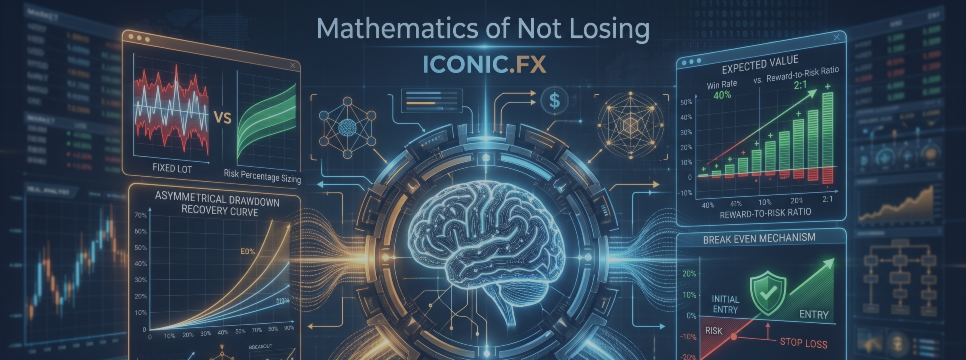
This article covers the mathematics that determine account survival and long term profitability — drawdown mathematics, position sizing mechanics, expected value calculation, and how these principles are implemented structurally in the ICONIC.FX Expert Advisor lineup. Understanding this mathematics will permanently change how you evaluate any trading system, automated or manual.
THE ASYMMETRY OF DRAWDOWN: WHY LOSSES ARE NOT SYMMETRICAL
The most important mathematical fact in trading is one that most traders never internalize properly: percentage losses and percentage gains are not symmetrical. Recovering a loss requires a larger percentage gain than the loss itself — and this asymmetry grows rapidly as the drawdown increases.
A 10% loss requires an 11.1% gain on the remaining capital to return to breakeven. A 20% loss requires a 25% gain. A 30% loss requires a 42.9% gain. A 50% loss requires a 100% gain. A 70% loss requires a 233% gain. These are not estimates. They are exact values derived from the simple mathematics of percentage calculation on a reduced base.
The practical implication is severe: a trader who experiences a 50% drawdown must double their remaining account just to get back to where they started. They have generated zero profit while taking on significant risk and spending significant time. The larger the drawdown, the more this dynamic destroys long term performance — not just by the loss itself, but by the compounding time cost of recovery.
This is why drawdown limitation is the foundational constraint of any serious trading system. Not maximizing returns. Limiting drawdown. The returns follow if the drawdown is controlled. They do not follow if it is not.
Every product in the ICONIC.FX lineup is built around this principle as its primary architectural constraint. ICONIC KYBERNETIC AI enforces this through the Physics Informed Margin Axiom — a hard 35% free margin floor that blocks any position which would breach that boundary at order level, before execution. This is not a soft guideline. No upstream logic can override it. The mathematical constraint is enforced unconditionally.
POSITION SIZING: THE VARIABLE THAT DETERMINES YOUR FATE
Fixed Lot: The Most Common Mistake
The default position sizing approach for most beginning automated traders is fixed lot: every trade opens with the same position size, regardless of account equity, regardless of stop loss distance, regardless of current volatility. This approach is mathematically incoherent.
When the stop loss is wide — because volatility is high — a fixed lot position risks a larger absolute amount per unit of stop distance than when the stop is narrow. The risk per trade varies with every entry even though the position size is constant. In a high volatility environment, fixed lot sizing produces risk per trade that can be two or three times higher than in a low volatility environment. The trader has no consistent exposure to the market — their actual risk fluctuates invisibly with market conditions.
Risk Percentage Sizing: The Correct Foundation
The correct foundation for position sizing is risk percentage: define the maximum acceptable loss per trade as a percentage of current account equity, then calculate the position size backward from the stop loss distance to achieve exactly that risk amount.
If the acceptable risk per trade is 2% of a 1,000 USD account, the maximum loss per trade is 20 USD. If the stop loss is 50 points and each point is worth 0.40 USD at a given position size, then the maximum position size is 1 lot. If the stop loss widens to 100 points in a higher volatility regime, the position size halves to 0.5 lots — maintaining the same 20 USD maximum risk. The exposure to the market remains consistent even as the stop distance and position size change.
This is the foundation that ICONIC BTC AI+, ICONIC NEUROCORE AI+, and ICONIC KYBERNETIC AI all build on. The risk percentage parameter defines the ceiling of what any single trade can cost the account — regardless of what the market does after entry.
ATR Based Dynamic Stops: Why Fixed Stop Distances Fail
A fixed stop loss distance — 500 points, 1,000 points, always the same — ignores the reality that market volatility is not constant. When volatility is high, price moves that distance in a single candle as normal market noise. When volatility is low, that distance may represent an exceptional multi session move. A fixed stop gets triggered by noise in high volatility regimes and fails to protect against serious moves in low volatility regimes.
ATR based stop placement solves this by anchoring the stop distance to a multiple of the Average True Range at the moment of entry. When volatility is elevated, the stop widens to accommodate normal price movement without premature exit. When volatility is compressed, the stop tightens to reflect the smaller range of typical moves. The stop breathes with the market rather than imposing a rigid distance that is appropriate in one regime and wrong in all others.
ICONIC BTC AI+ applies ATR based dynamic stop placement on every trade, calibrated specifically to Bitcoin's volatility characteristics. ICONIC NEUROCORE AI+ applies separate ATR based parameters to the BTC engine and the Gold engine, acknowledging that Bitcoin's volatility profile and Gold's volatility profile require different calibration. ICONIC KYBERNETIC AI does the same — isolated stop parameters per symbol, calibrated to each asset's specific volatility behavior.
EXPECTED VALUE: THE MATHEMATICS OF A GENUINE EDGE
Win rate alone tells you almost nothing about whether a trading system is profitable. A system with a 30% win rate can be highly profitable. A system with an 80% win rate can be a slow account destroyer. The variable that determines profitability is expected value — the average outcome per trade weighted by the probability of each outcome.
Expected value is calculated as follows: multiply the win rate by the average gain per winning trade, then subtract the loss rate multiplied by the average loss per losing trade.
A system with a 40% win rate and a 1.5 to 1 reward to risk ratio has an expected value of: (0.40 × 1.5) minus (0.60 × 1.0) = 0.60 minus 0.60 = 0.00. This system breaks even before costs. Add spread and commission and it loses money slowly.
A system with a 40% win rate and a 2.0 to 1 reward to risk ratio has an expected value of: (0.40 × 2.0) minus (0.60 × 1.0) = 0.80 minus 0.60 = 0.20. This system generates 0.20 units of expected profit per unit risked. Over 100 trades risking 1% each, that is 20% expected return before compounding.
The implication for system evaluation is direct: a system with a modest win rate and a strong reward to risk ratio outperforms a high win rate system with a poor reward to risk ratio over any sufficient sample size. Chasing win rate at the expense of reward to risk is a structural mistake that produces equity curves that look smooth and then collapse.
All products in the ICONIC.FX lineup are calibrated around positive expected value as the primary performance metric — not win rate. ICONIC BTC AI+ uses a configurable TP to SL ratio that targets reward to risk above 1.4 to 1 as its baseline, with the AI engine expanding the take profit target during high conviction setups identified by the MAP Elites archive. The reinforcement learning engines inside ICONIC NEUROCORE AI+ and ICONIC KYBERNETIC AI discover the expected value of each action across all states through live market interaction — the Q function is literally an estimate of expected cumulative reward.
THE BREAK EVEN MECHANISM: TURNING RISK INTO OPPORTUNITY
Once a trade has moved sufficiently in favor, the character of the position changes. The original stop loss distance represented the maximum acceptable loss on the trade. At some point during a profitable move, that original risk is no longer justified — the trade has demonstrated directional conviction and the initial risk can be eliminated.
The break even mechanism captures this by moving the stop loss to the entry price once the trade has achieved a defined level of profit. The position now has zero downside — it can only close at break even or better. The original risk has been converted into a free position. If the move continues, the full profit target is captured. If the market reverses and hits the stop, the account is unaffected.
This mechanism is not just psychologically satisfying. It changes the expected value calculation of the trade. A position that has reached break even now has a truncated loss distribution — the worst case outcome is no loss rather than maximum loss — while retaining the full upside of the original profit target. This asymmetry improves the trade's expected value after the break even trigger is reached.
ICONIC BTC AI+, ICONIC NEUROCORE AI+, and ICONIC KYBERNETIC AI all implement automatic break even logic as a structural feature. The trigger point is defined as a fraction of the distance to the full profit target — once the trade reaches this fraction of the move, the stop automatically advances to entry. No manual intervention required. No human decision under pressure. The mechanism executes automatically, every time, on every trade across every product.
CONSECUTIVE LOSSES AND THE PSYCHOLOGY OF RUIN
Even a system with strong positive expected value will experience losing streaks. This is not a failure of the system. It is a mathematical certainty. A sequence of independent trades with a 40% win rate will produce consecutive loss sequences of four, five, or six trades with meaningful probability over a large enough sample. These sequences are not signals that the system is broken. They are the normal expression of variance in a probabilistic system.
The danger is behavioral. A human watching an automated system experience five consecutive losses will frequently intervene — disabling the EA, changing parameters, or abandoning the system at exactly the moment when regression to the mean suggests the next sequence of trades is likely to be profitable. This intervention destroys the edge that the system carries. The human overrides the algorithm at the worst possible moment.
The correct mathematical response to a losing streak within defined parameters is to do nothing. Continue operating within the defined risk framework. Allow the edge to express itself over a sufficient sample. The only exception is when the drawdown exceeds the predefined maximum drawdown threshold — at which point a systematic review of the system is warranted, not emotional intervention mid streak.
ICONIC KYBERNETIC AI responds to losing streaks systematically rather than arbitrarily. The Stochastic Tunneling Nash allocation engine continuously rebalances capital between the BTC and Gold engines — when one engine underperforms, capital shifts toward the outperforming engine automatically, reducing exposure to the struggling engine without disabling it entirely. ICONIC BTC AI+ responds by reducing its Boltzmann exploration temperature during drawdown — the AI becomes more selective, requiring higher confidence before entering, reducing trade frequency without abandoning the strategy. ICONIC NEUROCORE AI+ applies similar dynamic through the Covariance Risk Parity engine, which reduces allocation to underperforming engines in response to deteriorating relative performance metrics.
The system manages losing streaks mathematically. The human does not need to.
THE COMPOUNDING IMPERATIVE
Consistent risk adjusted returns compound. This is the final mathematical principle that separates automated AI trading from discretionary trading as a long term wealth building approach.
A system that returns 3% per month on a 1,000 USD account produces 36% annually on a simple return basis. On a compound return basis — reinvesting profits, increasing position sizes as the account grows, maintaining the same risk percentage throughout — the same 3% monthly return produces 42.6% annually. Compounded over five years, the account reaches approximately 5,743 USD from an initial 1,000 USD. Compounded over ten years, it reaches 32,983 USD. Not from trading genius. From mathematical compounding of a consistent, disciplined edge.
The prerequisite for this compounding is survival. An account that experiences a 70% drawdown somewhere in that ten year window requires 233% recovery just to reach the starting point. The compounding advantage is destroyed. This is why drawdown limitation, enforced risk per trade, ATR based stop placement, and break even mechanics are not optional enhancements. They are the foundation on which compounding is possible at all.
ICONIC BTC AI+, ICONIC NEUROCORE AI+, and ICONIC KYBERNETIC AI are all built with this compounding horizon in mind. The risk architecture is not designed for maximum short term returns. It is designed for maximum long term survival — the necessary condition for compounding to produce its most powerful effects over time.
THE RISK ARCHITECTURE SUMMARY
Every product in the ICONIC.FX lineup implements the same foundational risk architecture derived directly from the mathematics described above:
- No grid, no martingale, no position stacking. One position per symbol at all times. No accumulation of losing positions that converts a manageable drawdown into account destruction.
- Hard stop loss before every execution. Defined before entry, never moved against the position. The maximum loss per trade is always known before the trade opens.
- ATR based dynamic stop placement. Stop distance calibrated to actual volatility at entry — wide in high volatility regimes, tight in low volatility regimes. Consistent risk exposure regardless of market conditions.
- Risk percentage position sizing. Position size calculated from stop loss distance to maintain consistent account risk per trade as equity grows or contracts.
- Automatic break even logic. Converts the original risk into a free position once a defined profit threshold is reached, improving expected value asymmetrically.
- Dynamic response to drawdown. Reduced exploration, rebalanced allocation, and tighter entry filters during underperforming periods — systematic responses, not arbitrary human decisions.
EXPLORE THE FULL LINEUP
The complete ICONIC.FX product lineup — ICONIC BTC AI+, ICONIC NEUROCORE AI+, and ICONIC KYBERNETIC AI — is available on the ICONIC.FX developer profile on MQL5.
For live trading updates and daily market content: instagram.com/iconicfxofficial
Community and announcements: t.me/iconicfxofficial