Surviving the Drawdown: Why Staying the Course Is the Hardest and Most Important Decision in Automated Trading

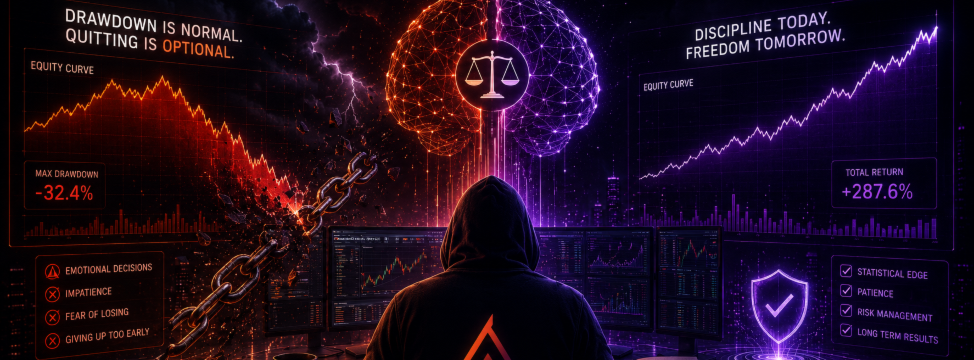
There is one mistake that destroys more automated trading accounts than any other. It is not a bad entry. It is not a missed exit. It is not a broker problem or an EA configuration error or a spread spike during a news event. It is a decision made by the trader — specifically, the decision to disable a functioning automated system during a normal drawdown period, at the precise moment when the statistical probability of recovery is highest.
This happens constantly. A trader purchases an Expert Advisor, deploys it on a live account, watches it perform acceptably for some weeks — and then encounters a sequence of losing trades. The equity curve dips below its recent high. The losses feel real in a way that backtested drawdowns never did. The trader disables the EA, waits for the market to "settle," and watches from the sidelines as the system's edge plays out in full without them. The recovery occurs. The trader re enables the EA — just in time for the next normal drawdown, which they also cannot tolerate.
The system was not broken. The trader's response to a normal statistical event was broken. Understanding why requires both the mathematics of drawdown and the psychology of loss — and why the two combine to produce exactly the wrong behavioral response at exactly the wrong moment.
WHAT A DRAWDOWN ACTUALLY IS — AND WHAT IT IS NOT
A drawdown is the peak to trough decline in account equity from a previous high to a subsequent low. It is measured as a percentage: a 10% drawdown means the account has fallen to 90% of its most recent equity peak.
What a drawdown is not: evidence that a system is failing. Any trading system with positive expected value will produce drawdowns. This is not a design flaw. It is a mathematical certainty arising from the probabilistic nature of any system that does not win every trade. The question is never whether a system will drawdown. The question is how deep the drawdown goes and how long it takes to recover — and whether those values are within the range that the system's expected value profile predicts.
The distinction between a normal drawdown and a system failure is one of the most important assessments an automated trader must be able to make — and it is also one of the most psychologically difficult, because the emotional experience of a normal drawdown and a system failure feel identical in real time.
THE MATHEMATICS OF INEVITABLE LOSING STREAKS
Consider a trading system with a 50% win rate — one that wins exactly half its trades. This is a coin flip for win rate, but assume the system has a 1.5 to 1 reward to risk ratio, giving it positive expected value. How many consecutive losses should this system produce, and how often?
The probability of any individual trade being a loss is 50%. The probability of two consecutive losses is 25%. Three in a row: 12.5%. Four in a row: 6.25%. Five consecutive losses: 3.125%. Six in a row: approximately 1.6%.
Over a sample of 100 trades, sequences of five or six consecutive losses are not rare events. They are expected. A sequence of four losses in a row has a 6.25% probability per occurrence — meaning in 100 trades, you will see four loss streaks several times on average. Each time feels significant. Each time, the temptation to intervene is real. Each time, the system is functioning exactly as probability predicts it should.
Now consider a system with a 40% win rate — common in trend following approaches — and a 2.5 to 1 reward to risk ratio that gives it strong positive expected value. With a 60% loss rate, sequences of five consecutive losses become quite common over large sample sizes. Six in a row: approximately 4.7% probability per occurrence. In 200 trades, this sequence will appear multiple times. The trader who interprets any of these sequences as system failure and disables the EA will never allow the positive expected value to express itself over a sufficient sample.
THE PSYCHOLOGY THAT MAKES DRAWDOWNS FEEL CATASTROPHIC
The mathematics establish that losing streaks are expected. The psychology explains why they feel catastrophic anyway — and why that feeling triggers behavioral responses that are precisely wrong for the situation.
Loss aversion is the most documented finding in behavioral finance: losses are felt approximately twice as intensely as equivalent gains. A 10% drawdown on a 10,000 USD account produces a psychological impact roughly equivalent to the pleasure of a 20% gain on the same account. The emotional asymmetry is hardwired, not rational, and does not diminish with trading experience in the way traders expect it to.
The second mechanism is recency bias: the tendency to weight recent events more heavily than the statistical baseline. During a losing streak, the recent events are losses. The trader begins to believe that the recent loss rate — which may be 80% over a sequence of five trades — is representative of the system's actual win rate. It is not. It is a short sequence within a much larger statistical sample, and short sequences have enormous variance even when drawn from a positive expected value distribution.
The third mechanism is the illusion of control. Manual trading offers the sense that the trader can intervene at any moment and change the outcome. Automated trading removes this sense of control — and during a drawdown, the absence of control feels unbearable. Disabling the EA restores the feeling of agency. The fact that the agency is counterproductive does not reduce its psychological appeal.
These three mechanisms combine to produce a consistent behavioral pattern: the trader disables the EA at the point of maximum emotional discomfort — which is also typically the point of maximum statistical probability of recovery.
HOW TO DISTINGUISH A NORMAL DRAWDOWN FROM A SYSTEM FAILURE
If the answer to "is this a normal drawdown or a system failure?" were always the same — if drawdowns were always just temporary — the solution would be simple: never intervene. But some drawdowns do represent genuine system failures. Markets change. Regime shifts can move a market permanently away from the conditions a system was designed for. An adaptive system mitigates this risk, but does not eliminate it entirely.
The framework for distinguishing normal drawdown from system failure has three components:
Depth relative to historical maximum drawdown. Every trading system, properly documented, should disclose its historical maximum drawdown. If the current drawdown exceeds the historical maximum by a significant margin — not 10% deeper but materially deeper, outside normal variance — this warrants genuine investigation. A drawdown that is within the historical range is normal, however uncomfortable it feels.
Duration relative to historical recovery periods. Drawdowns recover at a rate determined by the system's expected value and trade frequency. A system that typically recovers from its maximum historical drawdown within 30 trading days has a duration baseline. If a current drawdown exceeds this baseline by a significant multiple, this also warrants investigation — not immediate intervention, but analytical review of whether current market conditions have materially changed.
Behavior during the drawdown. Is the system continuing to take trades that match its historical profile? Are trade sizes consistent with the risk parameters? Are the individual losses within the expected range for the defined stop loss? If the system's behavior is consistent with its historical pattern but outcomes are temporarily poor, the drawdown is almost certainly statistical variance, not system failure. If the system's behavior has changed — if it is behaving differently from its documented operation — that warrants investigation.
HOW ICONIC.FX PRODUCTS MANAGE DRAWDOWN STRUCTURALLY
The hardest part of drawdown management for manual oversight is that it requires accurate, unemotional statistical assessment at exactly the moment when emotion is at its highest. Adaptive AI systems remove this requirement by building drawdown responses directly into their architecture.
Within ICONIC BTC AI+, the Boltzmann exploration temperature — which governs how aggressively the AI searches for new trading opportunities — responds directly to account performance. During drawdown periods, the temperature parameter reduces automatically, making the agent more conservative and more selective before initiating new positions. The epigenetic methylation gate adds a second layer: it can freeze the plastic neural adaptation weights during periods of choppy or adverse conditions, preventing the AI from overadapting to temporary noise. A critical confidence gate provides a third layer: if the AI's signal confidence drops below a defined threshold, the system can pause new entries for a configurable period and resume only when confidence recovers.
Within ICONIC NEUROCORE AI+, the Covariance Risk Parity allocation engine responds to drawdown by dynamically reducing the allocation to the underperforming engine relative to the outperforming one. If Bitcoin is in a drawdown period while Gold is performing, capital automatically shifts toward Gold — reducing overall portfolio drawdown without disabling either engine. The reinforcement learning agent also responds: Q values for actions that have recently produced negative reward are driven down, naturally making the agent more selective until market conditions realign with its learned policy.
Within ICONIC KYBERNETIC AI, drawdown management operates at the system architecture level through the Stochastic Tunneling Nash allocator. When one engine underperforms, the Nash equilibrium calculation shifts capital allocation toward the stronger engine continuously — not as a discrete switch but as a smooth, ongoing rebalancing that responds to real time performance data. The Physics Informed Margin Axiom adds an unconditional floor: regardless of what any other component recommends, no position can reduce free margin below 35%. This hard boundary prevents a drawdown in one engine from creating cascading exposure that amplifies the drawdown across the full account.
The common thread across all three products: drawdown does not require human intervention because the systems already respond to it structurally. ICONIC BTC AI+, ICONIC NEUROCORE AI+, and ICONIC KYBERNETIC AI each modulate their own behavior during adverse periods — the trader does not need to make that call under emotional pressure.
THE PRACTICAL FRAMEWORK: WHAT TO DO DURING A DRAWDOWN
For traders running any Expert Advisor during a drawdown period, the practical framework is straightforward:
- Verify, do not feel. Check whether the current drawdown depth and duration are within the system's documented historical range. If they are, the system is behaving normally. Feelings of urgency are not information about system performance — they are information about your psychology.
- Do not change parameters during a drawdown. Adjusting parameters during a losing period is optimization against recent noise. The parameters being changed are being selected because they would have performed better recently — which is exactly the definition of overfitting to a short period of recent data.
- Do not reduce risk percentage during a drawdown to "protect" the account. If the risk percentage is appropriate for normal conditions, it is appropriate during a drawdown. Reducing it at the bottom of a drawdown means smaller position sizes during the recovery period — the period when winning trades produce the least recovery toward the equity peak.
- Review if thresholds are breached, not because it feels bad. Define in advance the depth and duration thresholds at which you will genuinely review whether market conditions have changed enough to warrant system reassessment. Review at those thresholds regardless of how you feel. Do not review because five consecutive losses happened and you are uncomfortable.
THE FINAL WORD ON DRAWDOWN
The trader who can remain disciplined during drawdown periods — who understands that a 10% decline from an equity peak is a normal statistical event in a positive expected value system, not a signal of system failure — has solved one of the hardest problems in automated trading. Not through willpower. Through understanding.
The systems available through ICONIC.FX make this discipline easier by handling the systematic response to drawdown internally. The trader does not need to make real time decisions about parameter adjustments, allocation changes, or risk reductions during adverse periods. The architecture makes those adjustments automatically. The human element in the loop during a drawdown should be observation, not intervention.
Understand what a drawdown is. Trust the architecture. Let the edge play out.
Full product lineup and live performance data:
mql5.com/en/users/mauriceprg
Daily market analysis and AI system updates:
instagram.com/iconicfxofficial
Community and announcements:
t.me/iconicfxofficial