Copy Speed and Trade Verification in Master-Slave Trade Replication: A Complete Guide to Low-Latency Execution

PRODUCT ACCESS LINK ON MQL5 MARKET:
https://www.mql5.com/en/ market/product/191385
Introduction
In a trade copying environment, copy speed and order accuracy directly affect the consistency of results between Master and Slave accounts.
When orders are copied with minimal delay, differences in entry price can be reduced, especially during periods of increased market volatility. This helps maintain closer alignment between accounts and improves overall copy performance.
Order accuracy is equally important. If a trade is not copied correctly or is missed entirely, account performance may begin to diverge from the Master account.
In multi-account trading, even a single missed order can lead to differences in exposure, open positions, risk allocation, and overall trading results.
For this reason, reliable trade verification is an important component of any professional trade replication system.
Low-latency trade copying helps ensure that trades are transferred quickly between terminals. At the same time, copy monitoring helps confirm that orders have been received and processed correctly.
This becomes particularly important when managing multiple accounts simultaneously, where manual verification is not practical.
Features such as Slave Monitoring can help identify disconnected terminals and copy interruptions before they affect account consistency.
The combination of fast execution and reliable trade verification helps maintain alignment between accounts and reduces the likelihood of trading discrepancies.
What Is Copy Speed?
Copy speed refers to the amount of time required for a trade signal to travel from a Master account to one or more Slave accounts.
In professional trade replication systems, reducing latency is one of the primary objectives because market prices can change rapidly.
The faster the signal is transferred, the closer the execution price on the Slave account will be to the original execution price on the Master account.
Copy speed is influenced by several factors:
• VPS performance
• Network latency
• Broker execution infrastructure
• MetaTrader terminal responsiveness
• Number of connected Slave accounts
• Internal trade copier architecture
A well-designed trade replication system minimizes these delays and helps maintain consistency across all connected accounts.
Why Low-Latency Execution Matters
Financial markets continuously change, sometimes within milliseconds.
Even small execution delays may result in:
• Different entry prices
• Different stop loss distances
• Different take profit levels
• Different risk exposure
• Different trade outcomes
During volatile market conditions, these differences may become more noticeable.
Low-latency execution helps reduce these variations and improves synchronization between accounts.
Although no trade copier can eliminate all market differences, reducing avoidable delays significantly improves consistency.
Understanding Trade Verification
Trade verification is the process of confirming that a trade has been successfully copied and executed on the intended Slave account.
Verification systems help answer critical operational questions:
• Was the trade copied?
• Was the correct symbol used?
• Was the lot size correct?
• Was the order executed successfully?
• Was the trade received by the intended account?
Without verification, synchronization problems may remain hidden until significant differences appear between accounts.
Why Trade Verification Is Essential
Trade verification helps prevent several common problems:
• Missed trades
• Partial synchronization
• Incorrect trade volume
• Failed executions
• Symbol mismatches
• Account divergence
The larger the account network becomes, the more important verification becomes.
In environments with dozens of accounts, manually checking every trade is impractical.
Automated verification provides a scalable solution.
Relationship Between Speed and Accuracy
Fast execution alone is not enough.
A trade copied instantly but executed incorrectly still creates synchronization problems.
Likewise, perfectly verified trades that arrive too late may produce inconsistent results.
Professional trade replication systems therefore focus on two equally important objectives:
• Fast transmission
• Accurate execution
The combination of speed and verification forms the foundation of reliable copy trading.
Sources of Execution Delay
Several factors can affect trade replication speed.
Network Latency
Communication between terminals depends on network quality.
Longer routes and unstable connections increase latency.
VPS Performance
Many traders use VPS servers to host MetaTrader terminals.
Insufficient resources can cause:
• Delayed processing
• Terminal freezes
• Slower trade handling
Stable VPS environments improve performance consistency.
Broker Infrastructure
Broker execution quality differs from one provider to another.
Factors include:
• Order routing
• Server load
• Liquidity connections
These factors influence overall execution speed.
Terminal Processing
MetaTrader terminals require time to process incoming instructions.
CPU usage and memory availability may affect responsiveness.
Trade Verification Workflow
A professional verification system generally follows these steps:
-
Detect trade on Master account
-
Generate copy instruction
-
Transmit instruction to Slave
-
Receive instruction
-
Execute trade
-
Confirm execution
-
Update synchronization records
Each stage contributes to overall reliability.
Preventing Missed Trades
Missed trades are among the most common causes of account divergence.
Potential causes include:
• Internet interruptions
• VPS failures
• Broker disconnections
• Terminal crashes
• Symbol mismatches
• Synchronization errors
Verification systems help detect these problems quickly and reduce their impact.
Multi-Account Consistency
As the number of Slave accounts increases, maintaining consistency becomes more challenging.
A professional system should ensure:
• Uniform trade distribution
• Consistent execution logic
• Accurate synchronization
• Reliable verification
Consistency across accounts is often more important than raw execution speed.
Copy Monitoring
Copy monitoring provides visibility into trade replication activity.
Monitoring systems help identify:
• Delayed trades
• Missing trades
• Failed executions
• Synchronization issues
This allows traders to react before problems affect account performance.
Slave Monitoring Integration
Slave Monitoring complements trade verification by tracking account connectivity.
It helps identify:
• Online terminals
• Offline terminals
• Reconnection events
• Synchronization interruptions
This visibility helps maintain account consistency.
Trade Synchronization
Trade synchronization refers to maintaining alignment between Master and Slave accounts.
Synchronization includes:
• Market orders
• Pending orders
• Stop Loss updates
• Take Profit updates
• Trade modifications
Reliable synchronization requires both speed and verification.
Overview
MT5 to MT5 Copier is a professional trade replication system designed to synchronize trading activity between Master and Slave accounts.
The system combines multiple components including:
• Trade execution engine
• Trade verification system
• Symbol Mapping engine
• Slave Monitoring system
• Synchronization controller
• Performance tracking module
• Configuration management framework
These components work together to maintain consistency across multiple trading accounts.
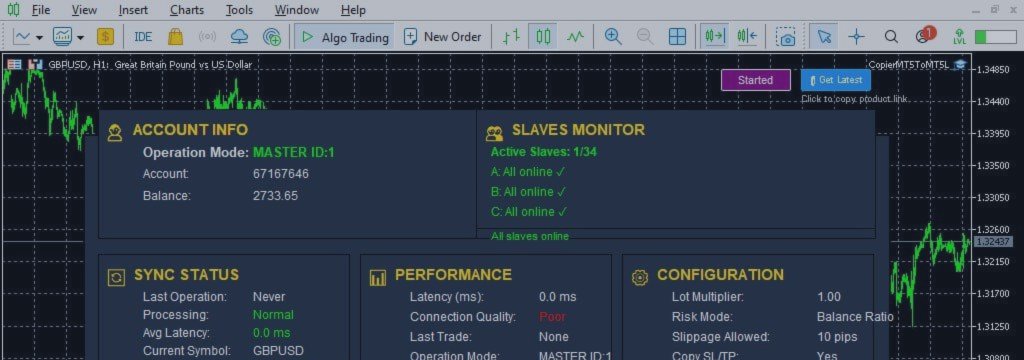
Dashboard Overview
The dashboard serves as the central monitoring and management interface.
It provides visibility into:
• Active Slave accounts
• Connection status
• Synchronization activity
• Performance metrics
• Trade replication events
The dashboard helps reduce the need for manual monitoring.
Account Information
The account section displays:
• Account number
• Balance
• Equity
• Account mode
• Master and Slave identifiers
This information helps confirm proper account configuration.
Slaves Monitor
The Slaves Monitor section provides real-time visibility of connected accounts.
Displayed information may include:
• Active Slave count
• Online status
• Offline status
• Reconnection events
• Offline duration
This allows traders to quickly identify connectivity problems.
Sync Status
Synchronization tracking provides insight into copier activity.
Common metrics include:
• Last synchronization time
• Last copied trade
• Processing status
• Synchronization delay
These metrics help verify that the system is functioning correctly.
Performance
Performance monitoring evaluates system efficiency.
Key metrics include:
• Latency
• Connection quality
• Trade processing speed
• Execution responsiveness
Performance tracking helps identify bottlenecks.
Configuration
The configuration system controls copier behavior.
Typical settings include:
• Master ID
• Slave ID
• Copy mode
• Synchronization settings
• Verification options
Proper configuration improves reliability.
Trade Settings
Trade settings determine how orders are copied.
Examples include:
• Copy Stop Loss
• Copy Take Profit
• Pending order replication
• Slippage limits
• Spread filtering
These settings provide flexibility for different trading environments.
Trade Filtering
Trade filtering allows selective copying.
Options may include:
• Buy-only copying
• Sell-only copying
• Symbol filtering
• Magic Number filtering
This allows greater control over replication behavior.
Symbol Mapping
Different brokers often use different symbol names.
Examples:
• EURUSD ↔ EURUSDm
• XAUUSD ↔ GOLD
• US30 ↔ US30.cash
Symbol Mapping ensures trades are copied to the correct instruments.
Lot Management
Lot management controls trade volume on Slave accounts.
Methods may include:
• Fixed lot sizing
• Balance ratio calculation
• Multiplier scaling
• Risk-based sizing
This helps maintain consistent risk exposure.
Day Filtering
Day filtering controls when copying is allowed.
Examples:
• Monday trading
• Tuesday trading
• Wednesday trading
• Thursday trading
• Friday trading
This provides scheduling flexibility.
Notifications
Notification systems help maintain operational awareness.
Alerts may include:
• Successful trade copying
• Synchronization warnings
• Offline Slave alerts
• Reconnection notifications
These alerts support proactive management.
Key Features
• Low-latency trade copying
• Trade verification system
• Real-time synchronization
• Slave Monitoring
• Symbol Mapping
• Advanced lot management
• Dashboard visibility
• Multi-account support
• Performance monitoring
• Trade filtering
Setup Guide
Master Terminal
• Attach EA
• Select Master mode
• Configure Master ID
• Enable AutoTrading
• Verify connectivity
Slave Terminal
• Attach EA
• Select Slave mode
• Configure CopyFromMasterID
• Assign unique Slave number
• Enable AutoTrading
Validation
After setup:
• Confirm account visibility
• Verify synchronization
• Monitor first copied trades
• Check verification status
This helps ensure proper operation.
FAQ
Why is copy speed important?
Because lower latency helps reduce execution differences between Master and Slave accounts.
Why is trade verification necessary?
Because it confirms that trades have been copied and executed correctly.
Can all price differences be eliminated?
No. Market conditions and broker execution may still create small variations.
What causes missed trades?
Common causes include connectivity issues, terminal failures, and synchronization interruptions.
Does Slave Monitoring improve reliability?
Yes. It helps identify connectivity issues before they significantly affect account consistency.
Copy speed and trade verification are two of the most important components of a professional trade replication system.
Fast execution helps minimize timing differences between Master and Slave accounts, while verification confirms that trades are copied accurately and consistently.
Together, these mechanisms support synchronization, improve operational visibility, and reduce the likelihood of account divergence.
However, modern trade replication systems extend beyond simple order copying. Features such as Slave Monitoring, Symbol Mapping, advanced lot management, trade filtering, and Reverse Trade Copying provide additional flexibility for different trading environments.
Reverse Trade Copying allows selected Slave accounts to execute trades in the opposite direction of the Master account. This can be useful for strategy evaluation, account-specific exposure management, hedging structures, and testing how trading logic behaves under inverted market conditions.
Combined with low-latency execution and reliable trade verification, reverse trade configurations can be managed within the same multi-account infrastructure while maintaining synchronization and operational control.
When integrated with Slave Monitoring, Symbol Mapping, performance tracking, synchronization management, and centralized dashboard visibility, these features form a comprehensive trade replication framework designed to support reliable and transparent multi-account trading operations.
PRODUCT ACCESS LINK ON MQL5 MARKET: