
0
140
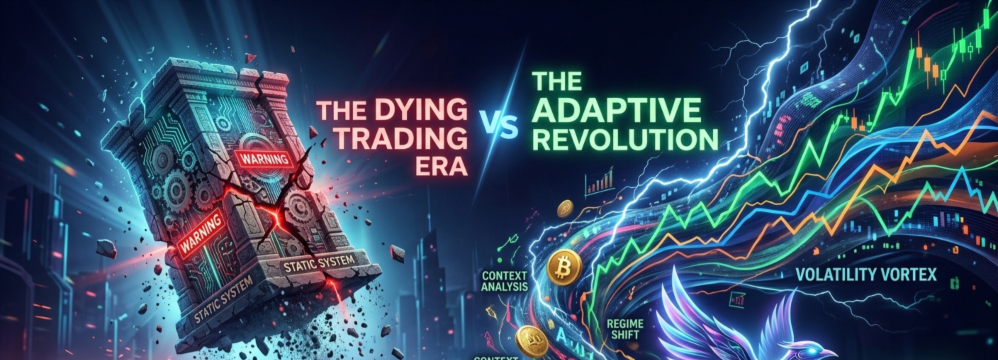
Why Static Trading Systems Are Dying in Modern Markets!
Static trading systems are losing relevance because modern markets no longer behave in stable, predictable patterns for long periods of time. Volatility changes faster, liquidity shifts more aggressively, news events reshape market structure within seconds, and different assets such as Bitcoin and Gold require different trading logic.
The traditional Expert Advisor model — built around fixed rules, fixed indicators, fixed parameters, and fixed assumptions — is increasingly fragile in this environment. The future of automated trading belongs to systems that can evaluate context, adapt to changing market regimes, manage risk dynamically, filter low-quality conditions, and protect capital before damage becomes visible.
This article explains why static trading systems are dying in modern markets, why adaptability is becoming a core requirement for Expert Advisors, and how concepts found in systems such as ICONIC BTC AI and ICONIC NEUROCORE AI reflect the next evolution of MQL5 trading automation.
Why Static Trading Systems Are Losing Their Edge
For years, many Expert Advisors were built around a simple idea:
Find a pattern.
Turn it into rules.
Automate the execution.
Optimize the parameters.
Run the system.
That approach worked better in environments where market behavior was more stable, spreads were more predictable, and price action followed cleaner cycles. But modern markets are different. They are faster, more fragmented, more reactive, and more sensitive to external events.
A static system assumes that the future will continue to behave like the past.
That is the weakness.
The market does not owe any system consistency. A setup that worked in a trending phase can fail in a range. A breakout model can become fragile during volatility compression. A scalping logic can break when spreads widen. A strategy that looked excellent in historical testing can become ineffective when liquidity conditions change.
This is why many static EAs do not fail because the entry was badly coded.
They fail because the environment changed and the system did not.
In modern trading, the real question is no longer:
Does the system have rules?
The real question is:
Can the system understand when its rules no longer fit the market?
That is where static systems begin to die.
The Problem With Fixed Rules in a Changing Market
Every trading system is built on assumptions.
A trend-following system assumes continuation.
A mean-reversion system assumes price will return to balance.
A breakout system assumes expansion after a level is breached.
A scalping system assumes execution quality remains stable enough for small edges to matter.
None of these assumptions are always true.
The problem with static systems is that they often apply the same logic regardless of the current environment. They treat a signal as valid simply because the technical condition appears. But a technical condition without context is not intelligence. It is just a trigger.
For example:
A breakout during strong momentum can be high quality
The same breakout during low-volume compression can be noise
A moving average signal in a trend can confirm direction
The same signal inside a range can become a trap
A pending order near structure can make sense now
The same pending order may become outdated after volatility changes
Static systems struggle because they rarely ask whether the market still supports the original idea.
They execute.
They do not evaluate.
And in today’s markets, evaluation is becoming more important than execution itself.
Market Regime Shifts Are Killing Old Automation Models
One of the biggest reasons static trading systems are losing relevance is the speed of market regime change.
A market regime describes the current character of the market. It can include trend, range, volatility, compression, expansion, liquidity quality, session behavior, and event sensitivity.
Different regimes reward different behavior.
A momentum system can perform well in a trending market and then suffer heavily in a sideways phase. A mean-reversion system can perform well during range conditions and then fail during a strong directional move. A system optimized for calm volatility can become unstable during news-driven expansion.
This is why regime awareness is becoming essential.
A modern Expert Advisor should not behave the same way in every condition. It should be able to recognize when the market is no longer aligned with its core logic.
That does not mean predicting the future perfectly. No system can do that.
It means understanding the present better.
A more adaptive system evaluates:
Is the market trending or ranging?
Is volatility expanding or compressing?
Is price structure clean or unstable?
Are spreads normal or distorted?
Is liquidity supportive or dangerous?
Is a news event likely to change execution quality?
Is this environment worth risking capital?
Static systems ignore these questions.
Adaptive systems are built around them.
Why Backtest Optimization Is Not Enough Anymore
A beautiful backtest can be dangerous when it creates false confidence.
Many static systems are optimized until they fit historical data extremely well. Parameters are adjusted. Filters are added. Rules are refined. The equity curve becomes smoother and more attractive.
But this does not necessarily mean the system is robust.
It may simply mean the system was shaped too closely around the past.
A backtest can show that a strategy worked on historical data. It cannot prove that the same strategy will adapt to future conditions. This distinction is critical.
A static EA can look impressive in a report because the historical environment matched its assumptions. But when the live market changes, the system may continue executing the same logic even though the edge has weakened.
That is where many traders confuse optimization with intelligence.
Optimization asks:
What settings worked best in the past?
Adaptability asks:
What should the system do when the market changes?
These are not the same question.
The next generation of Expert Advisors must go beyond historical fit. They must focus on decision quality, context recognition, and risk control in live conditions.
Why More Automation Is Not the Solution
Many traders believe that the future of trading automation is simply more automation.
More signals.
More entries.
More symbols.
More speed.
More execution.
But more automation does not automatically create better trading.
A system can be fully automated and still be blind. It can execute signals instantly and still make poor decisions. It can monitor multiple markets and still fail to coordinate risk properly.
The real evolution is not more automation.
It is better decision quality.
A next-generation EA should not simply ask:
Can I trade?
It should ask:
Should I trade here?
That single shift changes everything.
Better decision quality means the system can reject low-quality conditions, reduce risk when the environment deteriorates, pause during unstable periods, and avoid forcing trades simply because a signal appears.
This is the direction in which serious Expert Advisor development is moving.
Risk Architecture Is Becoming More Important Than Entry Logic
Many static systems are built around entries.
The entry becomes the center of attention. Traders look for the perfect indicator combination, the perfect signal, the perfect trigger. But in live markets, entries are only one part of the system.
Risk architecture is often more important.
A good entry cannot save a weak risk model.
A profitable signal cannot protect an account from uncontrolled exposure.
A strong backtest cannot replace capital protection.
Modern systems need multiple layers of defense:
controlled position sizing
exposure limits
volatility-based filtering
cooldown behavior after difficult periods
loss-streak awareness
spread and execution quality filters
news-sensitive protection
daily reset logic
capital preservation rules
This is where static systems often fall behind. They may know when to enter, but they do not always know when to slow down, stop, reduce, or wait.
And that is the difference between automation and architecture.
A static EA tries to trade the signal.
A mature EA tries to protect the account while trading the signal.
Why Capital Protection Is the New Competitive Advantage
The next generation of Expert Advisors will not be judged only by how much they can make in ideal conditions.
They will be judged by how well they protect capital in difficult conditions.
This is a major shift in thinking.
Old automation often focused on activity and profit potential. Newer system design focuses more heavily on survival, resilience, and controlled exposure. That does not mean performance becomes unimportant. It means performance must be built on a more stable foundation.
Capital protection matters because every system will eventually face hostile periods.
There will be market phases where signals fail.
There will be news events that distort execution.
There will be volatility spikes that invalidate assumptions.
There will be regimes where the system’s normal logic has less edge.
A static system often continues as usual.
A more adaptive system recognizes that survival comes first.
This is why features such as cooldowns, loss-streak protection, risk reduction, and quality filters are becoming more relevant. They help the system respond to stress rather than simply absorb it blindly.
The real edge is not always taking the next trade.
Sometimes the edge is knowing when not to.
News Events Expose Static Systems Quickly
News is one of the clearest examples of why static logic can be dangerous.
High-impact events do not only move price. They can change the entire trading environment. Spreads can widen. Slippage can increase. Pending orders can be triggered in poor conditions. Technical levels can lose meaning within seconds.
A static system may continue operating as if the environment is normal.
That is a serious weakness.
A modern EA needs some form of news awareness or event-sensitive behavior. It should understand that not all market time is equal. Some periods offer clean execution. Others create distorted conditions where the best decision may be to reduce activity or pause entirely.
This is not fear.
It is professional restraint.
A system that trades through every condition without distinction is not necessarily brave or advanced. It may simply lack context.
And lack of context is one of the main reasons static trading systems are becoming outdated.
Bitcoin and Gold Prove Why One-Size-Fits-All Logic Is Weak
Modern markets also make it obvious that different assets require different behavior.
Bitcoin and Gold are a strong example.
Bitcoin often reacts with explosive volatility, fast repricing, emotional momentum, and irregular liquidity behavior. Gold has its own character, influenced by macro expectations, risk sentiment, institutional flows, and structural price zones.
Both markets can offer opportunity.
But they should not be treated as if they are the same.
A static system often applies one logic across multiple instruments with minor parameter changes. That may look efficient, but it can create hidden weakness. The system may fail to respect the different rhythm, risk profile, and execution behavior of each market.
This is why specialized and adaptive frameworks are becoming more important.
Based on the available materials, ICONIC BTC AI is positioned around a BTC-focused Neurocore AI approach with multi-action trading logic, risk management, confidence evaluation, news handling, and trade management components.
ICONIC NEUROCORE AI extends the concept into a dual-symbol trading framework for BTC and Gold, combining AI-based decision-making, market context analysis, risk management, portfolio coordination, and cross-symbol trade handling.
The important point is not that every system must trade multiple markets.
The important point is that modern markets demand context.
A BTC system should understand BTC behavior.
A Gold system should respect Gold behavior.
A multi-symbol system should coordinate risk across assets instead of simply multiplying exposure.
That is the next level.
Adaptive Systems Do Not Need to Predict Everything
There is a misconception that adaptive trading systems must predict the future.
They do not.
The purpose of adaptation is not perfect prediction. The purpose is better response.
A static system says:
These are my rules, and I will apply them regardless of the environment.
An adaptive system says:
These are my rules, but I will evaluate whether the environment still supports them.
That difference is critical.
Adaptive systems can be designed to respond to changes in volatility, trend quality, spread behavior, market structure, news context, and system performance. They can filter poor conditions, reduce risk, pause after stress, and revalidate setups before execution.
They are not magic.
They are simply more realistic.
They are built on the understanding that markets change — and that a trading system must be able to change its behavior when conditions justify it.
This is why adaptive decision-making is becoming one of the most important themes in the future of Expert Advisors.
What Traders Should Look For in Modern Expert Advisors
If static trading systems are losing relevance, traders need to evaluate EAs differently.
Instead of focusing only on backtests, signal frequency, or short-term performance screenshots, they should ask deeper questions:
Does the system understand market regimes?
Does it include risk management beyond basic lot sizing?
Can it reduce activity during poor conditions?
Does it account for news-sensitive periods?
Does it use quality filters before execution?
Can it handle volatility changes?
Does it protect capital during loss streaks?
Does it adapt to different asset behavior?
Does it coordinate risk when multiple symbols are involved?
Is the system designed for decision quality, not just automation?
These questions matter because the market is no longer forgiving to systems that only know how to execute.
The strongest systems of the future will be those that know how to evaluate.
That is where traders should focus their attention.
How ICONIC BTC AI and ICONIC NEUROCORE AI Fit This Evolution
The shift away from static systems is not theoretical. It is already visible in the way more advanced Expert Advisors are being designed and positioned.
ICONIC BTC AI reflects the idea that Bitcoin should not be treated as a generic trading symbol. Based on the provided product and system descriptions, it is built around BTC-focused logic, Neurocore AI concepts, risk management, news handling, confidence evaluation, and adaptive trade management elements.
That aligns with the broader future of EA development: systems designed around market behavior, not just static indicators.
ICONIC NEUROCORE AI takes the concept further by combining BTC and Gold inside a dual-symbol strategy framework. Its documented focus includes AI-based decision-making, market context methods, portfolio coordination, cross-asset risk and stress management, trade management, pending-order logic, and news refresh mechanisms.
That matters because multi-asset automation without coordination is not enough. A true next-generation framework must evaluate how markets interact, how risk accumulates, and when exposure should be synchronized or reduced.
In that sense, both systems represent a broader movement:
From static execution
to adaptive evaluation.
From signal automation
to decision quality.
From one-dimensional trading logic
to market-aware system architecture.
That is the direction modern Expert Advisors are moving.
The Future of Expert Advisors Is Adaptive, Selective, and Risk-Aware
Static trading systems are dying because the market has outgrown them.
Modern markets reward systems that can interpret conditions, filter noise, manage risk, and protect capital. They punish systems that blindly repeat old logic without understanding whether the environment has changed.
This does not mean every static system will disappear overnight.
But it does mean their disadvantage is growing.
The future belongs to systems that are:
adaptive instead of rigid
selective instead of overactive
risk-aware instead of signal-addicted
context-driven instead of parameter-dependent
protective instead of purely aggressive
asset-specific instead of generic
coordinated instead of isolated
That is the next evolution of Expert Advisors.
Not more buttons.
Not more trades.
Not more historical optimization.
Better context.
Better filtering.
Better protection.
Better decisions.
Final Thoughts
Static systems were an important stage in the evolution of automated trading. They helped traders remove emotion, execute consistently, and systematize ideas.
But modern markets demand more.
They demand systems that can recognize when the environment has changed. They demand systems that can protect capital when conditions deteriorate. They demand systems that understand the difference between a valid signal and a high-quality opportunity.
That is why static trading systems are losing relevance.
The next generation of EAs will not be defined by how rigidly they follow rules.
It will be defined by how intelligently they adapt to reality.
And in that future, the strongest Expert Advisors will not simply trade automatically.
They will evaluate, filter, protect, and decide.
That is why static trading systems are dying in modern markets.



![[iVISTscalp5]: EURUSD. Forecast First. Market Reaction Afterwards//October 12-16, 2026](https://c.mql5.com/6/1038/splash-preview-777972.png "[iVISTscalp5]: EURUSD. Forecast First. Market Reaction Afterwards//October 12-16, 2026")