
Investing in Strategies
This is a generalized user guide explaining the capital allocation and risk management framework used by my Expert Advisors.
First, I will explain the problem with traditional EA risk management approaches, then the solution implemented in my systems, and finally how this mechanism works in practice inside the EA.
Problem statement
Traditional Expert Advisors usually calculate lot sizes and risk management based on the entire account balance. Some use a fixed lot size, while others calculate volume using formulas such as lotsize per X amount of balance. The problem with this approach is that it does not provide true diversification inside a trading account, as there is no real isolation between the strategies running on the portfolio.
When multiple EAs operate on the same account using the full account balance, conflicts may occur. For example, one strategy may significantly increase the account balance, causing another strategy to automatically trade larger volumes, even though it did not generate those profits itself. Drawdown calculations may also overlap, making portfolio-level risk management difficult to implement properly. In practice, every strategy behaves as if it were the only one running on the account.
Solution: Isolation
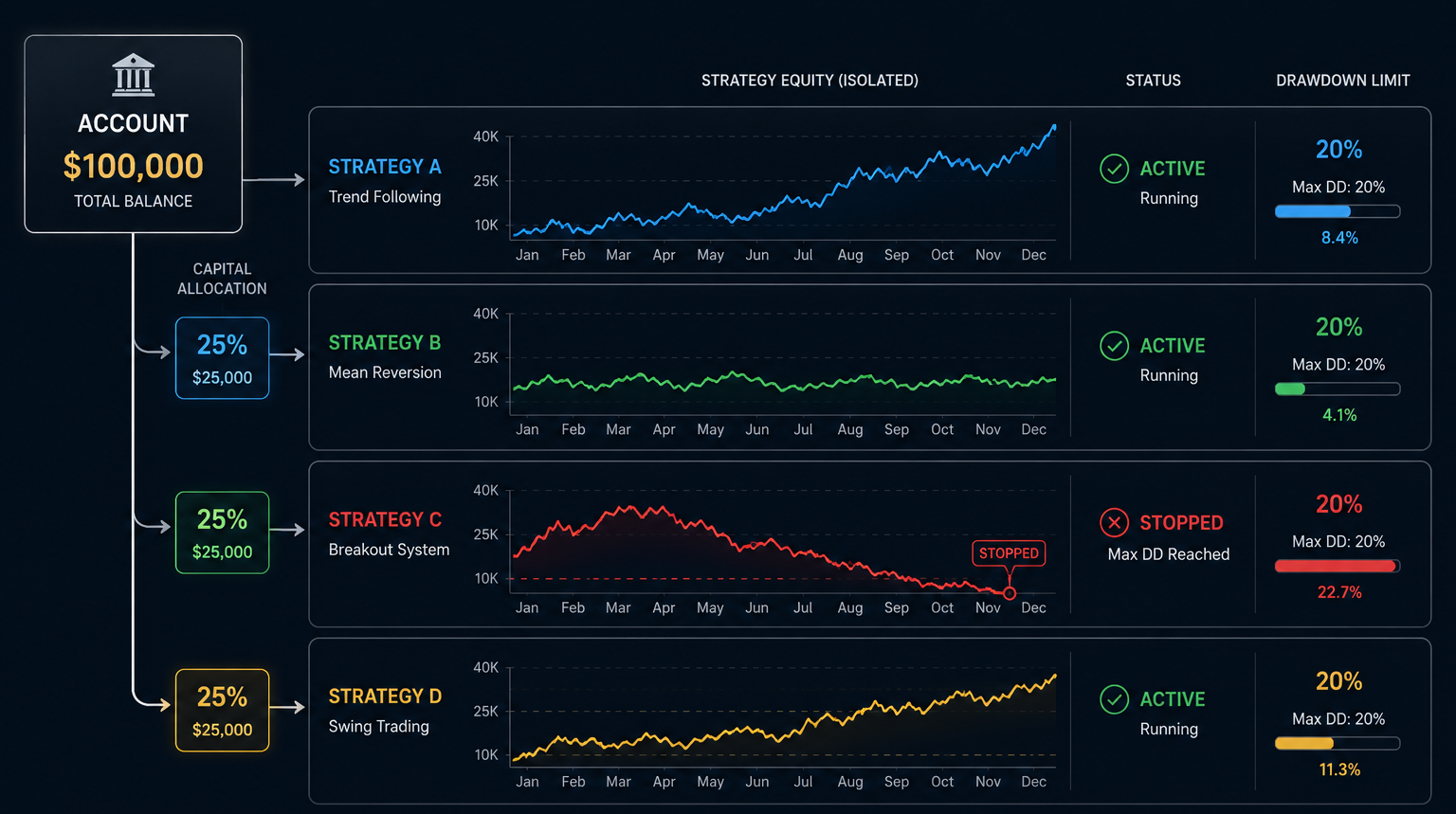
One solution to this problem is equity isolation. This means assigning a portion of the account balance to individual trading strategies, allowing them to operate independently from the remaining capital in the portfolio. Each strategy behaves as if it only has access to the balance assigned to it.
If a strategy performs well, it grows its own internal equity independently. At the same time, each strategy manages its own drawdown and daily drawdown limits based on its isolated equity. This naturally allocates more capital to successful strategies while limiting exposure to underperforming ones.
This concept is similar to portfolio investing. For example, if two investments initially receive equal capital allocation, the stronger performer will gradually represent a larger portion of the portfolio over time, while weaker performers become less significant. This is the principle of letting winners grow while limiting losses on weaker investments.
The same mechanism can be applied to trading strategies. Profitable strategies are allowed to compound their allocated capital, while losing strategies are restricted by their individual drawdown limits.
Another important concept is simplifying position sizing through predefined risk levels instead of manual lot size calculations. Rather than calculating volumes manually, the user only defines the percentage of a strategy’s internal equity that may be risked on a trade. This approach is generally more intuitive and allows the EA to automatically adapt position sizes to the strategy’s allocated capital.
How it works inside my Expert Advisors
To better understand how this framework operates in practice, let us go through an example using one of my Expert Advisors: the Gold Breakout Engine.
The EA uses two main categories of inputs:
- Portfolio Level Control
- Strategy Level Control
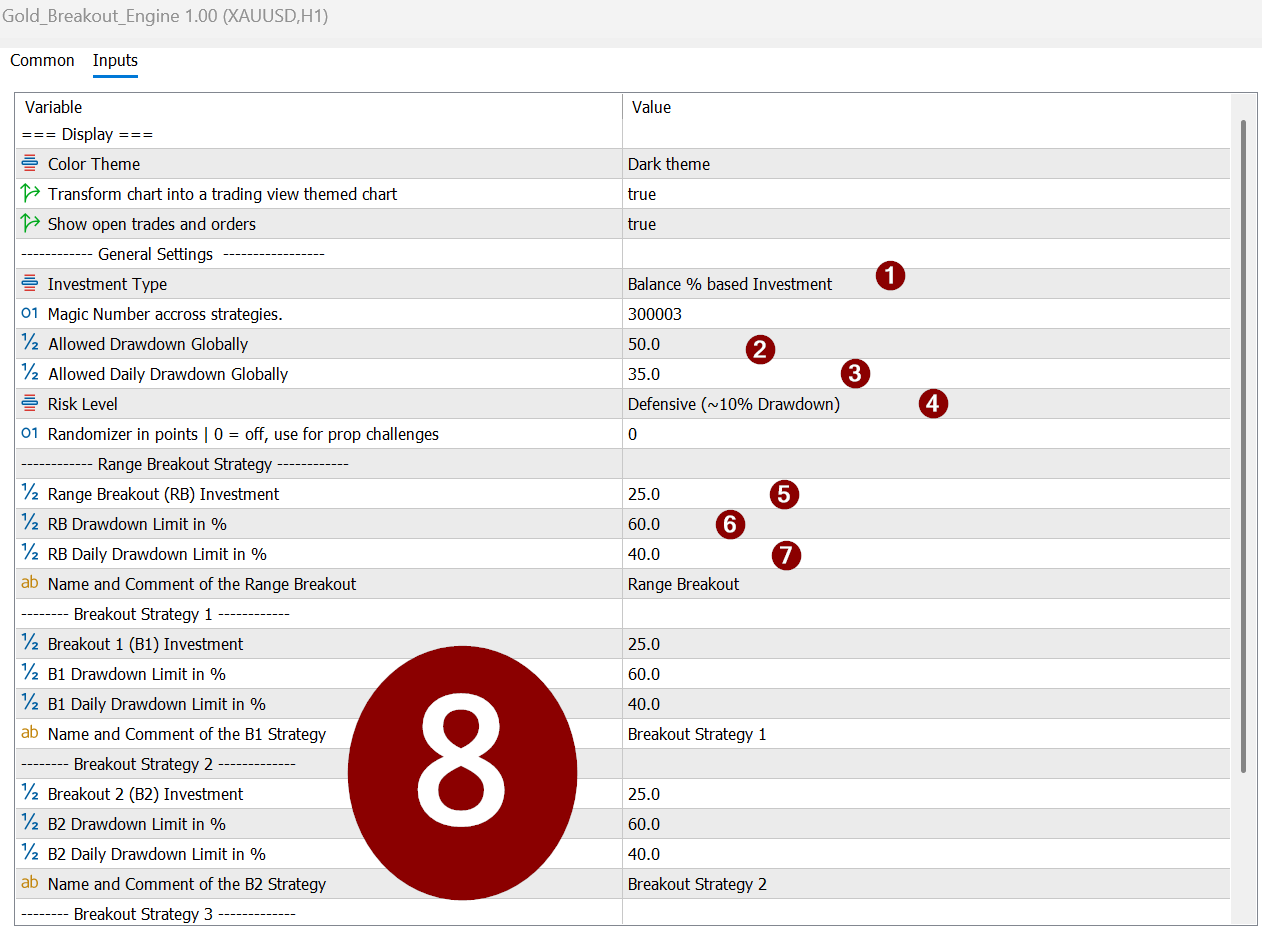
1 Investment Type: The first important parameter is the allocation method. Here you can decide how capital is assigned to the individual strategies. Two allocation methods are available:
- Balance Percentage Based Investment:The initial investment into a strategy is defined as a percentage of the account balance. For example, allocating 25% of a 10,000$ account results in a 2,500$ strategy allocation
- Initial Monetary Investment:The investment is defined using a fixed monetary amount, such as 2,000$.
5 Investment Amount:This parameter specifies the capital allocated to an individual strategy. Depending on the selected allocation method, this value represents either:
- a percentage of the account balance, or
- a fixed monetary investment.
7 Strategy Daily Drawdown Limit: You can also define a maximum allowed daily drawdown for each individual strategy. This value is also calculated using the strategy’s isolated internal equity.
8: The same configuration process can then be repeated for the remaining strategies inside the portfolio.
Important Notes
The equity isolation mechanism is implemented internally by the Expert Advisor. Funds are not separated into broker-side subaccounts, but are managed using the EA’s internal portfolio accounting system.
Although isolated risk management can significantly improve portfolio control and diversification, it does not eliminate trading risk. During periods of extreme volatility, slippage, low liquidity, or market gaps, losses may exceed the configured limits.
The purpose of this framework is not to maximize short-term profits, but to create a more structured and controlled approach to managing multiple trading strategies inside the same portfolio.
No strategy performs well under all market conditions. The goal of portfolio-level diversification is to combine strategies with different behaviors, allowing stronger strategies to compensate for weaker ones over time.
As with all forms of leveraged trading, proper risk management remains essential.